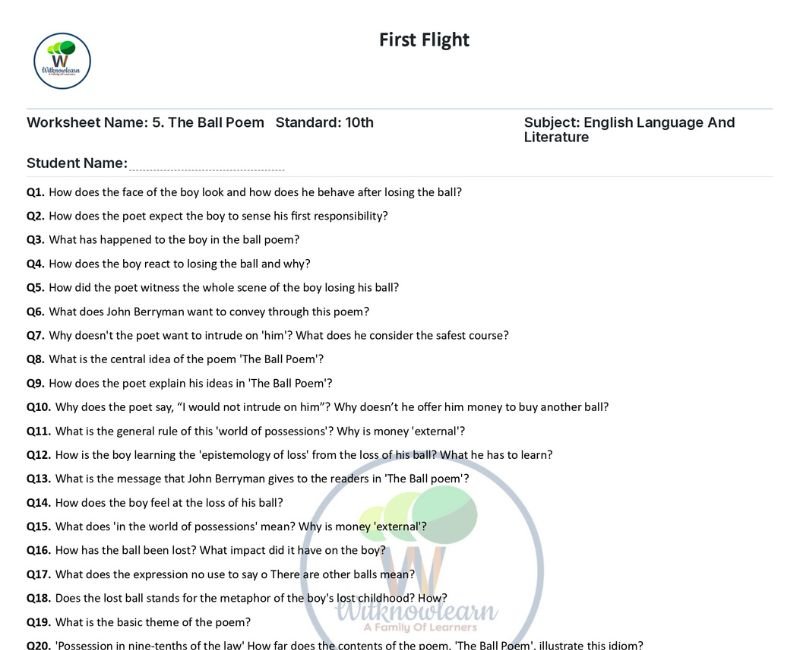
The Ball Poem Class 10 Worksheet with Answers
Why does losing an inexpensive ball affect the boy so deeply? Why does the speaker hesitate to replace it? Use The Ball Poem Class 10 worksheet with answers to practise explaining emotional attachment, the limits of money and learning through loss.
Attempt the questions independently before consulting the answers. Support your interpretation with relevant details and explain how a small event develops into a larger reflection on growing up.
Practise Literal Understanding and Deeper Meaning
“The Ball Poem” by John Berryman presents a boy’s response to losing a treasured possession. Its movement from a specific incident towards a general understanding of loss gives students useful practice in inference and symbolic interpretation.
The mixed English worksheet format supports short and long-answer work, extract-based questions, objective responses and vocabulary activities. Use factual tasks to check what happens and interpretive questions to explain why it matters.
Identify the instruction before writing. Describing the boy’s reaction is different from explaining what the reaction reveals about his attachment.
Explain the Boy’s Grief through Evidence
Questions about the boy’s feelings require attention to his physical response, stillness and gaze. Explain how the description communicates shock and sorrow rather than simply naming an emotion.
Avoid judging the loss only through the ball’s price. The poem invites readers to recognise the personal associations that make a possession important to its owner.
When asked about the boy’s memories, distinguish an interpretation from an invented history. The language suggests a connection with his earlier life, but it does not list particular games or events.
Practice Prompt: Explain Emotional Value
Question: Why might another ball fail to remove the boy’s sense of loss?
Answer approach: Distinguish replacing an object from restoring its personal associations. Explain how the poem gives the lost ball a significance beyond its material cost.
Interpret the Speaker’s Decision Not to Intervene
The speaker’s response offers opportunities to discuss sympathy, understanding and restraint. Explain why an immediate replacement would not address the experience the boy is facing.
A balanced answer should not confuse non-intervention with a lack of concern. Examine how the speaker recognises the depth of the boy’s loss and the learning taking place.
If asked to evaluate the decision, support your viewpoint with the poem. Keep the answer focused on this particular situation rather than turning it into a universal rule about responding to distress.
Connect Money, Possessions and Personal Meaning
Questions about money require a distinction between purchasing power and emotional restoration. Explain what money can replace and what remains beyond that replacement.
The poem also places the boy within a world where possessions can be lost. Discuss how this experience changes his understanding of ownership and uncertainty.
Do not suggest that all possessions are unimportant. The boy’s attachment is precisely what makes the loss meaningful and gives the experience its emotional force.
Keep the Contrast Precise
“Money cannot replace anything” is too broad. Explain that money can buy another object but cannot restore this particular possession and the experiences associated with it.
Read Extracts for Context and Inference
Locate the extract within the poem’s development. Does it describe the ball’s movement, the boy’s reaction, the speaker’s reflection or the larger lesson about loss?
For extract-based MCQs, compare all options with the wording. For True/False tasks, check the complete statement. For fill-in-the-blank questions, ensure the response fits both meaning and grammar.
Vocabulary questions require contextual reading. Words related to grief, responsibility or understanding contribute to the poem’s argument and should not be explained in isolation when the task asks for their significance.
A Routine for Poetry Extract Questions
- Read the lines as part of a complete sentence.
- Identify whose action or thought is being described.
- Read the question’s exact demand.
- Select a relevant detail or expression.
- Explain how it supports your answer.
When instructed to find a word from the extract, provide the word appearing there rather than a different synonym.
Explain Responsibility and Learning through Loss
Questions about responsibility should connect it with the boy’s growing awareness that valued things cannot always be recovered. Avoid reducing the idea to a warning about careless play.
The phrase “epistemology of loss” concerns understanding the nature of losing something. Explain how experience gives the boy knowledge that an easy reassurance or replacement would not provide.
When discussing recovery, focus on learning to continue despite loss. The poem does not require the boy to stop caring about the ball or erase his feelings.
| Question Area | Skill Developed | Answer-Writing Focus |
|---|---|---|
| The boy’s reaction | Inference from description | Connect behaviour with shock and grief. |
| The ball’s significance | Symbolic interpretation | Explain personal value beyond material cost. |
| The speaker’s restraint | Understanding motivation | Explain why replacement would not resolve the deeper loss. |
| Money and possessions | Conceptual distinction | Separate buying another object from restoring attachment. |
| Responsibility and recovery | Interpretation of theme | Explain learning to face loss and continue. |
| Language and poetic devices | Close reading | Identify the feature and explain its effect. |
Practise Imagery, Repetition and Form
Imagery questions ask you to explain how the language helps readers picture the event or recognise its emotional significance. Select a relevant description and connect it with the poem’s mood.
For repetition, explain what the repeated wording emphasises. For enjambment, identify how a sentence continues across line breaks and consider its contribution to movement or reflection.
The poem does not follow a regular end-rhyme scheme. Do not force the line endings into a repeated pattern. For any device question, check the actual language before choosing a label.
Write Clear Short and Extended Responses
For a short answer, state the main point, include relevant evidence and explain the connection. Follow the word limit given in the task.
For an extended response about growing up, organise the answer around attachment, recognition of irreversible loss and the need to continue. Support each point through the poem’s development.
When a question invites a personal connection, keep the example brief and relevant. Explain the connection without allowing your experience to replace analysis of the poem.
Practice Prompt: Connect the Incident with the Theme
Question: How does the loss of the ball become a lesson larger than the incident itself?
Answer approach: Begin with the boy’s attachment, explain the limits of replacement and connect the experience with learning to face future losses.
Use the Answers for Active Revision
Complete the worksheet before consulting the answers. Compare meaning, evidence and reasoning rather than expecting identical sentences.
- Check accuracy: have you described the incident correctly?
- Check inference: have you invented memories not supplied by the poem?
- Check theme: have you explained loss rather than only the ball’s price?
- Check expression: are your sentences clear and complete?
Rewrite responses where the central idea is correct but its explanation is incomplete. Teachers can use the worksheet for classroom comprehension, homework or discussion followed by individual writing.
Related Interpretation Practice
For another account of changing understanding through loss, use The Sermon at Benares Class 10 worksheet with answers.
For a different emotional response to a brief event, try the Dust of Snow Class 10 worksheet with answers.
Frequently Asked Questions About The Ball Poem
Who wrote The Ball Poem?
John Berryman wrote “The Ball Poem”. It explores a boy’s experience of losing a treasured possession.
Why is the boy upset about losing an inexpensive ball?
Its value is personal rather than merely financial. The language suggests that the ball is connected with his earlier experiences and attachment.
Why does the speaker not offer another ball?
A replacement would not restore the lost object’s personal meaning. The speaker recognises that the boy is learning something deeper about loss.
What does the ball symbolise?
It can represent a treasured possession and the childhood experiences associated with it. Its loss introduces the boy to the limits of recovering what matters to him.
What does “epistemology of loss” mean?
It means understanding the nature of loss—what it means to lose something and how a person learns to live with that experience.
How does the poem present responsibility?
The boy begins to recognise that losses occur in a world of possessions and that he must learn to face them. The idea goes beyond simply taking better care of a toy.
What does learning to “stand up” suggest?
It suggests recovering the ability to continue after loss. It does not mean that the attachment was unimportant or that the sorrow must disappear immediately.
Does The Ball Poem have a regular rhyme scheme?
No. It uses free verse without a regular end-rhyme scheme. Examine its sentence flow, repetition and imagery instead of imposing a fixed pattern.
 Download