50 Unseen Passages for Class 10 with Answers CBSE
Build a regular reading routine with WitKnowLearn’s 50 unseen passages for Class 10 with answers. Use this PDF resource to practise finding information, understanding unfamiliar texts and writing responses supported by evidence.
Attempt each passage before consulting the answers. Review how you reached your response, identify the details you missed and apply that learning to the next comprehension task.
Develop Reading Skills through Unseen Passages
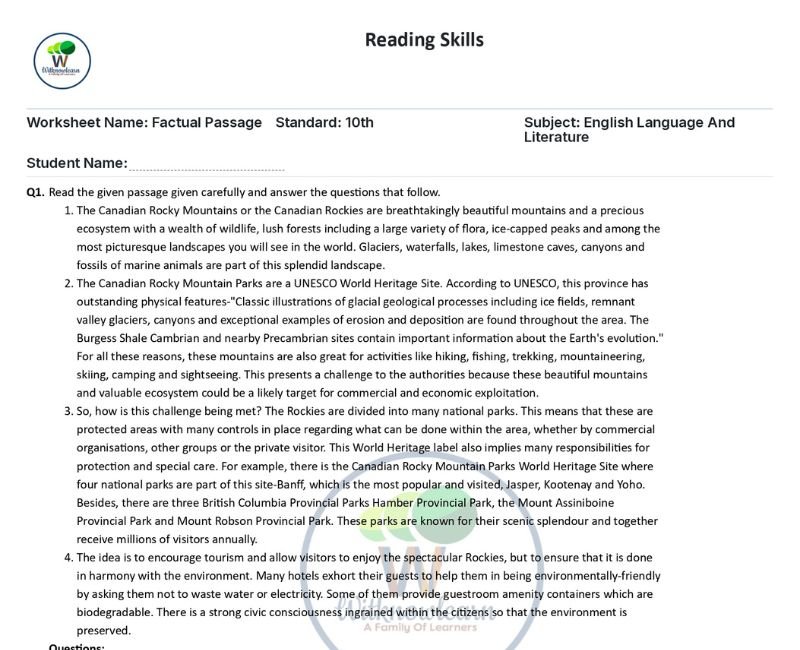
An unseen passage introduces a text that you have not prepared in advance. Your task is to understand its meaning and respond to the questions using the information it provides. Success depends on careful reading, relevant evidence and clear expression.
This Class 10 English reading comprehension collection provides material for repeated practice. Instead of completing several passages hurriedly, work through one carefully and review your answers. Notice whether a mistake came from overlooking a detail, misunderstanding a word or drawing an unsupported conclusion.
Passage topics can introduce information about different areas of life, but your response should follow the text. Even when you know something about the topic, check what the writer actually says before answering.
Connect Your Practice with CBSE Reading Skills
The CBSE Class 10 English Language and Literature curriculum for 2026–27 assigns 20 marks to reading comprehension. Its reading section includes a discursive passage and a case-based factual passage with visual input, such as statistical data or a chart.
Use this collection to strengthen your comprehension skills, and include separate practice with visual data when preparing for case-based tasks. Read the title, labels, units and written explanation together. A figure becomes meaningful only when you understand what it measures.
Questions can require comprehension, interpretation, analysis, inference, evaluation and vocabulary. Prepare by explaining how you reached an answer, rather than recognising a familiar question format alone.
How to Solve an Unseen Passage for Class 10
1. Establish the Main Idea
Read the passage once to understand its subject and overall direction. Ask yourself what the writer wants the reader to know. Write a short phrase that captures the central idea before examining individual details.
For a title question, choose an option that covers the passage as a whole. A title based on one small example may overlook the writer’s broader point.
2. Match Each Question to Evidence
Read the question carefully and identify its key instruction. A question asking “why” needs a reason; a question asking “how” needs an explanation of a process or relationship. Return to the relevant paragraph and locate the supporting information.
If two reasons are requested, provide two distinct reasons. Check that your response completes every part of the task.
3. Make Supported Inferences
An inference goes beyond repeating a sentence, but it still depends on textual evidence. Connect the clues provided and decide what they reasonably suggest.
Before finalising your answer, ask: Which detail supports this conclusion? If you cannot identify one, reread the passage and reconsider your interpretation.
4. Understand Vocabulary in Context
For synonyms, antonyms and word meanings, examine the sentence in which the word appears. Look for examples, contrasts or explanations nearby. These clues can help you select the meaning intended by the writer.
When a question asks you to find a word from a specified paragraph, search within that paragraph and supply the exact word. Check the instruction before replacing it with your own expression.
5. Compare MCQ Options Carefully
Read all options before selecting an answer. Compare each one with the passage and check whether it changes the writer’s meaning, adds an unsupported detail or answers only part of the question.
Pay attention to words such as “always,” “only” and “never.” Decide whether the passage supports that level of certainty.
Original Mini Practice Example
Passage: A school library extended its opening hours for a month. More students borrowed books, but the librarian also noticed that several visitors came mainly to use the quiet study area. The school decided to collect student feedback before making the arrangement permanent.
Question: Why did the school seek feedback before making the extended hours permanent?
Sample answer: The school wanted to understand how students used the additional time and whether the arrangement met their needs, since visitors used both the borrowing service and the quiet study area.
Practice point: The answer connects details from the passage to explain the decision. It does not add an unrelated reason.
Question Types to Practise
| Question Type | Your Task | Check Before Submitting |
|---|---|---|
| Direct information | Locate a stated fact or detail | Does your answer match the passage accurately? |
| Main idea or title | Identify the overall focus | Does your choice cover the whole text? |
| Inference | Draw a conclusion from clues | Can you point to supporting evidence? |
| Vocabulary | Interpret a word in context | Does the meaning fit the sentence? |
| Cause and effect | Explain a relationship | Have you distinguished the reason from the result? |
| Visual-data interpretation | Read figures alongside the text | Have you checked labels, units and categories? |
Use the 50 Passages as a Practice Programme
Divide the collection into manageable sessions. Begin with untimed practice so that you can focus on evidence and accuracy. Once your method becomes more reliable, introduce timed attempts and record how long you need.
Keep a simple progress record: passage attempted, questions answered correctly and one skill to improve. Review patterns across several attempts. If vocabulary questions repeatedly cause difficulty, spend your next session examining context clues.
Revisit selected passages after a gap. Explain why each answer fits rather than relying on your memory of the answer key. This makes repeated practice more purposeful.
Write Concise, Complete Answers
Follow the word limit and instructions given with each question. Include the information needed to answer it, then remove repetition. Use your own wording where appropriate while preserving the passage’s meaning.
After checking the answers, revise one weak response. Identify the missing detail or unclear explanation and correct it before moving ahead.
Use in the Classroom and at Home
Teachers can assign a passage for independent work, then ask students to justify selected answers using textual evidence. Pair discussion can help students compare interpretations and explain why one response is better supported.
For home revision, complete the passage first and check the answers afterwards. Discuss the reason for a correction, then attempt another question using the same skill. This keeps the focus on learning a method.
Extend Your English Reading Practice
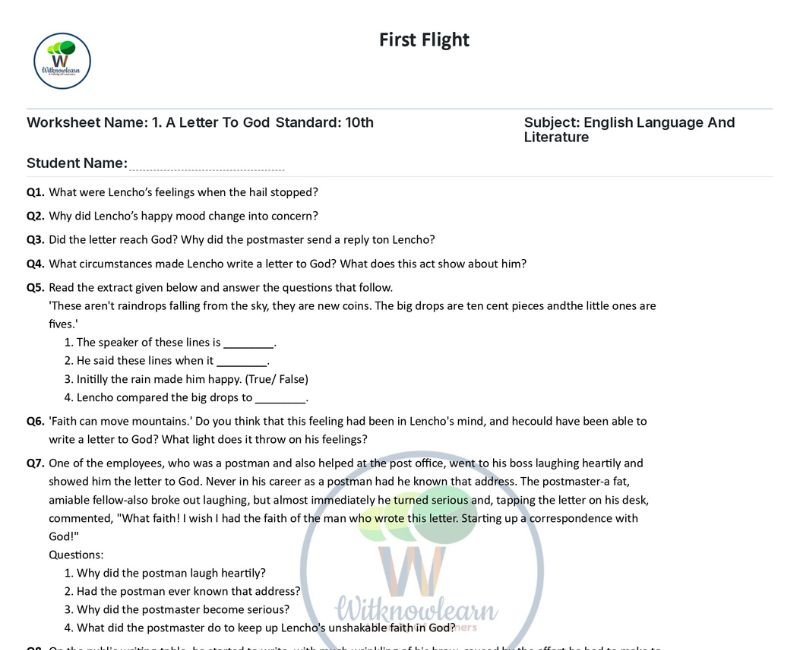
Explore the A Letter to God Class 10 worksheet with answers for practice in interpreting motives and supporting responses with details.
The From the Diary of Anne Frank worksheet offers further opportunities to examine a writer’s perspective. Apply the habit of linking each explanation to evidence.
FAQs about Unseen Passages for Class 10
What is an unseen passage?
It is a text you have not prepared beforehand. You read it and answer questions that assess your understanding of its information, language and meaning.
How should I solve an unseen passage?
Understand the main idea, read each question carefully, locate relevant evidence and write a focused answer. Review your response against the passage before finishing.
Should I read the questions or passage first?
Try both approaches during practice. A quick look at the questions can guide your attention, while an initial reading of the passage helps establish context. Choose the method that supports your accuracy.
How do I answer inference questions?
Combine clues from the passage to reach a reasonable conclusion. Make sure your interpretation is supported by the text.
Can I copy sentences from the passage?
Follow the question’s instruction. Word-finding tasks require the exact word; explanation tasks usually benefit from a clear response in your own words that preserves the original meaning.
How can I find synonyms in an unseen passage?
Read the relevant sentence and nearby clues. Check that the selected word matches the requested meaning and comes from the paragraph specified.
How many marks does CBSE assign to reading comprehension?
The 2026–27 Class 10 English Language and Literature curriculum assigns 20 marks to reading comprehension.
How should I use unseen passages with answers?
Attempt the questions independently, check the answers and identify why any correction is needed. Practise that skill again in your next passage.
 Download