Class 1 • Science and EVS • Discover the Clues of Life
🌱 Living and Non-Living Things Worksheet for Class 1
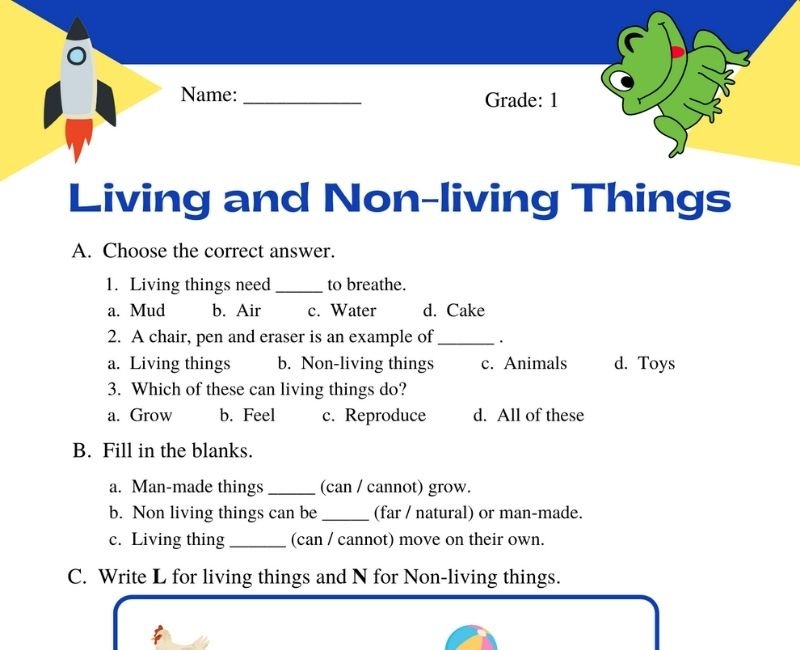
Can a quiet plant be living? Does a robot become alive when it moves? Explore this living and non-living things worksheet for Class 1 with an online quiz, 10 interactive games and activities and five practice tasks. Look for growth, basic needs and changes over time.
📝 Living and Non-Living Things Online Quiz for Class 1
Question 1/20 • Answered 0/20
Which of these is a living thing?
🎮 Living and Non-Living Things Online Games
Sort discovery cards, arrange growth stages, reunite young animals with adults, pack a plant-care kit and choose useful evidence.
1. 🔎 Sort the Explorer’s Finds
Choose a card, then place it in the living or non-living group.
Ready to play!
2. 🌱 Build a Bean Growth Timeline
Arrange the stages from earliest to latest. Tap two cards to swap them.
Ready to play!
3. 🐣 Reunite Young Animals and Adults
Match each young animal with its adult form.
Ready to play!
4. 🧰 Pack a Seedling-Care Kit
A bean seedling already has suitable soil and room. Select the three other needs shown: water, air and light.
Ready to play!
5. 🕵️ Choose Useful Clues of Life
A scientist studies a young earthworm. Select the two useful clues, not colour or decoration.
Ready to play!
🧩 Living and Non-Living Things Online Activities
Explore once-living objects, repair needs labels, correct a scientist’s notebook, measure a change and create your own record.
6. 🍂 Explore the Once-Living Shelf
Sort the clear examples into living now, no longer living, or never living. The leaf and twig are described as dead.
Ready to play!
7. 🔧 Repair the Needs Board
The labels are mixed up. Give each example its correct description.
Ready to play!
8. 📒 Correct the Fern Notebook
A notebook says: “The fern does not walk, so it is non-living.” Repair the label and choose better evidence.
Ready to play!
9. 📏 Compare Two Observation Days
The seedling is 3 cm tall on Day 1 and 5 cm on Day 7. The pencil is 7 cm on both days. Record each increase.
Ready to play!
10. 📝 Make a Life-Clues Record
Choose an example and record what you would observe over time. Create a note, then discuss it with an adult.
Ready to play!
✏️ Five Living and Non-Living Things Practice Tasks
1. 🐟 Label Two Examples
Give the fish and helmet their correct labels.
Ready to play!
2. 🌵 Find Plant Animal and Object
Match each example to its group.
Ready to play!
3. 🫘 Read a Seed Observation
A healthy seed develops a small root. What does this show?
Ready to play!
4. 💧 Match a Need to a Plant
Which of these belongs in the care plan for a healthy cactus?
Ready to play!
5. 🌿 Complete the Growth Sequence
A sprouted seed comes before a young plant with leaves. Choose the missing middle stage.
Ready to play!
📖 Living and Non-Living Things Class 1 Worksheet Guide
Read about living things non-living things growth and basic needs
This living and non-living things worksheet for Class 1 helps children classify familiar examples and explain their choices. Living things include people, animals and plants. Non-living examples include spoons, helmets, marbles and toy vehicles. Use the existing worksheet download option on this page for paper practice alongside the online quiz and games.
Introduce several clues of life together. Living things carry out life processes: they use energy, grow and develop, and respond to their surroundings. Plants and animals need suitable conditions to remain healthy. A young rabbit grows into an adult rabbit; a healthy seed can begin growing when conditions are suitable. Avoid using just colour, size or movement as the deciding rule.
Plants are living things even though most stay rooted in one place. A green plant with leaves uses light to make its own food. It also needs water, air, nutrients and enough room for healthy growth. Soil can provide water, support and mineral nutrients, but soil is not the food a green plant makes.
Seeds need careful wording. A viable seed contains a living young plant. Many familiar seeds begin germinating when they have water, air and suitable warmth. Light requirements vary, and a seed uses its stored food at first. A seed that has not sprouted after a few minutes should not immediately be labelled non-living.
A moving object is not necessarily alive. Wind can move a balloon, and a battery can power a robot. A sleeping animal may look still while it continues to breathe and remain alive. Similarly, a pile of blocks can become taller when someone adds blocks, but that is not the biological growth of a living thing.
Some non-living things came from living things. A dead leaf is no longer living, while a plastic spoon was never alive. This is a useful extension after children can classify clear examples. When discussing a leaf, seed or piece of wood, describe the actual example rather than assuming every similar-looking item has the same condition.
For meaningful Class 1 Science and EVS practice, compare observations over several days. Record a new root, a taller stem or an extra leaf. Do not harm a plant or animal to test whether it is living. Encourage children to say, “My evidence is…” and connect the label to something they noticed.
💡 Tips for Learning About Living Things
For Parents and Teachers
- Use clear examples before introducing seeds or once-living materials.
- Compare several clues instead of teaching movement as the only test.
- Photograph a growing plant over time without withholding its basic needs.
- Ask children to explain the evidence behind a label.
For Students
- Look carefully at the example.
- Remember that plants are living.
- A battery-powered toy is still non-living.
- Observe growth over time rather than expecting an instant change.
- Do not hurt living things during an investigation.
- Use more than one clue when explaining your answer.
❓ Living and Non-Living Things Worksheet FAQs
What are living and non-living things for Class 1?
Living things include plants, animals and people. They carry out life processes such as using energy and growing. Non-living things, such as spoons and marbles, do not carry out these processes.
What are five examples of living things?
A child, rabbit, snail, fern and sunflower plant are living things. The examples include both animals and plants.
What are five examples of non-living things?
A spoon, helmet, glass marble, toy train and plastic bottle are non-living things.
Why are plants living things if they do not walk?
Plants grow, use energy, exchange gases and respond to their surroundings. Walking from place to place is not a requirement for being alive.
Is a seed a living thing?
A viable seed contains a living young plant. It may remain inactive until suitable conditions allow it to begin growing.
Is a car or robot living because it moves?
No. A car or robot can move using an engine, motor or battery. Movement alone does not make an object living.
Is a sleeping animal still living?
Yes. A sleeping animal remains alive and continues processes such as breathing, even if it appears still.
Can something non-living come from a living thing?
Yes. A dead leaf came from a living plant but is no longer living. A wooden object also contains material that came from a tree.
Do plants eat soil?
No. Green plants make their own food using light. Soil can provide mineral nutrients, water and support for roots.
What activity helps children understand living things?
Observe a healthy growing plant over several days. Record changes such as a new root, a taller stem or another leaf, while continuing to care for the plant.
🌱 Online Living and Non-Living Things Quiz for Class 1
Look for clues, notice changes and explain what makes a living thing different.
📝 Try the Online Quiz Download