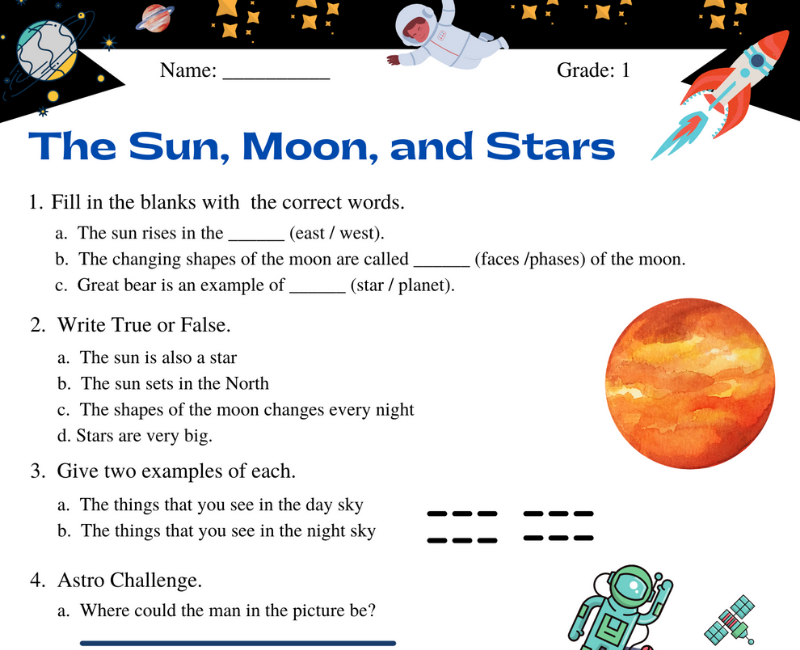
☀️ Sun Moon and Stars Worksheet for Class 1
Explore the sky with this Sun Moon and stars Class 1 worksheet, a colourful online quiz and hands-on learning games. Discover how sunlight helps us, why the Moon shines and what makes day and night.
Try 20 quiz questions, 10 online games and activities, and five practice tasks. Build a light pathway, turn an Earth model, repair sky facts and record an imaginary sky observation.
📝 Sun Moon and Stars Online Quiz for Class 1
The language selector changes the quiz. The learning guide, games and activities are in English.
Question 1/20 • Easy • 0/20 answered
Which object gives Earth daylight?
🎮 Sun Moon and Stars Online Games for Class 1
Build, arrange and explore. These games use different tasks from the quiz.
1. ☀️ Build the Moonlight Pathway
Arrange the three cards to show how sunlight can reach our eyes after reflecting from the Moon.
Your sequence is empty.
Ready to explore!
2. 🌍 Turn Earth into Day and Night
Move the red place around Earth. Stop once in daylight and once in darkness, then record each position.
Recorded: neither position yet.
Ready to explore!
3. 🌙 Arrange the Lit Moon Pictures
Arrange these appearances from the smallest visible sunlit portion to the largest. This is a size comparison, not a complete Moon calendar.
Your sequence is empty.
Ready to explore!
4. ⭐ Copy the Star Pattern
Study this imaginary pattern. Tap the matching squares on the empty board below. It is a picture puzzle, not a named constellation.
Ready to explore!
5. 🔆 Reveal the Hidden Star Dots
This contrast model contains five star dots. Change the sky brightness and compare how easily you can notice them. Real stars do not switch off in daytime.
Ready to explore!
🧩 Sun Moon and Stars Online Activities for Class 1
Repair fact cards, compare pictures and create a simple sky record.
6. 🔧 Repair the Sky Fact Cards
Each card needs a correct ending. Repair all three statements.
Ready to explore!
7. 🎨 Create a Daytime Moon Scene
Build an illustration containing a Sun symbol, a pale Moon and a tree. Use pictures only; never look directly at the Sun.
Ready to explore!
8. 🪞 Match the Moon Appearances
Reveal two cards at a time. Match the same illustrated Moon appearance.
Find three pairs.
9. 📓 Make a Sky Observation Record
Record a real observation with an adult, or make an imaginary example. Choose “not seen” when appropriate. Do not look directly at the Sun.
Ready to explore!
10. 🖼️ Create a Three-Part Sky Poster
Give each object its correct description. Then reveal your completed mini poster.
Ready to explore!
✏️ Sun Moon and Stars Practice Tasks for Class 1
1. 🏷️ Label the Sky Objects
Match each picture with its name.
Ready to explore!
2. 🌍 Mark Day and Night
Match each place description with day or night.
Ready to explore!
3. 🔢 Count the Illustrated Stars
Count the star symbols in this picture. These are drawing symbols, not actual star shapes.
Ready to explore!
4. 🌓 Name the Lit Appearance
Use the picture to complete the label.
Ready to explore!
5. 📝 Repair an Observation Note
A cloudy-sky note says “The Moon disappeared forever.” Build a more careful note using all three strips.
Your sequence is empty.
Ready to explore!
📖 About the Sun Moon and Stars Worksheet
Read the Sun Moon and stars learning guide for Class 1
A Sun Moon and stars worksheet for Class 1 helps children connect everyday sky observations with simple science ideas. Begin with familiar questions: What lights the daytime sky? Does the Moon make its own light? Why can the sky look different at different times? Use pictures and conversation before expecting children to remember scientific words.
The Sun is a star and the closest star to Earth. It gives off its own light and heat. Sunlight brightens our surroundings, and its warmth helps make Earth suitable for life. Teach children about the Sun using illustrations and safe classroom models. Children must never look directly at the Sun.
The Moon does not produce its own visible light like the Sun. We see it because it reflects sunlight. It is sometimes visible during the day as well as at night. Avoid teaching that a Moon picture always means night or that the Moon must be visible every night.
Day and night happen because Earth turns. A place facing the Sun receives direct sunlight and has daytime. As that place turns away from the Sun, it experiences night. The Sun does not switch off at bedtime. The turning Earth game provides a simplified model of this idea.
Other stars are present during the day, but the bright daytime sky usually makes them difficult to see. At night, many stars can become easier to see when the sky is clear and sufficiently dark. Clouds, buildings and artificial lights can affect what an observer notices.
The Moon can appear as a crescent, a half-lit circle or a full circle. These appearances are called phases. The Moon does not break into pieces or change its round body into a thin object. We see different amounts of its sunlit half as its position changes relative to Earth and the Sun. For Class 1, recognising a few familiar appearances is enough.
Use the existing worksheet download option on this page for paper practice. Children can label pictures, compare day and night scenes and draw a sky observation. The online quiz supports checking understanding, while the games practise arranging, building, comparing and explaining.
Keep learning playful. Let children explain an observation in their own words, revisit a model and change an answer after thinking. The diagrams are simplified teaching pictures and do not show the actual sizes or distances of objects in space.
👨👩👧 Tips for Parent and Teacher
- Use Sun illustrations and remind children never to look directly at the Sun.
- Ask “What did you notice?” before giving an explanation.
- Use a globe and torch with adult supervision to revisit day and night.
- Accept “I could not see the Moon” as a valid observation.
- Let children draw or describe their ideas before writing full sentences.
🌟 Tips for Students
- Look closely at each diagram before answering.
- Use the numbered buttons to revisit quiz questions.
- Remember that the Sun is a star.
- Think about where moonlight comes from.
- Try a model again if your first plan does not work.
- Describe only what you actually noticed in the sky.
- Observe the night sky with an adult from a safe place.
❓ Sun Moon and Stars Worksheet FAQs
Is the Sun a star?
Yes. The Sun is the closest star to Earth. It gives off its own light and heat.
Why does the Moon shine?
The Moon reflects sunlight. It does not make its own visible light like the Sun.
Can we see the Moon during the day?
Yes. The Moon is sometimes visible in the daytime when it is above the horizon and conditions allow us to see it.
What causes day and night?
Earth turns. A place facing the Sun has daytime. When that place turns away from the Sun, it has night.
Why can we not usually see other stars during the day?
The bright daytime sky makes most other stars difficult to see. The stars are still there.
Why does the Moon seem to change shape?
We see different amounts of the Moon’s sunlit half as the Moon moves around Earth. Its round body does not break into different shapes.
Does a crescent Moon mean part of the Moon is missing?
No. The Moon is still there as a whole round body. Only a smaller part of its sunlit surface is visible from our viewpoint.
How can I teach the Sun Moon and stars to Class 1?
Use labelled pictures, a simple day-and-night model, matching activities and short conversations about the sky. Introduce one idea at a time.
Is it safe for children to look directly at the Sun?
No. Use pictures and classroom models for this lesson. Never ask children to look directly at the Sun.
How can children use this worksheet with the online quiz?
Begin with pictures and the printable worksheet, try a game, then complete the quiz. Read the explanations after submission and revisit any confusing idea.
🚀 Ready for Another Sky Adventure?
Revisit the Sun Moon and stars online quiz, explore a model and share one new sky fact.
Back to the Online Quiz ↑ Download