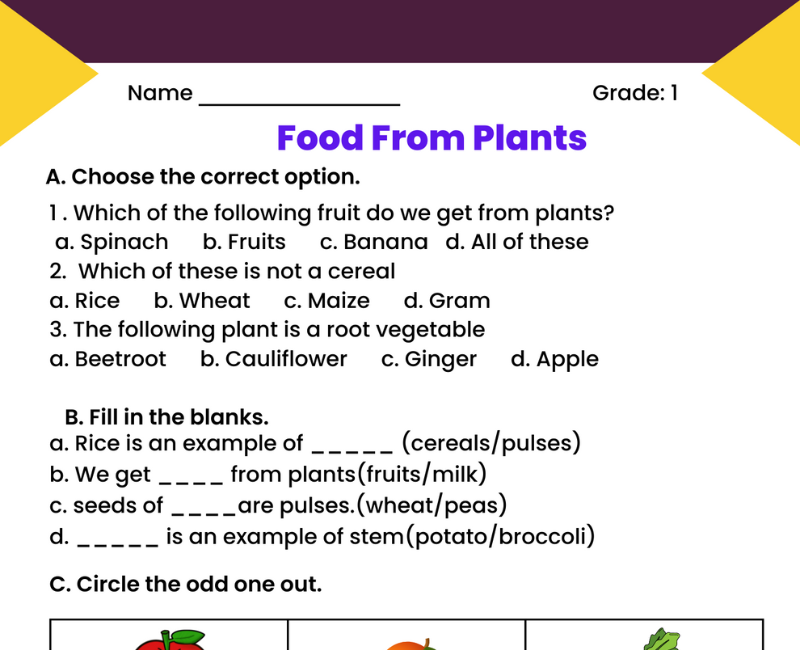
🌾 Food We Get from Plants Worksheet for Class 1
Discover the plant parts on our plates! Explore edible roots, leaves, stems, flowers, fruits and seeds, along with familiar grains, pulses, oils and spices.
This food from plants Class 1 worksheet includes a 20-question online quiz, 10 online games and activities, and five practice tasks. Sort a harvest basket, label a vegetable diagram and trace ingredients back to plants.
📝 Food We Get from Plants Online Quiz for Class 1
The selector changes the quiz language. Games, activities and the learning guide are in English.
Question 1/20 • Easy • 0/20 answered
Which part of spinach is commonly eaten?
🎮 Food from Plants Online Games for Class 1
Explore a harvest basket, construct labels and follow a plant ingredient journey.
1. 🧺 Sort the Harvest by Plant Part
Tap a food card, then its matching plant-part basket. The labels specify which part is being considered.
Choose a harvest card.
Ready to explore!
2. 🥕 Label a Carrot Plant Diagram
Follow the two pointer lines. Label the green part above the soil and the orange storage part below it.
Ready to explore!
3. 🌻 Follow Sunflower Seeds to Oil
Arrange a simple production journey. Oil extraction is an adult or industrial task, not a classroom tasting experiment.
Build your sequence.
Ready to explore!
4. 🍲 Build a Three-Part Recipe Board
For this pretend recipe board, choose one edible leaf, one edible root and one edible seed. Use only the prepared-food examples listed.
Ready to explore!
5. 🃏 Food and Plant-Part Memory
Find each food’s matching part. Reveal two cards at a time.
Find three pairs.
🧩 Food from Plants Online Activities for Class 1
Repair plant-part labels, read a harvest chart and create a food discovery card.
6. 🔧 Repair the Plant-Food Labels
Repair three labels. A food can have different descriptions depending on the question.
Ready to explore!
7. 🌿 Explore the Flavour Shelf
Use this fact shelf: tea commonly uses leaves, coffee uses seeds, and cinnamon uses bark. Match the three ingredient labels.
Ready to explore!
8. 📊 Record the Harvest Display
Count the labelled food pictures by plant part. Each picture represents one display item, not a serving size.
Ready to explore!
9. 📓 Make a Plant-Food Discovery Card
Choose an example and match the edible part named in this activity.
Ready to explore!
10. 🖼️ Create a Plant-Food Explorer Poster
Complete three accurate reminders for a classroom display.
Ready to explore!
✏️ Food from Plants Practice Tasks for Class 1
1. 🌾 Find Three Cereal Crops
Select the three cereal crops.
Ready to explore!
2. 🫘 Find the Pulse Pair
Select two pulse foods from these cards.
Ready to explore!
3. 🔗 Trace Ingredients to Plants
Match the named ingredient with its plant source.
Ready to explore!
4. 🛡️ Choose Safe Explorer Actions
Select three suitable actions for a picture-based plant-food lesson.
Ready to explore!
5. 🔤 Build the Word SEEDS
Tap the English letters in order. The two S tiles and two E tiles are separate pieces.
_ _ _ _ _
Ready to explore!
📖 Food We Get from Plants Class 1 Learning Guide
Read about edible plant parts and plant food sources
A food we get from plants worksheet for Class 1 connects familiar meals with the plants that produce their ingredients. Children can begin with a fruit, vegetable or grain they recognise, then ask which part of the plant is used as food.
We eat different parts of different food plants. Carrot and radish are root examples. Spinach and lettuce provide edible leaves. Sugarcane is a stem example, while the familiar cauliflower head contains an immature flowering structure. Mangoes and grapes are fruits. Peas and beans provide edible seeds.
Some examples need careful explanation. A potato is a stem tuber, not a root, even though it grows underground. Growing below the soil does not automatically make a plant part a root. Broccoli includes flower buds and edible stems, so saying that only one part can ever be eaten is too rigid.
Grains such as wheat, rice and maize come from cereal plants. Pulses such as lentils and chickpeas also come from plants. These are useful food groups, but they answer a different question from “Which plant part is this?” A food can be described by its food group and by its plant part.
Plant ingredients can change appearance during preparation. Wheat can be ground into flour, and oil can be extracted from seeds such as mustard or sunflower. Looking at ingredients helps children trace a prepared food back to its source. Processing does not erase the ingredient’s plant origin.
Herbs and spices also come from plants. Coriander leaves are used as a herb, and coriander seeds are used as a spice. Cinnamon comes from bark, while cloves are dried flower buds. Introduce these as optional familiar examples rather than expecting children to memorise every plant product.
Everyday kitchen categories and botanical categories can differ. A tomato is commonly used as a vegetable in cooking but is botanically a fruit. For Class 1, explain the question clearly and avoid marking a child wrong for using a reasonable category when the activity has not specified which meaning is intended.
Not every plant is food, and not every part of a food plant is edible. Children should never taste an unknown leaf, berry or flower. Use pictures for these activities and let an adult manage identification, washing and preparation. Use the existing download option on this page for printable practice alongside the online quiz and games.
👨👩👧 Tips for Parent and Teacher
- Use familiar local foods and name the edible part clearly.
- Separate food groups from botanical plant parts.
- Explain that underground does not always mean root.
- Use pictures instead of tasting unfamiliar plants.
- Welcome different food traditions and preparation methods.
🌟 Tips for Students
- Look closely at the food picture and its name.
- Ask which plant part the question means.
- Trace a prepared food back to its ingredients.
- Remember that one plant can provide more than one useful part.
- Try changing a label when a clue does not fit.
- Never taste unknown plants or plant parts.
- Ask an adult before handling or preparing real food.
❓ Food We Get from Plants Worksheet FAQs
What foods do we get from plants?
Plants provide fruits, vegetables, grains, pulses, nuts, oils, herbs and spices.
Which plant parts do we eat?
Depending on the food plant, we may eat roots, stems, leaves, flowers, fruits or seeds. Some plant foods also come from bark or other specialised structures.
Which roots do we eat?
Carrot and radish are familiar examples of edible roots.
Which leaves do we eat?
Spinach, lettuce and coriander leaves are familiar food examples.
Is potato a root or a stem?
A potato is a stem tuber. It grows underground, but underground location alone does not make a plant part a root.
Which flowers do we eat?
Cauliflower and broccoli are familiar examples involving flowering structures. Broccoli stems are edible too.
Which seeds do we eat?
Peas, beans, lentils and chickpeas are examples. Cereal grains such as wheat and rice also contain the seed.
Is tomato a fruit or a vegetable?
Botanically, tomato is a fruit. In everyday cooking it is usually treated as a vegetable. The intended category should be made clear in a question.
Can the same plant provide different food parts?
Yes. Coriander leaves and seeds are both used in cooking, for example.
Can children eat any leaf from a food plant?
No. Not every part is edible. Children should use only food identified and prepared appropriately by a responsible adult.
🌾 Online Food from Plants Quiz for Class 1
Try again and name one food and the plant part it comes from.
Return to the Plant Food Quiz ↑ Download