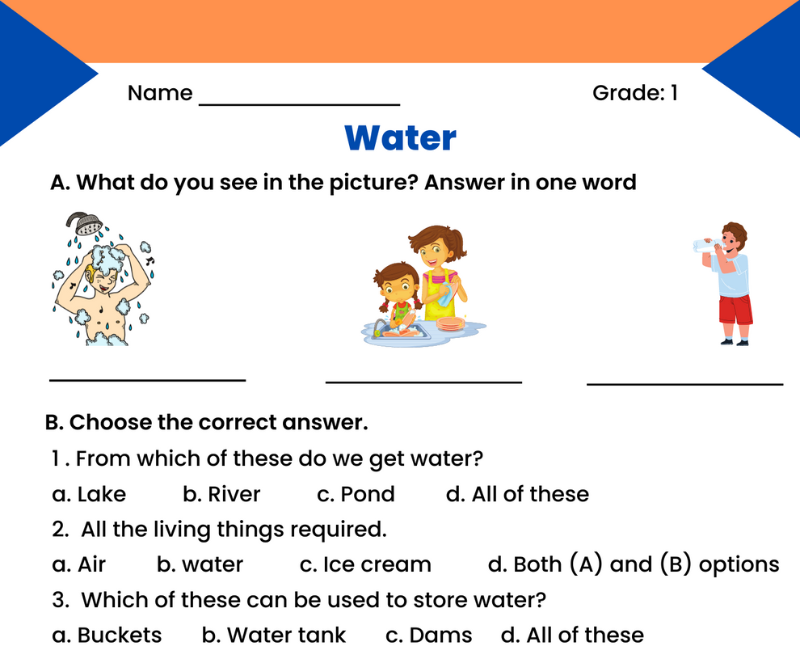
💧 Water Worksheet for Class 1
Follow water from natural sources to everyday uses! Explore sources of water, uses of water, ice, water vapour and water conservation through colourful picture challenges.
This water Class 1 worksheet includes a 20-question online quiz, 10 online games and activities, and five practice tasks. Connect a pipe puzzle, compare containers and help protect an imaginary pond.
📝 Water Online Quiz for Class 1
The selector changes the quiz language. Games, activities and the learning guide are in English.
Question 1/20 • Easy • 0/20 answered
Which activity uses water inside our bodies?
🎮 Water Online Games for Class 1
Connect pipes, deliver water-use cards and explore how water changes shape.
1. 🔧 Connect the Garden Water Pipe
Tap pipe tiles to rotate them. Connect the inlet at the left of the top-left tile to the outlet at the right of the bottom-right tile. Real plumbing is an adult task.
Inlet → top-left square • Bottom-right square → garden outlet
Ready to explore!
2. 📮 Deliver the Water-Use Cards
Match each pictured task with its use of water.
Ready to explore!
3. 🚰 Visit the Water-Saving Stations
Two unneeded taps can be closed in this model. A faulty tap needs an adult report. Leave the drinking station available.
Ready to explore!
4. 🥛 Explore Two Container Shapes
Both containers hold six equal model units. Reveal the amount labels, then complete the comparison. The drawing is a simplified model.
Ready to explore!
5. ☁️ Arrange a Water Journey
Build one simplified water-cycle pathway. Real water can take many routes.
Build your sequence.
Ready to explore!
🧩 Water Online Activities for Class 1
Explore ice and liquid water, investigate pretend water loss and create a conservation poster.
6. 🧊 Change the Water Model
Use the model controls to show melting and freezing. This is a screen model, not an instruction to handle hot water or a freezer alone.
Ready to explore!
7. 🔎 Solve the Leaky-Tank Story
A pretend tank starts with eight water tokens. Two move into the leak tray. Move exactly two tokens, then record how many remain. Tokens are not real litres.
Leak tray: 0 tokens
Ready to explore!
8. 🗺️ Complete the Water Supply Map
Match the descriptions. A delivery point is different from a natural water body.
Ready to explore!
9. 🐟 Protect the Virtual Pond
Remove three litter symbols from this picture. Leave the living things alone. Real cleanup near water is an adult task.
Ready to explore!
10. 🖼️ Create a Water-Care Poster
Complete three accurate messages for your pretend classroom poster.
Ready to explore!
✏️ Water Practice Tasks for Class 1
1. 🏷️ Match the Water Form
Match each example with solid, liquid or gas.
Ready to explore!
2. 🌱 Find the Living Water Users
Select three living things that need water.
Ready to explore!
3. 🧺 Choose Water-Using Tasks
Select three tasks that use water.
Ready to explore!
4. 🕵️ Repair a Water-Safety Note
Give each note a careful ending.
Ready to explore!
5. 🔤 Build the Word WATER
Tap the English letters in order.
_ _ _ _ _
Ready to explore!
📖 Water Class 1 Learning Guide
Read about water sources uses forms and conservation
A water worksheet for Class 1 helps children connect familiar experiences with simple science. Begin with water used for drinking, cooking, washing and growing plants. Ask children to describe a use and explain why it matters rather than memorising a long list.
Rain, rivers, lakes and groundwater are important parts of our water environment. A well provides access to water underground. A tap is a delivery point connected to a water supply; it does not create water. The source and treatment arrangements differ between communities.
People, other animals and plants need water. Plants take up much of their water through their roots. Water also provides habitats for many living things. Rivers, lakes and oceans are different environments, and ocean water contains too much salt for ordinary drinking.
Liquid water flows and takes the shape of its container. Pouring the same amount into a differently shaped container can change the water level without changing the amount, provided none is spilled. The container game uses simplified drawings to explore this idea.
Water can be solid ice, liquid water or water vapour, which is a gas. Ice melts when it gains enough heat. Liquid water can evaporate into water vapour. Water vapour itself is invisible; the visible white cloud above warm water is made of tiny droplets. Use pictures and adult-led demonstrations rather than asking children to handle hot water.
A simple water-cycle story connects evaporation, cloud formation and rain. Liquid water evaporates, water vapour can cool and condense into tiny droplets, and droplets in clouds can grow into raindrops. This is one simplified pathway: real water also moves underground, through plants and along many other routes.
Water that looks clear is not automatically safe to drink. Harmful germs or chemicals may not be visible. Children should use drinking water approved by the responsible adult and should not taste unknown water to test it. Treatment and storage are adult responsibilities.
Saving water means avoiding unnecessary waste while still meeting drinking, hygiene and other needs. Turn off an unneeded tap, report leaks and use suitable amounts. Children should not try to repair plumbing or enter water bodies to remove rubbish. Use the existing worksheet download option on this page for printable practice alongside the quiz and games.
👨👩👧 Tips for Parent and Teacher
- Use small, supervised demonstrations with room-temperature water.
- Explain that clear-looking water may still be unsafe to drink.
- Let adults handle treatment, plumbing and hot-water demonstrations.
- Encourage conservation without limiting drinking or necessary handwashing.
- Keep observation activities away from unsafe water edges.
🌟 Tips for Students
- Drink only from the safe supply your adult provides.
- Notice different ways water is used.
- Close taps when water is no longer needed.
- Tell an adult about a leaking tap.
- Keep litter away from drains and water bodies.
- Ask an adult before trying a water experiment.
- Never taste unknown water to check it.
❓ Water Worksheet for Class 1 FAQs
Why do we need water?
Our bodies need water to work properly. We also use water for cooking, washing and growing food. Other animals and plants need water too.
What are some sources of water?
Rain, rivers, lakes and groundwater are familiar examples. Wells provide access to groundwater, while taps deliver water from a supply.
What are five uses of water?
Drinking, cooking, washing hands, bathing and watering plants are five examples.
What are the three forms of water?
Solid ice, liquid water and water vapour, which is a gas.
Can we see water vapour?
Water vapour itself is invisible. Visible mist and clouds contain tiny water droplets or ice crystals.
Why does ice melt?
Ice changes to liquid water when it gains enough heat.
Does clear water always mean safe drinking water?
No. Some harmful germs and chemicals cannot be seen. Use the safe drinking supply approved by the responsible adult.
Can children drink rainwater directly?
They should not assume it is safe. Collected rainwater can contain germs or chemicals. Adults must manage decisions about treatment and use.
How can Class 1 children save water?
Close taps when they are not needed, report leaks and avoid unnecessary overflow. Continue drinking enough and washing properly.
What is the water cycle in simple words?
Water moves between the ground, water bodies and air. Evaporation, cloud formation and rain are parts of this continuing movement.
💧 Online Water Quiz for Class 1
Try again and share one way to use water thoughtfully.
Return to the Water Quiz ↑ Download