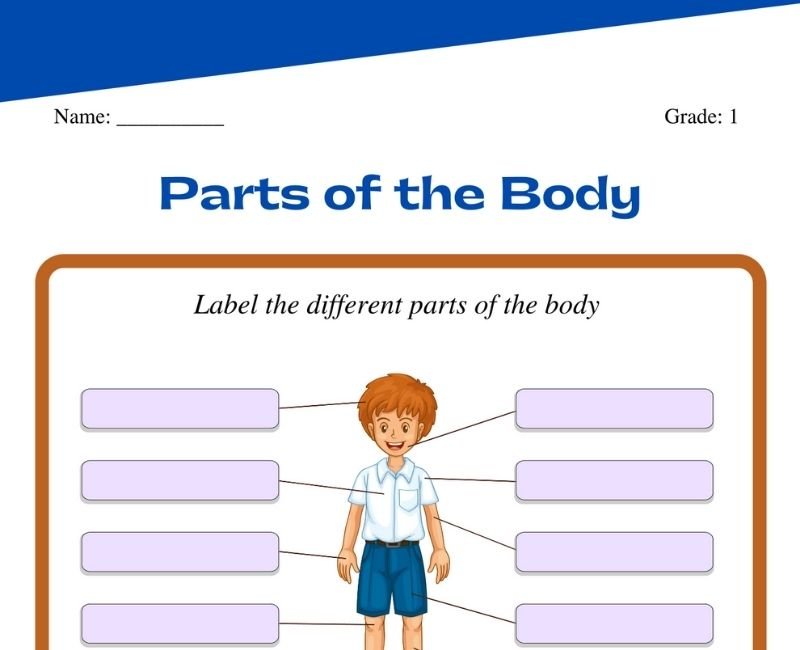
Class 1 • Science and EVS • Discover How Body Parts Work Together
🧒 Parts of Our Body Worksheet for Class 1
Read a sign, hear a tune, bend an elbow and explore what happens inside the body. This parts of our body worksheet for Class 1 includes an online quiz, 10 games and activities and five practice tasks about body functions, sense organs and simple internal organs.
📝 Parts of Our Body Online Quiz for Class 1
Question 1/20 • Answered 0/20
Which body part helps us see the letters on a sign?
🎮 Parts of Our Body Online Games for Class 1
Find bending joints, deliver sense clues, assemble an action team, match organ jobs and play body-function memory.
1. 📍 Find the Bending Joints
The diagram marks two joints. Match A and B with elbow and knee.
Ready to play!
2. 📮 Deliver the Sense Clues
Choose a clue card, then deliver it to the matching sense. These are picture clues, not real tasting tasks.
Ready to play!
3. 🧩 Build the Page-Turning Team
In this story, a child looks at a page, plans the action and turns it by hand. Select the three parts named by those jobs.
Ready to play!
4. 🏥 Match the Organ Job Cards
Give each internal organ its job card.
Ready to play!
5. 🃏 Sense-and-Part Memory
Reveal two cards. Match a sense with its body part.
Ready to play!
🧩 Body Parts and Functions Online Activities
Control a virtual elbow, match clothing with body parts, repair organ facts, count parts in a picture and create a senses record.
6. 🦾 Control a Virtual Elbow
Move the slider until the model’s hand reaches the marked ball. This is an on-screen model; you do not need to copy the movement.
Ready to play!
7. 🧤 Match Clothing to Body Parts
Match each item with the part it is worn on.
Ready to play!
8. 🔧 Repair the Mixed-Up Organ Notes
The notebook has the wrong organ names. Repair each sentence.
Ready to play!
9. 🔢 Count This Model’s Hands and Feet
Count only the hands and feet shown in this model, then record the total.
Ready to play!
10. 📓 Create a Senses Discovery Card
Choose an imagined observation and the sense you would use. Create a card and explain your choice.
Ready to play!
✏️ Five Body Parts Practice Tasks for Class 1
1. ↕️ Arrange Head Neck and Trunk
Arrange these three parts from top to bottom. Tap two cards to swap them.
Ready to play!
2. 👂 Complete Two Sense Links
Match seeing and hearing with their body parts.
Ready to play!
3. 🫁 Sort Visible Parts and Internal Organs
Classify the hands and lungs. Use the body model as a guide.
Ready to play!
4. 🎈 Notice Two Clues
A picture story shows bright balloons and a ringing triangle instrument. Select the two senses involved.
Ready to play!
5. 🦵 Match Joint and Limb
Complete both links: elbow to arm, knee to leg.
Ready to play!
📖 Parts of Our Body Class 1 Worksheet Guide
Read about body parts sense organs movement and internal organs
This parts of our body worksheet for Class 1 connects body-part names with familiar functions. Children identify the head, neck, arms, hands, legs and feet, then explore how different parts work together. Use the existing worksheet download option on this page for paper practice alongside the online quiz and games.
Begin with visible body parts. The neck connects the head with the trunk. Arms include elbows, and legs include knees. Hands help with actions such as holding and drawing. Feet are at the ends of the legs. People’s bodies and ways of completing activities can differ, so use the illustrated examples without expecting every child to move in the same way.
The five basic senses commonly introduced in Class 1 are sight, hearing, smell, taste and touch. Eyes are associated with sight, ears with hearing, the nose with smell and the tongue with taste. Skin is associated with touch. Hands contain skin, but touch is not limited to the hands.
Everyday activities often involve several parts and senses. In an illustrated story, a child may see a coloured puppet and hear its bell. Someone drawing may use their eyes to look, their hand to guide a pencil and their brain to help plan the action. The aim is to understand cooperation rather than assign every activity to only one part.
The worksheet also introduces simple internal organs. The brain helps with thinking and sends and receives messages. The heart pumps blood. The lungs help with breathing. The stomach helps break down food as part of digestion. These are introductory descriptions; the diagrams are simplified and are not medical maps or drawings to scale.
Keep sensory practice familiar and gentle. A clean scarf can be described as soft, and a normal-volume bell can be described as ringing. Children should not taste unknown items or test temperature by touching hot objects. The interactive scenes on this page are picture activities, so no real tasting, blindfolding or physical movement is required.
These Class 1 body parts and functions activities encourage children to match, compare, correct an explanation and apply what they know. For additional naming practice, use the related body-labelling worksheet linked below.
💡 Tips for Learning Body Parts
For Parents and Teachers
- Connect each new name with a familiar function.
- Use skin, rather than hands alone, when discussing touch.
- Keep internal-organ explanations short and accurate.
- Let children respond by pointing, speaking or using the on-screen controls.
For Students
- Look carefully at the picture before choosing.
- Think about the job the body part does.
- Remember that elbows belong to arms and knees belong to legs.
- Different body parts often work together.
- Use only familiar, safe objects for real sensory observations.
- Ask an adult if you are unsure about an activity.
❓ Parts of Our Body Worksheet FAQs
What body parts should Class 1 children learn?
Begin with familiar visible parts such as the head, neck, arms, hands, elbows, legs, knees and feet. Connect the names with simple functions and pictures.
What are the five basic senses and their body parts?
Sight is associated with eyes, hearing with ears, smell with the nose, taste with the tongue and touch with skin.
Is skin or the hand the sense organ for touch?
Skin is associated with touch. Hands have skin, but skin on other body parts can also sense touch.
What is the difference between an elbow and a knee?
An elbow is a joint in the arm. A knee is a joint in the leg. Both allow bending, but they are in different parts of the body.
What connects the head to the trunk?
The neck connects the head with the trunk of the body.
What does the heart do?
The heart pumps blood through the body.
What do the lungs do?
The lungs help with breathing and the exchange of gases between air and the body.
What does the brain do?
The brain helps with thinking, remembering and coordinating many body activities. It sends and receives messages.
What does the stomach do?
The stomach helps break down food. It is one of several organs involved in digestion.
How can I teach body parts through games?
Use picture matching, function cards, simple models and short stories. Allow children to answer on screen or by pointing instead of requiring physical movement.
🧒 Online Parts of Our Body Quiz for Class 1
Discover each part’s job and how the body works as a team.
📝 Try the Online Quiz Download