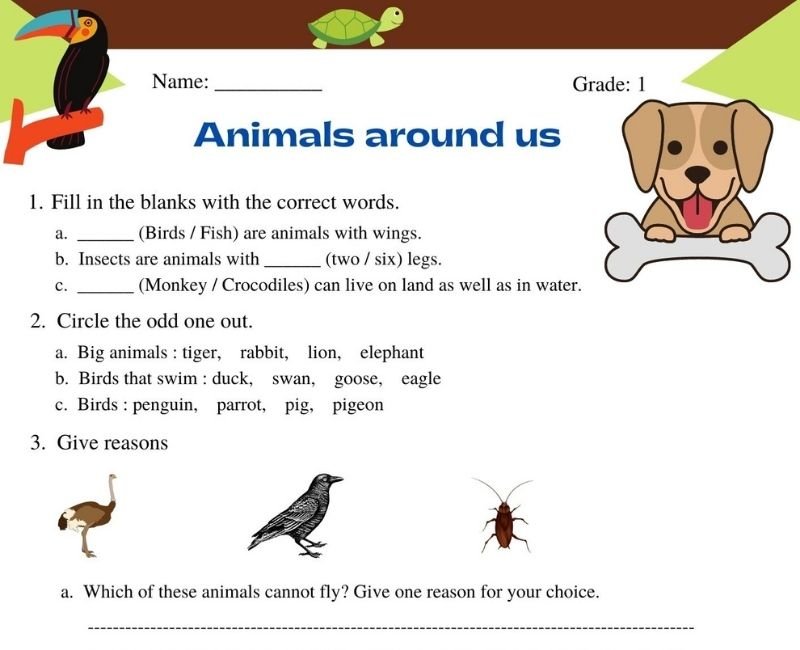
🐾 Animals Around Us Worksheet for Class 1
Explore wild and domestic animals, birds, insects and water animals through colourful pictures and observation tasks. Notice feathers, legs, wings and the different ways animals move.
This animals around us worksheet for Class 1 includes a 20-question online quiz, 10 online games and activities, and five practice tasks. Build an insect model, sort animal cards and make a little animal field guide.
📝 Animals Around Us Online Quiz for Class 1
The selector changes the quiz language. Games, activities and the learning guide are in English.
Question 1/20 • Easy • 0/20 answered
Which animal is commonly cared for on farms?
🎮 Animals Around Us Online Games for Class 1
Sort animals, assemble a six-legged model and discover different ways of moving.
1. 🧺 Sort the Animal Cards
Tap an animal card, then its group. A pet can also be domestic; these baskets compare domestic and wild kinds.
Choose an animal.
Ready to explore!
2. 🐜 Build a Six-Legged Insect Model
The head, middle section and abdomen are ready. Add one leg at a time to the middle section until your simplified insect has six legs.
Ready to explore!
3. 🚦 Give Animals Their Movement Passes
Choose the movement combination that fits each animal. Some animals need more than one movement on their pass.
Ready to explore!
4. 🔎 Complete the Body-Covering Tray
Match the animal with its familiar body covering. These are picture clues, not real samples to collect from animals.
Ready to explore!
5. 📊 Make an Animal Survey
This imaginary garden survey shows every animal to count. Record each kind, then check your table.
Ready to explore!
🧩 Animals Around Us Online Activities for Class 1
Compare features, organise observation records and create an animal information card.
6. 🏞️ Complete the Land and Water Chart
Match these examples with the settings they use. This is a simple comparison, not a complete habitat description.
Ready to explore!
7. 🪶 Repair the Feature Chart
Complete both features for each animal. A shared feature does not always mean the same animal group.
Ready to explore!
8. 🃏 Animal Picture and Name Memory
Reveal two cards at a time. Match each picture with its English animal name.
Find three picture-and-name pairs.
9. 👣 Plan an Animal Observation Walk
Choose exactly four actions for a respectful observation walk with an adult.
Ready to explore!
10. 📓 Create an Animal Field-Guide Card
Choose one animal, then complete its group and feature. The animal choices here are different from the quiz examples.
Ready to explore!
✏️ Animals Around Us Practice Tasks for Class 1
1. 🐾 Match Animals with Their Feet
Match the familiar foot feature with each animal.
Ready to explore!
2. 🦜 Find the Feathered Pair
Select exactly two animals with feathers.
Ready to explore!
3. 🏡 Complete the Domestic Animal Group
Select the three domestic animals. The wild animal should stay out of this group.
Ready to explore!
4. 🔍 Record a Visible Feature
Match each observation with the illustrated animal. Use the feature, not the animal’s size.
Ready to explore!
5. 🌿 Choose Respectful Animal Care
Select three actions that respect animals.
Ready to explore!
📖 About the Animals Around Us Worksheet
Read the animals around us learning guide for Class 1
An animals around us worksheet for Class 1 helps children recognise familiar animals and describe what they notice. Begin with clear pictures and everyday examples. Ask children to name an animal, describe a visible feature and explain one way it moves. They do not need to memorise a long list of scientific groups before exploring animals.
Domestic animals belong to kinds that people have bred over many generations to live alongside them. Cows, goats, sheep and dogs are familiar examples. Some domestic animals are kept as pets, while others are cared for on farms. “Pet” and “domestic” are not completely separate categories: a pet dog is also a domestic animal.
Wild animals include tigers, elephants and many animals living close to our homes, such as squirrels. Wild animals do not all live in forests. Depending on the species, they may live in grasslands, deserts, water or other habitats. Seeing a wild animal in a zoo does not turn it into a domestic animal.
Birds are animals with feathers. Many birds fly, but some, including ostriches, do not. Flying alone is not enough to identify a bird: bats are mammals, and butterflies are insects. These examples help children use body features as well as movement when comparing animals.
Adult insects have six legs. A spider has eight legs and belongs to a different group. Use a clear diagram rather than counting the legs visible in a tiny cartoon. An illustrator may hide a leg behind the body, so the number of legs visible in a picture is not always the animal’s full leg count.
Animals can move in more than one way. Ducks can walk, swim and fly. Frogs can hop on land and swim in water. Avoid sorting each animal into only one movement group when more than one description fits. For early learning, use specific examples instead of saying that every animal in a broad group behaves in exactly the same way.
The online games focus on sorting, constructing, comparing and recording. The quiz checks understanding through separate questions. Use the existing download option on this page for the printable animals worksheet, then revisit a picture or game if a child needs another example.
Animal care begins with respect. Observe unfamiliar animals from a distance, do not chase them and never disturb eggs or nests. Ask an adult before approaching or feeding any animal. Encourage children to report an injured animal to an adult rather than handling it themselves.
👨👩👧 Tips for Parent and Teacher
- Ask children to describe a feature before naming a group.
- Explain that a pet dog is also a domestic animal.
- Use accurate diagrams when counting legs.
- Accept more than one movement when appropriate.
- Observe real animals respectfully with adult supervision.
🌟 Tips for Students
- Look for feathers, legs and other clear features.
- Read the whole question before choosing.
- Remember that birds and insects are animals too.
- Think of different ways the same animal can move.
- Try changing your plan in a game.
- Keep a safe distance from unfamiliar animals.
- Tell an adult if you see an injured animal.
❓ Animals Around Us Worksheet FAQs
What do children learn in animals around us for Class 1?
Children recognise familiar animals and compare their features, movements and surroundings. They also learn simple ideas about domestic animals, wild animals and respectful animal care.
What are domestic animals?
Domestic animals are kinds that people have bred over many generations to live alongside them. Examples include cows, goats, sheep and dogs.
What is the difference between a pet and a domestic animal?
A pet is an animal kept for companionship. Domestic describes a kind of animal shaped by many generations of living with people. A pet dog is also a domestic animal.
Do all wild animals live in forests?
No. Different wild animals live in grasslands, deserts, water and other habitats. Some also live close to people.
Are birds and insects animals?
Yes. Birds and insects belong to the animal kingdom. “Animal” does not mean only a large four-legged creature.
Can all birds fly?
No. Ostriches are birds that cannot fly. Feathers are a useful feature for recognising birds.
Is a bat a bird?
No. A bat is a mammal. Being able to fly does not make an animal a bird.
Is a spider an insect?
No. Spiders have eight walking legs. Adult insects have six legs.
Can one animal move in different ways?
Yes. A duck can walk, swim and fly. A frog can hop and swim.
How can children observe animals safely?
Observe with an adult, keep a respectful distance and avoid chasing, handling or feeding unfamiliar animals. Tell an adult about an injured animal.
🐾 Online Animals Around Us Quiz for Class 1
Try the quiz again and explain one animal feature you noticed.
Return to the Animal Quiz ↑ Download