Fruits and Vegetables: A Colourful Market Adventure! 🥕
Explore familiar produce with a colourful quiz, 10 interactive tasks and five short online practice sets.
📝 Fruits and Vegetables Online Quiz for SR KG
🎮 Fruits and Vegetables Online Games
Explore produce, sort picture cards and pack a pretend market order. Choose one game at a time.
🎨 Fruits and Vegetables Online Activities for UKG
Repair labels, compare picture sizes, arrange a display and trace produce outlines.
✏️ Fruits and Vegetables Online Practice for SR KG
Try five short tasks. An adult can read the clues aloud.
💡 Tips for Teaching Fruits and Vegetables
👩🏫 Open Parent and Teacher Tips
- Start with familiar produce and welcome names from the child’s home language.
- Use shape, plant parts and labels as well as colour when comparing foods.
- Say whether a sorting task uses everyday cooking groups or botanical plant parts.
- Let children observe, point or draw without requiring tasting.
- Choose a few tasks per session and revisit the words during a pretend market game.
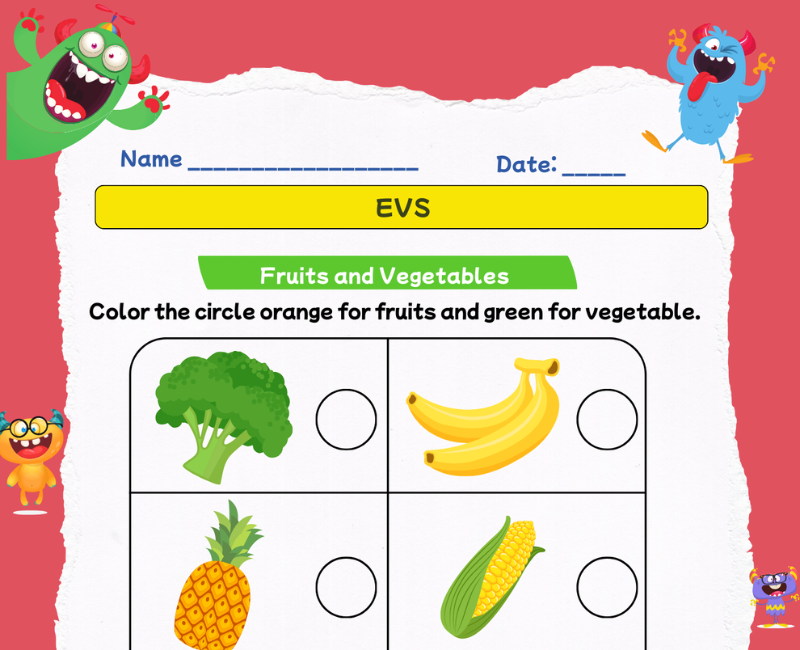
📄 Fruits and Vegetables Worksheet for SR KG
📖 Read the Fruits and Vegetables Worksheet Learning Guide
🍎 Begin with familiar names and pictures
A fruits and vegetables worksheet for UKG helps children connect everyday foods with spoken words, pictures and written labels. Begin with familiar examples such as apple, banana, carrot and potato. Invite children to point, name or describe what they notice. Accept a familiar home-language name before adding the English word, and introduce only a few new words at a time.
🥬 Compare more than colour
Fruits and vegetables matching activities can develop careful observation. Compare an outline, leaf, stalk, peel or visible seed rather than relying only on colour. The same food can vary in size, colour and shape. A green apple and a green cabbage are different foods, while two apples can look different. Use labelled examples to support the comparison.
🌱 Explain the grouping rule
For a fruit and vegetable sorting worksheet, state the rule before sorting. Everyday cooking groups and botanical plant parts are different ways of describing produce. A tomato is botanically a fruit, although commonly used as a vegetable in cooking. Spinach is grown for leaves, carrot for its root and onion for its bulb. Use clear, familiar examples first and discuss exceptions with adult support.
🎮 Practise through different tasks
The fruits and vegetables online quiz for SR KG has twenty questions with a review after submission. Separate online games include a plant-part explorer, picture sorting, memory pairs, packing an exact order and completing a repeating pattern. Online activities add label repair, size comparison, a market display, a bean-growing sequence and outline tracing. Five extra practice sets support vocabulary, spelling, sentence work and observation.
✏️ Connect printable and online learning
Use the existing download option on this page for the printable fruits and vegetables worksheet PDF. Read labels together, invite a drawing or dictate a sentence before independent writing. Continue with places around us online activities, describing words online games and singular and plural practice. Keep the focus on curious observation and playful language.
❓ Fruits and Vegetables Worksheet FAQs
💬 How do I teach fruits and vegetables to UKG children?
Begin with familiar pictures and names. Invite children to observe, point, match or describe before adding written labels and sorting tasks.
💬 What can a fruits and vegetables worksheet for SR KG include?
Picture matching, naming, sorting, counting, simple word building, comparisons and drawing are useful options.
💬 How can I explain the difference between fruits and vegetables?
Explain that everyday cooking groups and botanical plant parts use different rules. Begin with clear examples, then discuss foods that fit different descriptions.
💬 Is a tomato a fruit or a vegetable?
Botanically, a tomato is a fruit because it develops from a flower and contains seeds. It is commonly used as a vegetable in cooking.
💬 Are all fruits sweet?
No. Sweetness is not a reliable rule for identifying a botanical fruit. Some fruits are sour, mild or used in savoury dishes.
💬 Can the same fruit or vegetable have different colours?
Yes. Varieties and ripeness can affect colour, and foods of the same kind can vary in shape and size too.
💬 Which vegetables are leaves, roots or bulbs?
Spinach and cabbage are valued for their leaves, carrot is a root and onion is a bulb. Start with a few familiar examples.
💬 Are brinjal and eggplant the same food?
Yes. Brinjal, eggplant and aubergine are common names for the same plant food.
💬 How can children match pictures without reading independently?
An adult can read the labels while the child compares pictures and points to a choice. Add independent reading when appropriate.
💬 Must children taste the food to join these activities?
No. Pictures, pretend market games, spoken descriptions and drawings allow participation without tasting.
💬 Are the online activities different from the quiz?
Yes. The quiz uses multiple-choice questions. The activities involve sorting, memory, packing, pattern building, size comparison, sequencing, designing and tracing.
💬 Where can I download the fruits and vegetables worksheet PDF?
Use the existing download option on this page. The online quiz, games and practice sets provide additional learning alongside the printable worksheet.
 Download