Find the Missing Letters! 🔤🚂🌈
20 quiz questions and 10 interactive activities. Build letter trains, match capital and small letters, deliver alphabet mail and repair letter gaps.
📝 Missing Alphabet Quiz for UKG
⏱ Time Left: 20:00
Question 1 of 20 • Answered: 0/20
Which capital letter fills the gap?
Question navigation — green means answered.
🎮 Uppercase and Lowercase Games for UKG
1. 🔎 Explore Capital and Small Letters
Choose a letter. Say its name and compare its capital and small forms.
A a
Ready to play!
2. 🤝 Join Letter Partners
Tap a capital and its matching small letter. Join all three pairs.
Ready to play!
3. 🃏 Case Pair Memory
Reveal two cards at a time. Match L, N, R and T with their small partners.
Find four pairs.
4. 🚂 Build a Middle-Alphabet Train
Arrange J, K, L, M, N and O in alphabet order. Tap tickets to load them.
🚂 Empty train
Ready to play!
5. 📮 Deliver Case Mail
Choose a small-letter envelope, then deliver it to the matching capital mailbox.
Ready to play!
🧠 Missing Letter Activities for SR KG
6. 🔧 Repair Three Letter Gaps
Each gap starts with an incorrect card. Set the missing letter in the same case as its row.
Ready to play!
7. 🌉 Build a Two-Case Bridge
Fill both rows with forms of the same missing letter. Choose a capital and a small letter, then save the bridge.
B __ D / b __ d
Ready to play!
8. 🔍 Find Every Q Card
Collect every uppercase or lowercase form of Q. Leave b, p and d unselected.
Ready to play!
9. 🤖 Follow a Mixed-Case Route
Follow L → m → N → o → P → q. Tap the next neighbouring square; diagonal moves do not count.
Ready to play!
10. ✍️ Trace Capital and Small Letters
Choose a letter and trace its outline. An adult demonstrates the classroom handwriting model. Screen fonts may differ from handwriting; outlines do not show stroke order.
Ready. Name the letter and trace its outline.
📄 Uppercase and Lowercase Missing Alphabet Worksheets PDF
Use the existing download option on this page for the printable worksheet. The quiz and games provide additional UKG and SR KG alphabet practice.
📖 Read the missing alphabet learning guide
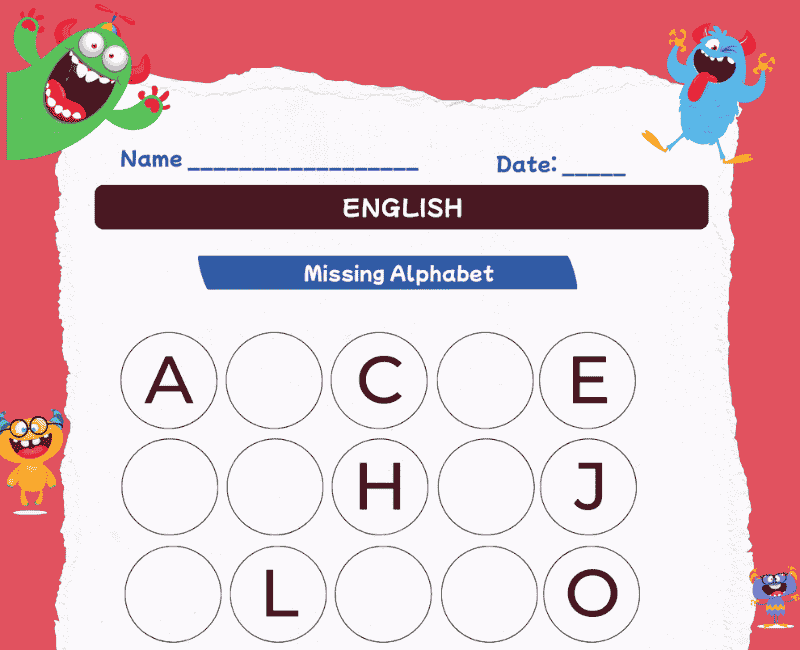
Uppercase and lowercase missing alphabet worksheets help children recognise letters and practise alphabetical order. This UKG resource is also suitable for guided Senior KG or SR KG practice. Children notice the letters around a gap, identify the missing letter and choose the required capital or small form. Begin with a short sequence before using longer alphabet rows.
Letter recognition and sequence recall are different skills. A child may recognise M on a card but need help remembering which letter comes before it. Another child may sing the alphabet song yet find a single letter difficult to name. Combine missing-letter practice with mixed-order letter finding and capital-small matching so each skill gets attention.
Use uppercase and lowercase models clearly. Uppercase R and lowercase r are two written forms of the same letter, even though their shapes differ. Lowercase b and d are different letters. Size alone does not determine a letter’s case: a small printed capital is still uppercase. Use the visible form and a consistent handwriting model when discussing examples.
For a missing capital letter worksheet, begin with a small group such as G, H, blank, J. Name the known letters, follow the alphabet sequence and place the missing card. Then explore a similar lowercase task with a different group. A full alphabet strip can support a child who is not ready to recall the sequence without a model.
Mixed-case rows add another step. Children must recognise the letter identity even when capital and small forms alternate. Keep the requested form explicit: a task asking for a capital needs the uppercase form. Not every mixed-case activity is a handwriting exercise; some focus on finding the next letter or connecting two forms of one letter.
Movable cards provide useful practice beyond selecting an answer. Children can build a letter train, deliver a lowercase envelope to its capital mailbox or repair a misplaced sequence. A two-row bridge connects the same alphabet gap across both cases. These activities invite children to explain the neighbouring letters and revise their choices.
The online missing alphabet quiz includes twenty questions, while the ten games offer matching, memory, ordering, sorting, route planning and tracing. The drawing board includes capital and small letters, with red and black pens. Its dotted outlines are visual models rather than stroke-order instructions; an adult should demonstrate the classroom handwriting approach and review writing.
Use these missing letters worksheets for UKG alongside picture books, letter cards and paper practice. Alphabet order is not the same as spelling a word, so explain when a task changes from an alphabet row to word reading. Keep sessions short and choose a manageable selection. Access the printable PDF through the existing download option on this page, then revisit any difficult letters through a playful activity.
💬 Missing Alphabet Worksheet FAQs
😊 What are missing alphabet worksheets?
They show letter sequences with gaps. Children use alphabetical order to identify the missing letters and practise recognising their written forms.
😊 How do I teach missing letters to a UKG child?
Use a short letter strip, name the visible letters and model finding the gap. Let the child place a card, then try a new sequence with support.
😊 What is the difference between uppercase and lowercase letters?
They are capital and small forms of the same alphabet letters, such as R and r. Their shapes can differ, and size alone does not determine case.
😊 Should children practise capital and small letters together?
Show how the two forms relate, while keeping each task manageable. Start with clear examples and introduce mixed-case rows when the child is comfortable.
😊 Why can a child sing the alphabet but struggle with missing letters?
Reciting a memorised sequence and recognising individual letters are different skills. Practise finding letters in mixed order as well as placing them in a sequence.
😊 Can my child use an alphabet chart?
Yes. A chart or movable strip can provide support. Gradually reduce help when the child is ready and revisit a small group rather than guessing.
😊 How can I help with b and d confusion?
Compare clear models, name each letter and discuss their visible differences. Use the handwriting method taught in class and revisit without rushing.
😊 Are missing alphabet letters and missing letters in words the same task?
No. Alphabet gaps use the conventional A-to-Z sequence. Word gaps require knowledge of the word and its spelling or sound-letter relationships.
😊 Do the online activities check handwriting automatically?
No. An adult reviews tracing and letter formation. The quiz and matching games check selected responses separately.
😊 Where can I download uppercase and lowercase missing alphabet worksheets?
Use the existing download option on this page for the printable resource. The quiz and activities offer additional practice.
 Download