Good Habits: Small Choices, Caring Actions! 🌈
Explore polite words, fair turns and caring for belongings with a quiz, 10 interactive tasks and five practice sets.
📝 Good Habits Online Quiz for SR KG
Question 1 of 20 • Answered: 0/20
📚 A borrowed storybook
A classmate lends you a storybook. Which reply shows appreciation?
🎮 Good Habits Online Games
Build a polite request, practise borrowing and returning, match words and share turns. Choose one game at a time.
1. 💬 Build a Polite Request
Use all four pieces to build: Please may I borrow the blue crayon?
Your request will appear here.
Ready to play!
2. 🤝 Borrow and Return Role Play
In this pretend story, a friend agrees to lend a puzzle. Follow the message one step at a time.
Ask if you may borrow the puzzle.
Ready to play!
3. 🃏 Manners Pair Memory
Match each phrase with its example situation: Hello/greeting, Thank you/receiving help, Excuse me/passing politely, Sorry/acknowledging a mistake.
Find four phrase-and-situation pairs.
4. 🧺 Helpful Choice or Needs a Change?
Sort the actions. We are discussing choices, not labelling a whole child.
Ready to play!
5. 🎲 Pass the Fair-Turn Token
The agreed order is Asha → Ben → Chi, repeated twice. Tap the child whose turn is next.
Token starts with Asha.
Ready to play!
🎨 Good Habits Online Activities for UKG
Repair a conversation, return labelled belongings, design a care poster and draw a kindness card.
6. 🔧 Repair the Conversation
Match each situation with its helpful phrase. An adult can read the short clues.
Ready to play!
7. 🏷️ Return the Labelled Belongings
The labels say: Sam—blue book, Lee—green ruler, Nia—red cap. Tap an item, then its owner.
Sam: blue book • Lee: green ruler • Nia: red cap
Ready to play!
8. 📖 Make a Care-for-Books Poster
Choose three different helpful messages for a shared-book poster. Select a message, then tap a poster line.
Ready to play!
9. 🌱 Make a Small Practice Plan
Choose an action to practise and helpful support. This is a personal plan, not a behaviour score.
Your plan will appear here.
Ready to play!
10. 🖍️ Draw a Kindness Card
Choose a heart, star or speech-bubble guide. Trace or add your own picture for a kindness card. Drawing has no single correct answer.
Use the guide or add your own details. Drawing is not automatically graded.
✏️ Good Manners Online Practice for SR KG
Try five short tasks. An adult can read the clues aloud.
1. 🔎 Explore Manners Words
Choose a word and read its meaning with an adult.
Use something with permission and an agreement to return it.
Ready to explore.
2. 🔤 Build Kind or Help
Choose a word and arrange its letter tiles.
Choose letters.
Ready to explore.
3. 🧱 Build an Invitation Request
Arrange the three pieces to ask about joining a game.
Build your sentence.
Ready to explore.
4. 👂 Listen to Two Requests
Dev asks for a quiet pause. Jo asks for help finding a puzzle piece. Match the support to each stated request.
Dev: quiet pause • Jo: help finding a piece
Ready to explore.
5. 💬 Make an Encouraging Message
Choose a calm, helpful message for someone who is learning. Make a message card.
Your message will appear here.
Ready to explore.
💡 Tips for Teaching Good Habits
👩🏫 Open Parent and Teacher Tips
- Model one specific action, such as asking before borrowing.
- Use short role plays and discuss how a choice affects another person.
- Recognise effort and repair; avoid labelling children as good or bad.
- Accept spoken words, gestures, familiar languages and other ways of communicating.
- Practise a small routine with calm reminders and support.
📄 Good Habits Worksheet PDF for SR KG
📖 Read the Good Habits and Good Manners Learning Guide
🤝 Teach actions that children can practise
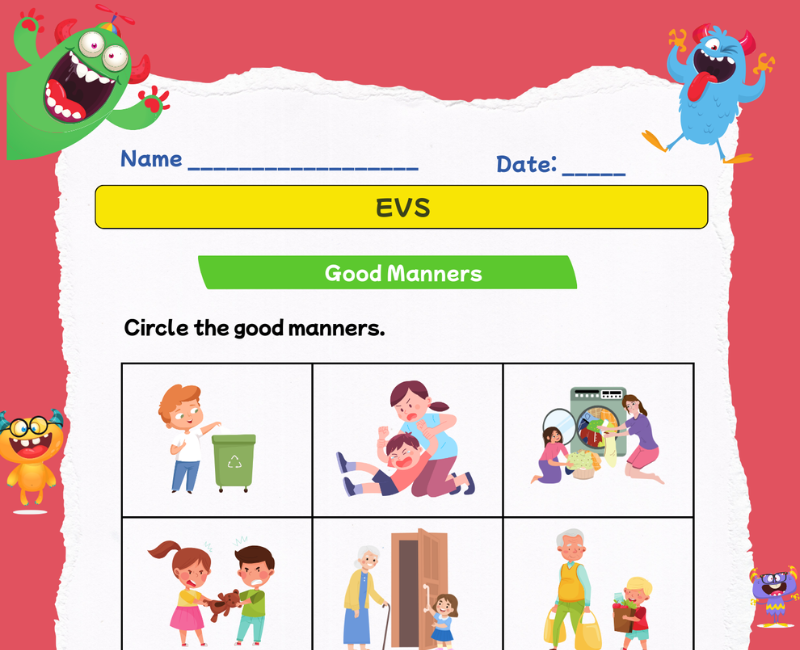
A good habits worksheet for UKG helps children explore everyday choices through pictures, stories and conversation. Focus on an observable action: ask before borrowing, listen to an explanation, return a shared item or make room for another person. A good manners worksheet for SR KG can connect polite words with meaningful actions rather than asking children to memorise a long list.
💬 Connect polite words with context
Practise please, thank you, excuse me and sorry through short situations. A child can ask for a pencil, thank someone for explaining a game or acknowledge an accidental mistake. Words alone do not complete the lesson: returning an item, changing an action and helping repair damage also matter. Welcome familiar languages and comfortable ways of greeting or responding.
🎲 Make turn-taking clear
Good habits online activities can make an agreement visible with a turn token or a short sequence. Name the agreed order and show when the turn changes. Ask before taking over someone’s work, and respect a child who prefers a wave to a hug. Children may need different amounts of time or support to communicate. Listening does not require every child to sit or look the same way.
🌱 Support practice without shame
A good and bad habits worksheet may use contrasting actions, but an action should not become a label for the whole child. Discuss what happened, who was affected and what might help next. Model a calm reminder and offer another chance to practise. Habits develop through repeated opportunities; forgetting once does not erase earlier effort.
🎮 Combine printable and online activities
The good habits online quiz for SR KG contains twenty original questions with review after submission. Ten separate tasks and five practice sets explore conversation, borrowing, sorting, memory, fair turns, responsibility and drawing. Use the existing download option for the printable good habits worksheet PDF. Extend learning with My School online activities, My Family online games and cleanliness practice.
Adult reference: UNICEF guidance on positive parenting in the early years.
❓ Good Habits Worksheet FAQs
💬 What are good habits for SR KG children?
Useful examples include asking before borrowing, returning belongings, taking turns, speaking honestly, caring for shared materials and asking for help.
💬 What is the difference between good habits and good manners?
A habit is an action practised regularly. Manners are considerate ways of interacting, such as thanking someone or making a respectful request. The two can overlap.
💬 How can I teach good manners to UKG children?
Model one action, use a short role play and give children opportunities to practise. Explain why the action helps rather than only naming a rule.
💬 Which polite words can young children practise?
Please, thank you, excuse me and sorry are useful examples. Practise them in meaningful situations and welcome equivalent words in familiar languages.
💬 How can I teach taking turns?
Agree on a simple order and make it visible with picture cards or a token. Explain when a turn finishes and support children while they wait.
💬 Does saying sorry always make a mistake right?
Not by itself. Acknowledging what happened, changing the action and helping repair harm where possible make an apology more meaningful.
💬 Should a child always give up a personal toy when asked?
No. Teach asking, listening to the answer and making an agreed plan. Taking turns with a shared class resource is different from demanding someone’s personal belongings.
💬 Can a child greet someone without hugging?
Yes. A wave, spoken greeting, sign or another comfortable response can be friendly. Respect the child’s choice about physical contact.
💬 What if a child keeps forgetting a routine?
Use a calm, specific reminder, make the next step clear and practise together. Adjust the task or support instead of judging the child.
💬 Can children join without reading or speaking fluently?
Yes. An adult can read the prompts while the child points, arranges cards, draws or uses another communication method.
💬 Are the good habits games different from the quiz?
Yes. The quiz uses multiple-choice questions. Games use sentence construction, role play, matching, sorting, fair-turn tokens, poster design and drawing.
💬 Where can I download the good habits worksheet PDF?
Use the existing download option on this page. The online quiz, games and practice sets provide additional learning alongside the printable worksheet.
 Download