Class 9 Advanced Maths · Logarithms Worksheet
Logarithms Class 9 Advanced Maths Worksheet with Online Quiz, Games and Activities
How does a logarithm undo a power, and why do scientists measure earthquakes and acidity on log scales? Find out with this Logarithms worksheet for Class 9 Advanced Maths: take the Logarithms Class 9 online quiz, climb a ladder of powers in hands-on activities, try three maths experiments in the Virtual Lab and play interactive games online.
Flip the cards and try the Log Ladder Lab, then tap the Games, Labs, Challenges or Virtual Lab button.
Logarithms Class 9 Online Quiz
20 questions · tap an answer to move on · full review at the end
Flip the cards, try the Log Ladder Lab, then play the games, do the labs and take the challenges. Earn up to 3 stars in every activity.
Fact cards: tap a card to flip it
Log Ladder Lab
Three logarithms to find with your hands. Change the power with the buttons and watch the ladder of powers until it reaches the target number, then press Check. A wrong choice shows what goes wrong, so you can try again.
Challenge marks: 0 / 15 (0 of 5 challenges done)
Finish all 5 challenges to see your comment.
Virtual Lab: do real experiments step by step
Practice sheet
Logarithms Class 9 Advanced Maths Activities
Climb the Log Ladder Lab, sort logs by value, combine logs with the laws, solve log equations, count digits and use log scales, then fold paper, build a log ruler and halve a strip in the Virtual Lab. Earn up to 3 stars in every activity.
Logarithms in Class 9 Advanced Maths
A logarithm answers the question: to what power must a base be raised to give a number? logb a = x means bˣ = a. So log₂ 32 = 5 because 2⁵ = 32, and log₁₀ 0.01 = −2 because 10⁻² = 0.01. The base must be positive and not 1, and the number must be positive.
Laws of logarithms
The product rule log MN = log M + log N, the quotient rule log (M/N) = log M − log N and the power rule log Mᵏ = k log M turn multiplication, division and powers into addition, subtraction and multiplication. The change of base rule logb a = log a ÷ log b links logs of different bases.
Solving equations and log scales
To solve a log equation, combine the logs, change to exponential form, solve, and reject roots that make an argument zero or negative. Log scales such as pH, the Richter scale and decibels squeeze huge ranges of numbers into small, easy numbers.
Logarithms Class 9 Advanced Maths
A logarithm is the power to which a fixed number, called the base, must be raised to give another number. If bˣ = a, then x = logb a, read as “log of a to the base b”. For example, 2⁵ = 32, so log₂ 32 = 5. Logarithms were introduced by the Scottish mathematician John Napier in 1614 to turn long multiplications into simple additions, and for centuries scientists used log tables and slide rules built on this idea.
Conditions for a logarithm
logb a is defined only when a > 0, b > 0 and b ≠ 1. The logarithm of zero or of a negative number is not defined because a positive base raised to any power is always positive. Base 1 is not allowed because 1 raised to any power is 1.
Types of logarithms
| Type | Base | Written as | Example |
|---|---|---|---|
| Common logarithm | 10 | log a | log 1000 = 3 |
| Natural logarithm | e ≈ 2.718 | ln a | ln e = 1 |
| Binary logarithm | 2 | log₂ a | log₂ 64 = 6 |
Laws of logarithms
| Law | Formula | Example |
|---|---|---|
| Product | logb MN = logb M + logb N | log 2 + log 5 = log 10 = 1 |
| Quotient | logb (M/N) = logb M − logb N | log₂ 64 − log₂ 8 = log₂ 8 = 3 |
| Power | logb Mᵏ = k logb M | log 8 = 3 log 2 |
| Change of base | logb a = log a ÷ log b | log₄ 8 = 3/2 |
| Special values | logb 1 = 0, logb b = 1, blogb a = a | 5log₅ 13 = 13 |
Solving logarithmic equations
Combine the logs into a single log, change to exponential form, solve the resulting equation and then check every root. For log₂ (x − 3) + log₂ (x + 1) = 5 we get (x − 3)(x + 1) = 32, so x = 7 or x = −5. The value −5 makes an argument negative, so it is an extraneous root and is rejected.
Counting digits
The whole-number part of log N is called its characteristic. A number N greater than 1 has (characteristic + 1) digits. Since log 3⁴⁰ = 40 × 0.4771 = 19.084, the number 3⁴⁰ has 20 digits.
Logarithmic scales
| Scale | Formula or rule | Meaning |
|---|---|---|
| pH of a solution | pH = −log [H⁺] | pH 3 is 1000 times more acidic than pH 6 |
| Richter scale | each unit = 10 times stronger | magnitude 8 is 1000 times magnitude 5 |
| Decibels | L = 10 log (I/I₀) | doubling intensity adds about 3 dB |
Worked examples
Example 1. Simplify 3 log 2 + log 5 − log 4: this is log (8 × 5 ÷ 4) = log 10 = 1.
Example 2. Solve log₃ x + log₉ x + log₂₇ x = 11/2: (1 + 1/2 + 1/3) log₃ x = 11/2, so log₃ x = 3 and x = 27.
Example 3. Bacteria doubling every hour from 500 reach 64000 when 2ᵗ = 128, so t = log₂ 128 = 7 hours.
Common mistakes
| Mistake | Correct idea |
|---|---|
| log (M + N) = log M + log N | The product rule is for log (MN). |
| log (M/N) = log M ÷ log N | It is log M − log N. |
| Keeping every root | Reject roots that make an argument zero or negative. |
| (1/3) logb x = ∛x | It equals logb ∛x. |
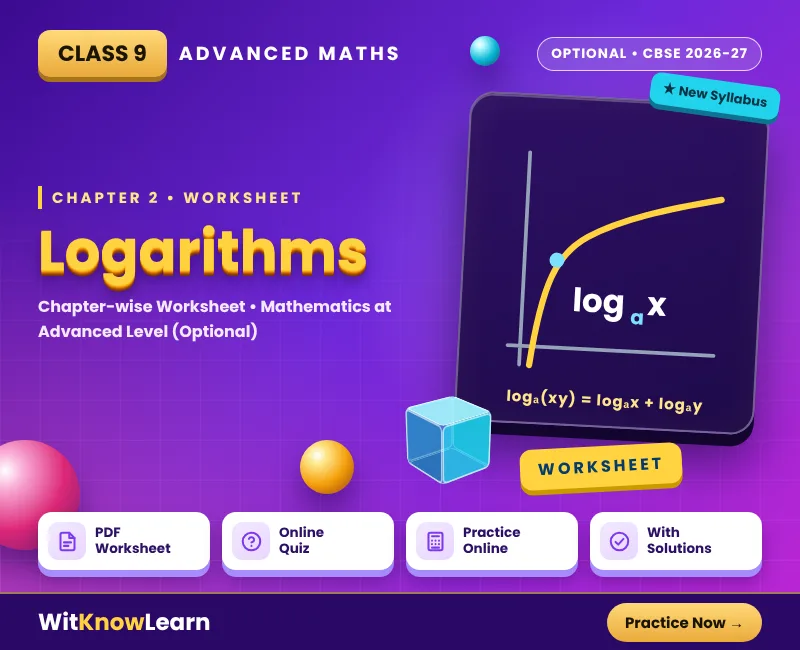
The graphs of y = log x and y = 10ˣ are mirror images in the line y = x, because logarithms and exponents undo each other. Step by step solutions for every exercise of this chapter are linked below.
Related Class 9 Advanced Maths Solutions
- Logarithms Class 9 Advanced Maths Solutions
- Sets Class 9 Advanced Maths Solutions
- Relations and Functions Class 9 Advanced Maths Solutions
- Coordinate Geometry Class 9 Advanced Maths Solutions
- Combinatorics Class 9 Advanced Maths Solutions
- Progressions Class 9 Advanced Maths Solutions
- The World of Numbers Class 9 Solutions
- Algebraic Identities Class 9 Solutions
Frequently Asked Questions
 Download