Class 9 Advanced Maths · Relations and Functions Worksheet
Relations and Functions Class 9 Advanced Maths Worksheet with Online Quiz, Games and Activities
When is a relation a function, and how does a graph move when the rule changes? Find out with this Relations and Functions worksheet for Class 9 Advanced Maths: take the Relations and Functions Class 9 online quiz, slide graphs in hands-on activities, try three maths experiments in the Virtual Lab and play interactive games online.
Flip the cards and try the Graph Shift Lab, then tap the Games, Labs, Challenges or Virtual Lab button.
Relations and Functions Class 9 Online Quiz
20 questions · tap an answer to move on · full review at the end
Flip the cards, try the Graph Shift Lab, then play the games, do the labs and take the challenges. Earn up to 3 stars in every activity.
Fact cards: tap a card to flip it
Graph Shift Lab
Three graphs to match with your hands. Shift the blue graph left, right, up or down with the buttons until it lies exactly on the dashed target, then press Check. A wrong choice shows what goes wrong, so you can try again.
Challenge marks: 0 / 15 (0 of 5 challenges done)
Finish all 5 challenges to see your comment.
Virtual Lab: do real experiments step by step
Practice sheet
Relations and Functions Class 9 Advanced Maths Activities
Shift graphs in the Graph Shift Lab, sort relations into functions and non-functions, feed inputs into function machines, find domains and ranges and spot graph shifts, then draw arrow diagrams, plot y = |x| and measure a spring in the Virtual Lab. Earn up to 3 stars in every activity.
Relations and Functions in Class 9 Advanced Maths
An ordered pair (a, b) has a first and a second entry, so (2, 3) ≠ (3, 2). The Cartesian product A × B is the set of all ordered pairs (a, b) with a ∈ A and b ∈ B, and n(A × B) = n(A) × n(B). A relation from A to B is any subset of A × B; its first entries form the domain and its second entries form the range.
Functions
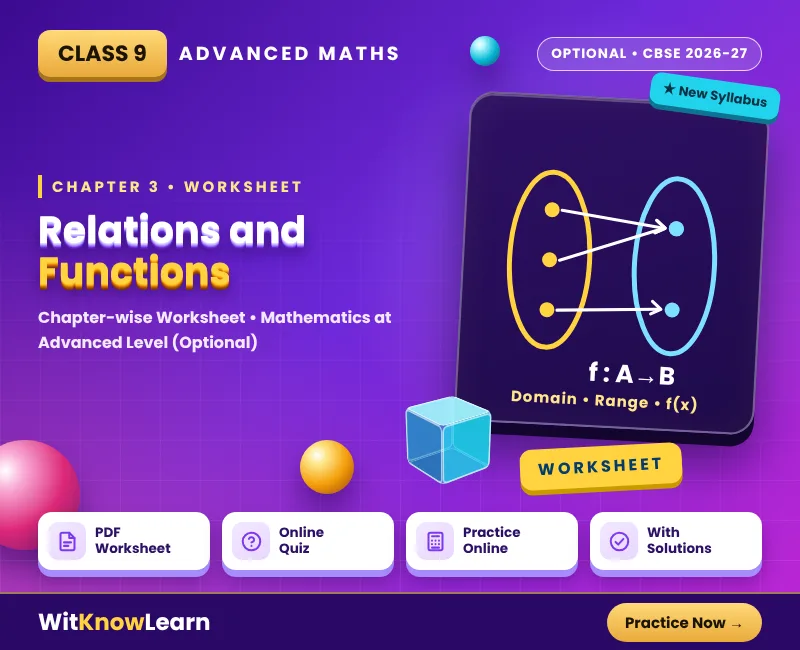
A function f : A → B is a relation in which every element of A has exactly one image in B. Two elements may share an image, but no element may have two images or none. In an arrow diagram exactly one arrow leaves each element of A.
Graphs and shifts
The graph of y = |x| is a V with vertex (0, 0) and the graph of y = x² is a parabola with lowest point (0, 0). The graph of y = f(x − h) + k is the graph of y = f(x) moved h units right and k units up, without changing its shape.
Relations and Functions Class 9 Advanced Maths
An ordered pair (a, b) is a pair of objects written in a fixed order. The Cartesian product of two non-empty sets A and B, written A × B, is the set of all ordered pairs (a, b) with a ∈ A and b ∈ B. If A = {1, 2} and B = {x, y}, then A × B = {(1, x), (1, y), (2, x), (2, y)}. The product is named after the French mathematician René Descartes, who also introduced the coordinate plane, which is simply R × R.
Relations
A relation R from A to B is any subset of A × B. If (a, b) ∈ R we say a is related to b. The set of first entries is the domain, the set of second entries is the range, and B is the co-domain. Since A × B has n(A) × n(B) elements, there are 2^(n(A) × n(B)) relations from A to B.
| Type of relation | Meaning | Example on A = {1, 2, 3} |
|---|---|---|
| Empty relation | no pair satisfies the rule | {(a, b) : a + b = 10} |
| Universal relation | R = A × A | {(a, b) : a + b ≤ 6} |
| Identity relation | {(a, a) : a ∈ A} | {(1, 1), (2, 2), (3, 3)} |
Functions
A function f from A to B is a relation in which every element of A has exactly one image in B. We write f : A → B and f(a) = b, where b is the image of a and a is a pre-image of b. A relation is a function when no two different pairs have the same first entry. There are n(B)^n(A) functions from A to B.
Important functions and their graphs
| Function | Graph | Domain | Range |
|---|---|---|---|
| Identity f(x) = x | line through O at 45° | R | R |
| Constant f(x) = c | horizontal line | R | {c} |
| Modulus f(x) = |x| | V-shape, vertex (0, 0) | R | [0, ∞) |
| Square f(x) = x² | parabola opening up | R | [0, ∞) |
| Cube f(x) = x³ | S-shaped curve | R | R |
| Reciprocal f(x) = 1/x | two branches | R − {0} | R − {0} |
Shifting graphs
The graph of y = f(x) + k is the graph of f moved k units up (down if k is negative). The graph of y = f(x − h) is moved h units right when h > 0 and left when h < 0. Together, y = f(x − h) + k moves the point (0, 0) of y = |x| or y = x² to (h, k). For example, y = |x − 2| − 1 has its vertex at (2, −1).
Worked examples
Example 1. If (x − 2, 7) = (3, y + 1), then x − 2 = 3 and 7 = y + 1, so x = 5 and y = 6.
Example 2. f(x) = ax + b with f(0) = 3 and f(2) = 11 gives b = 3 and a = 4, so f(5) = 23.
Example 3. The domain of f(x) = √(5 − x) is all x with 5 − x ≥ 0, that is (−∞, 5].
Common mistakes
| Mistake | Correct idea |
|---|---|
| (2, 3) = (3, 2) | Ordered pairs depend on order. |
| Two inputs with one image is not a function | That is allowed; one input with two images is not. |
| y = (x + 1)² moves right | It moves 1 unit left. |
| Range of x² is R | The range is [0, ∞). |
Functions are used everywhere: a cab fare depends on distance, the length of a spring depends on the weight, and a mobile bill depends on data used. Step by step solutions for every exercise of this chapter are linked below.
Related Class 9 Advanced Maths Solutions
- Relations and Functions Class 9 Advanced Maths Solutions
- Sets Class 9 Advanced Maths Solutions
- Logarithms Class 9 Advanced Maths Solutions
- Coordinate Geometry Class 9 Advanced Maths Solutions
- Combinatorics Class 9 Advanced Maths Solutions
- Progressions Class 9 Advanced Maths Solutions
- Class 9 Coordinates Solutions
- Algebraic Identities Class 9 Solutions
Frequently Asked Questions
 Download