Class 9 Advanced Maths · Sets Worksheet
Sets Class 9 Advanced Maths Worksheet with Online Quiz, Games and Activities
How do Venn diagrams turn survey data into answers, and why does a set with n elements have 2ⁿ subsets? Find out with this Sets worksheet for Class 9 Advanced Maths: take the Sets Class 9 online quiz, fill Venn diagrams in hands-on activities, try three maths experiments in the Virtual Lab and play interactive games online.
Flip the cards and try the Venn Region Lab, then tap the Games, Labs, Challenges or Virtual Lab button.
Sets Class 9 Online Quiz
20 questions · tap an answer to move on · full review at the end
Flip the cards, try the Venn Region Lab, then play the games, do the labs and take the challenges. Earn up to 3 stars in every activity.
Fact cards: tap a card to flip it
Venn Region Lab
Three Venn diagrams to fill with your hands. Use the buttons to set the number in each region until every given count matches, then press Check. A wrong choice shows what goes wrong, so you can try again.
Challenge marks: 0 / 15 (0 of 5 challenges done)
Finish all 5 challenges to see your comment.
Virtual Lab: do real experiments step by step
Practice sheet
Sets Class 9 Advanced Maths Activities
Fill Venn diagrams in the Venn Region Lab, sort finite, infinite and empty sets, count subsets, solve survey problems and test the laws of sets, then build subsets and run a class survey in the Virtual Lab. Earn up to 3 stars in every activity.
Sets in Class 9 Advanced Maths
A set is a well-defined collection of distinct objects called its elements. We write sets in roster form, such as {2, 4, 6}, or in set-builder form, such as {x : x is an even natural number, x ≤ 6}. A set may be empty, finite or infinite, and the number of elements of a finite set A is its cardinal number n(A).
Subsets and power sets
A is a subset of B when every element of A is also in B. The empty set is a subset of every set. The collection of all subsets of A is its power set P(A), and if n(A) = n then P(A) has 2ⁿ elements, because each element can either be in or out of a subset.
Operations and Venn diagrams
The union A ∪ B joins the elements of both sets, the intersection A ∩ B keeps the common elements, the difference A − B keeps elements of A that are not in B, and the complement A′ = U − A keeps everything outside A. Venn diagrams show these regions as parts of overlapping circles inside a rectangle for the universal set.
Counting with sets
For two finite sets n(A ∪ B) = n(A) + n(B) − n(A ∩ B). For three sets n(A ∪ B ∪ C) = n(A) + n(B) + n(C) − n(A ∩ B) − n(B ∩ C) − n(A ∩ C) + n(A ∩ B ∩ C). These formulas solve survey problems in one or two lines.
Sets Class 9 Advanced Maths
A set is a well-defined collection of distinct objects, called its elements or members. Well-defined means that for any object we can say clearly whether it belongs to the set or not. The vowels of the English alphabet, {a, e, i, o, u}, form a set; “tall students” do not, because tall is not precisely defined. Sets are named with capital letters, elements are written inside braces, and x ∈ A means x is an element of A.
Ways of writing a set
In roster form every element is listed, for example A = {2, 4, 6, 8}. In set-builder form a rule describes the elements, for example A = {x : x is an even natural number, x ≤ 8}. Order does not matter and repeated elements are written only once, so the letters of SWEET form {S, W, E, T}.
Types of sets
| Type | Meaning | Example |
|---|---|---|
| Empty set φ | no elements | {x ∈ N : x < 1} |
| Singleton set | exactly one element | {x ∈ N : x² = 16} = {4} |
| Finite set | elements can be counted to an end | factors of 100 |
| Infinite set | counting never ends | prime numbers |
| Equal sets | exactly the same elements | {1, 2, 3} and {3, 2, 1} |
| Disjoint sets | no common element | even primes and odd numbers |
| Universal set U | all elements under discussion | all students of a school |
Subsets and power sets
A is a subset of B, written A ⊆ B, when every element of A is also an element of B. The empty set is a subset of every set and every set is a subset of itself. A subset that is not equal to the whole set is a proper subset. The power set P(A) is the set of all subsets of A. If n(A) = n, then n(P(A)) = 2ⁿ, because each of the n elements is either chosen or not chosen. For A = {p, q}, P(A) = {φ, {p}, {q}, {p, q}}.
Operations on sets
| Operation | Meaning | A = {1, 2, 3}, B = {2, 3, 4} |
|---|---|---|
| Union A ∪ B | in A or B or both | {1, 2, 3, 4} |
| Intersection A ∩ B | in both A and B | {2, 3} |
| Difference A − B | in A but not in B | {1} |
| Complement A′ | in U but not in A | U − A |
Venn diagrams and laws of sets
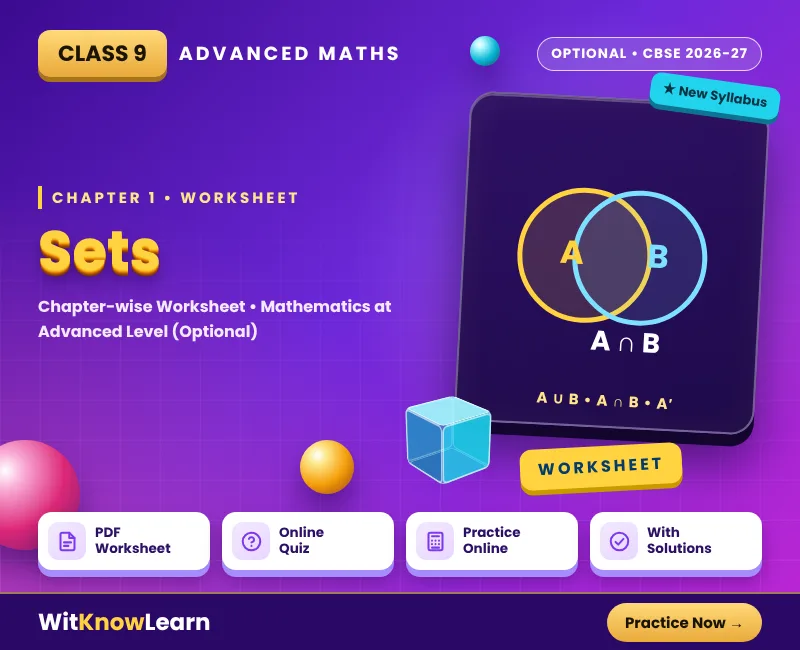
A Venn diagram, named after the English mathematician John Venn, draws the universal set as a rectangle and each set as a circle inside it. The overlapping part shows the intersection. Venn diagrams make the laws of sets easy to see: A ∪ A′ = U, A ∩ A′ = φ, (A′)′ = A, A − B = A ∩ B′, and De Morgan’s laws (A ∪ B)′ = A′ ∩ B′ and (A ∩ B)′ = A′ ∪ B′.
Counting formulas
| Formula | Use |
|---|---|
| n(A ∪ B) = n(A) + n(B) − n(A ∩ B) | two-set surveys |
| n(A − B) = n(A) − n(A ∩ B) | only A |
| n(A′) = n(U) − n(A) | outside A |
| n(A ∪ B ∪ C) = n(A) + n(B) + n(C) − n(A ∩ B) − n(B ∩ C) − n(A ∩ C) + n(A ∩ B ∩ C) | three-set surveys |
Worked examples
Example 1. In a class of 40, 25 like tea and 20 like coffee, and everyone likes at least one. Then n(T ∩ C) = 25 + 20 − 40 = 5, so 20 like only tea and 15 like only coffee.
Example 2. If n(A) = 7, the number of proper subsets of A is 2⁷ − 1 = 127.
Example 3. In a survey of 500, 285 watch football, 195 hockey, 115 basketball, 45 football and basketball, 70 football and hockey, 50 hockey and basketball, and 50 none. Then 450 = 285 + 195 + 115 − 70 − 50 − 45 + x, so x = 20 watch all three.
Common mistakes
| Mistake | Correct idea |
|---|---|
| Writing φ = {φ} | φ has no element; {φ} has one element. |
| Writing {2} ∈ {2} | {2} ⊆ {2} is true, {2} ∈ {2} is false. |
| Adding n(A) + n(B) for the union | Subtract the overlap n(A ∩ B). |
| Forgetting the centre in 3-set problems | Subtract n(A ∩ B ∩ C) from each pair first. |
Sets are the language of all later mathematics: relations, functions, probability and combinatorics are all built on them. Step by step solutions for every exercise of this chapter are linked below.
Related Class 9 Advanced Maths Solutions
- Sets Class 9 Advanced Maths Solutions
- Logarithms Class 9 Advanced Maths Solutions
- Relations and Functions Class 9 Advanced Maths Solutions
- Coordinate Geometry Class 9 Advanced Maths Solutions
- Combinatorics Class 9 Advanced Maths Solutions
- Progressions Class 9 Advanced Maths Solutions
- The World of Numbers Class 9 Solutions
- Probability Class 9 Solutions
Frequently Asked Questions
 Download