Class 1 • Science and EVS • Observe the World Around You
🌳 Our Surroundings Class 1 Worksheet
Become a surroundings explorer! Use this Our Surroundings Class 1 worksheet with an online quiz, 10 games and activities and five practice tasks. Notice plants, animals and objects, explore natural and human-made things and learn thoughtful ways to care for shared places.
📝 Our Surroundings Online Quiz for Class 1
Question 1/20 • Answered 0/20
What do we call the things and places around us?
🎮 Our Surroundings Online Games for Class 1
Sort discovery cards, design a park, remember a scene, match materials and organise things around us.
1. 🧺 Sort the Discovery Cards
Choose a card, then its correct group: natural or human-made.
Ready to play!
2. 🌷 Design a Mini Park
Choose exactly two plants, one animal and two human-made objects. Tap a selected card again to remove it.
Ready to play!
3. 👀 Remember the Window View
Observe four cards. Hide them, then choose the same four from the tray.
Ready to play!
4. 🧵 Match Materials to Objects
These objects were made from the stated materials. Match each material to its object.
Ready to play!
5. 🗂️ Build Three Discovery Shelves
Sort into living natural things, non-living natural things and human-made objects.
Ready to play!
🧩 Our Surroundings Online Activities for Class 1
Care for a virtual garden, arrange a safe response, repair labels, guide a robot and make an observation record.
6. 🌿 Care for the Virtual Garden
In this pretend scene, tap only the three pieces of litter to place them in a bin. Leave the living things alone. For real unknown waste, tell an adult.
🗑️ Virtual pieces collected: 0
Ready to play!
7. 🛡️ Arrange a Safe Response
A child notices broken glass. Order the story: notice it and stay back, tell an adult, let the adult deal with it. Swap two cards at a time.
Ready to play!
8. 🔧 Repair the Museum Labels
Each display needs two labels: where it comes from and whether it is living. Repair all three.
Ready to play!
9. 🤖 Guide the Paper-Carrying Robot
The robot carries its own paper waste. Reach the bin by tapping neighbouring path squares. Do not enter the flower bed or pond.
Ready to play!
10. 📓 Make My Observation Record
Imagine a place or observe nearby with an adult. Select the things you notice, then create a record. There is no single correct collection.
Ready to play!
✏️ Five Our Surroundings Practice Tasks
1. 🔍 Spot Natural Things
Select every natural thing in this tray.
Ready to play!
2. 🧸 Compare a Bear and a Toy
Match each description to the correct label.
Ready to play!
3. 🌱 Name the Living Natural Group
Choose a label for the whole group.
Ready to play!
4. 🪨 Check a Non-Living Natural Group
Which label fits these two things?
Ready to play!
5. 🏡 Build a Mixed Surroundings Pair
Choose one natural thing and one human-made object. More than one pair is possible.
Ready to play!
📖 Our Surroundings Class 1 Science Worksheet Guide
Read about natural things human-made objects and caring for surroundings
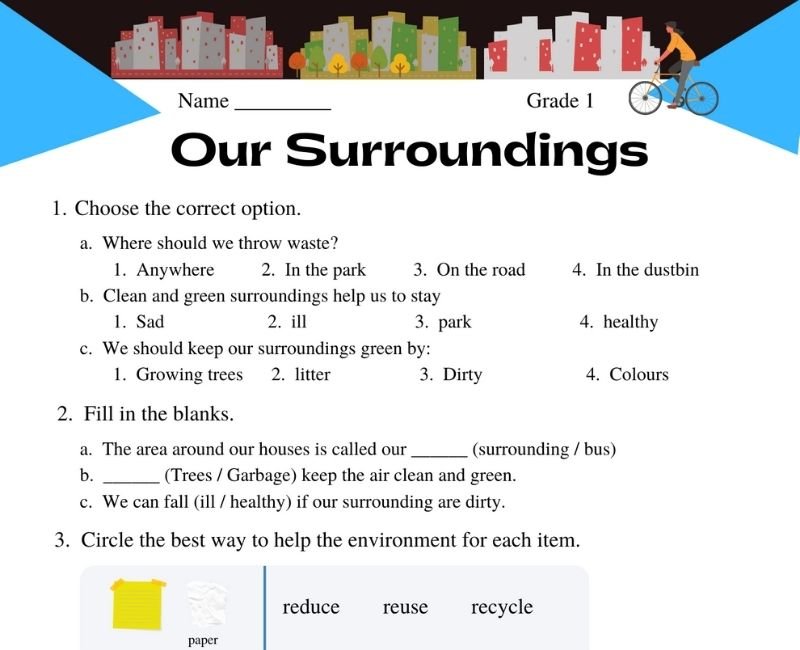
Our surroundings include the things and places around us. At home, in school or outdoors, children may notice people, plants, animals, buildings, roads, furniture and many other objects. This Our Surroundings Class 1 worksheet helps children look carefully, name familiar things and explain what they observe. Use the existing worksheet download option on this page for paper practice alongside the online quiz and games.
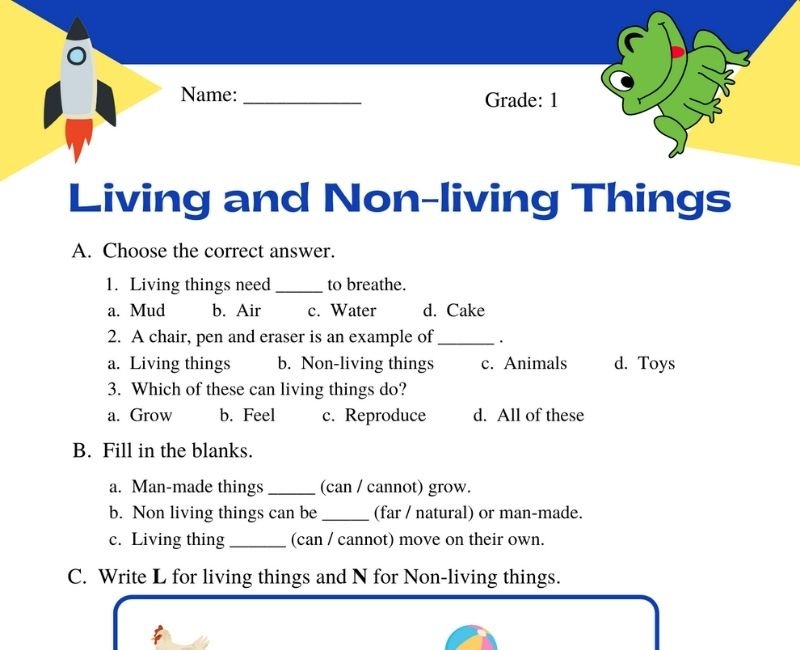
Natural things come from nature. Examples include clouds, rain, rocks, plants and animals. Human-made things are objects people make, such as school bags, tables, roads and toys. Some books use the term “man-made things” for the same idea. A wooden chair is human-made even though its wood came from a tree.
Natural and living do not mean the same thing. A butterfly is a natural living thing. A mountain is natural but non-living. A toy butterfly is human-made and non-living, even if a battery makes it move. A plant grown in a garden is still a living natural thing; people caring for it does not turn the plant into a manufactured object.
Observation is more useful than guessing. Children can describe a leaf’s colour, notice a bird on a branch or compare a real flower with a flower drawn on paper. Encourage statements supported by what they can actually see. They can also notice air moving when leaves flutter, even though air itself is usually invisible.
Keeping surroundings clean involves everyday choices. Put your own waste in the appropriate bin, care for shared objects and avoid damaging plants. Bin colours and collection rules differ between places, so follow the local labels rather than memorising a universal colour rule. Children should tell an adult about unknown waste, sharp objects or a full bin.
These Class 1 Science and EVS activities on our surroundings use sorting, matching, observation, planning and simple explanations. They support discussion at home and in class without requiring children to memorise a long definition. Revisit the same ideas through a new scene so children learn to apply them rather than repeat one answer.
💡 Tips for Exploring Our Surroundings
For Parents and Teachers
- Begin with objects the child can see nearby.
- Use separate examples for natural versus human-made and living versus non-living.
- Ask “What did you notice?” before asking for a category.
- Model care for shared spaces and let adults handle unsafe waste.
For Students
- Look carefully before answering.
- Name the object you are describing.
- Use what you observe to explain your idea.
- Remember that a moving toy is still a toy.
- Care for plants without pulling off leaves or flowers.
- Tell an adult if you notice something unsafe.
❓ Our Surroundings Class 1 Worksheet FAQs
What are surroundings for Class 1?
Surroundings are the things and places around us, such as our home, school, plants, animals, roads and nearby objects.
What are examples of natural things around us?
Plants, animals, rocks, clouds and rain are examples of natural things. Natural things can be living or non-living.
What are human-made or man-made things?
They are objects people make, such as tables, school bags, buildings and toys. Their materials may originally come from nature.
Are all natural things living things?
No. Trees and birds are living natural things, while rocks and mountains are non-living natural things.
Is a plant in a pot natural or human-made?
The plant is a living natural thing. The pot is human-made. Consider the plant and container separately.
Why is a moving toy not a living thing?
A toy may move because someone pushes it or because a battery powers it. Movement alone does not show that something is alive.
How can children help keep their surroundings clean?
Children can put their own waste in the correct bin, keep shared spaces tidy and tell an adult about unsafe waste. They should not handle sharp or unknown discarded objects.
How can I teach our surroundings through activities?
Use a short observation walk with an adult, sort picture cards, compare natural and human-made objects and ask children to describe what they actually notice.
🌳 Online Our Surroundings Quiz for Class 1
Observe carefully, explain your ideas and become a thoughtful surroundings explorer.
📝 Try the Online Quiz Download