Meet your
green neighbours.
Trees with trunks. Bushy shrubs. Soft-stemmed herbs. Vines that climb or trail. Step into the garden and see what makes each one special.
Ready for a little plant challenge?
20 questions • 10 easy, 5 average, 5 thinking
Types of Plants Class 2 Online Quiz
Question 1 of 20 • Easy • 0 answered
Which plant is shown as a tree?
The clock starts with your first answer or quiz navigation. Read Question does not start it. The timer stays inside this quiz.
THE LITTLE BOTANY STUDIO
Pick a mission. Make a discovery.
Choose a game ↓ Tap the raised cards • Swipe on mobile
PLANT EXPLORERS • Nursery Sort
Sort these five plants into their matching nursery beds.
Tap a plant, then its nursery bed. Swipe the plant row on a phone.
Types of plants explained for Class 2
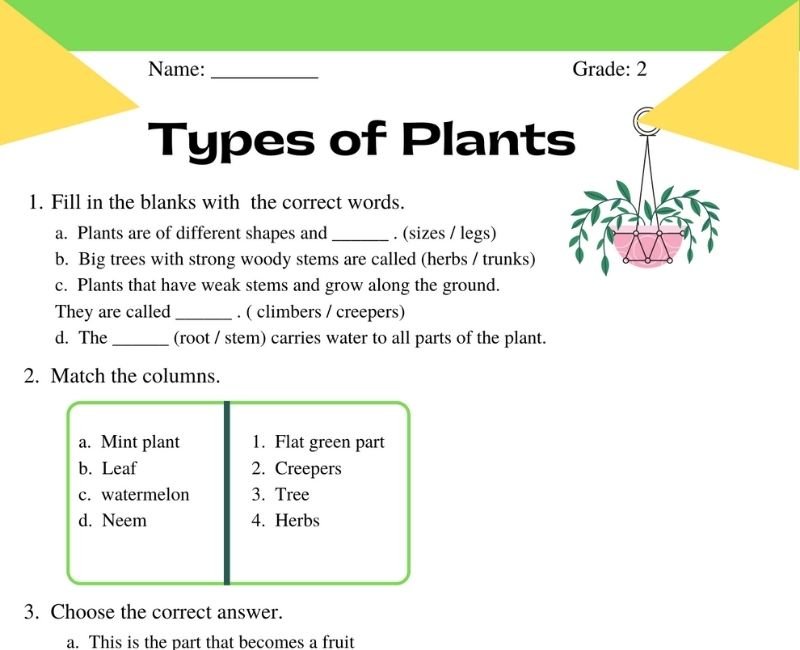
Types of Plants Class 2 Worksheet and Learning Guide
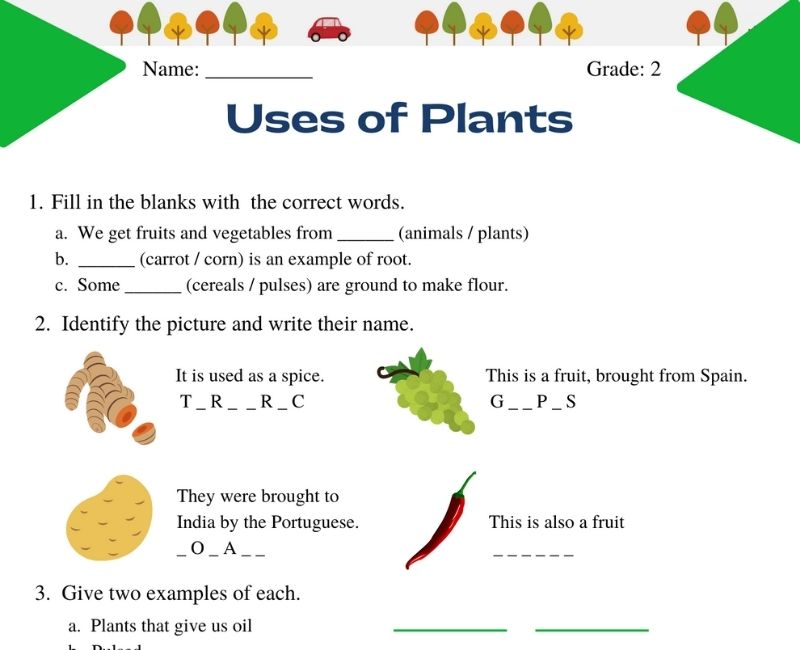
This Class 2 science worksheet introduces five familiar plant growth habits—trees, shrubs, herbs, climbers and creepers. The online games use original illustrated specimens to help children observe stems, branching and growth direction. These are general science activities, not a worksheet from a specified NCERT chapter.
Trees with woody trunks
A typical tree has a main woody trunk with branches above the ground. Mango and neem are familiar examples. Trees can grow tall, but height alone is not a reliable test. A young mango plant is still a young tree even before it becomes tall.
Shrubs and bushy plants
Shrubs are woody plants that usually have several stems branching close to the ground. Hibiscus and a bush rose are examples used here. Their bushy shape helps distinguish them from the single main trunk of a typical tree. Some rose varieties climb, so these pictures specifically show bush roses.
Herbs with soft stems
In this lesson, herbs are plants with soft, non-woody stems. Mint and coriander are examples. Many familiar herbs are small, but “small” alone does not mean “herb.” A young tree and a small woody shrub are different. Herbs also do not all have the same lifespan.
Climbers and their supports
Climbers use supports as they grow upward. A pea plant may hold a support with tendrils; other climbers use different methods. The studio shows pea plants and grapevines climbing a trellis. Climbing stems are not all soft and green—some climbers become woody.
Creepers spreading along the ground
Creepers in this beginner lesson are plants shown trailing along the ground. Pumpkin and watermelon vines are familiar classroom examples. In the trail game, the board is a top view of a ground bed. Real vines may grow differently when gardeners train them onto supports.
Difference between climbers and creepers
Look at the growth shown. A vine using support to grow upward is demonstrating climbing. A vine spreading over the ground is demonstrating trailing or creeping. Observe the stem and support instead of deciding only by whether the plant has a heavy fruit.
Parts of a plant
Roots anchor a plant and take up water and minerals. The stem supports the plant and carries materials between its parts. Leaves help the plant make food using light. Flowers are involved in reproduction, and fruits often contain seeds. The diagram game uses a simplified flowering plant so children can locate these parts clearly.
Types of plants questions and examples
Ask children to name a familiar example and explain the visible clue. For instance, “This is a shrub because it has several woody stems near the ground” is stronger than guessing from its colour. Specimen sorting, stem matching and garden planning practise that reasoning in different ways.
Hands-on plant observation
Look at a familiar plant with an adult. Observe the stem without damaging it, notice where it branches and see whether it uses a support. Sketch one useful clue. The drawings here are simplified learning illustrations and are not drawn to a common height scale.
Keep exploring Class 2 Science
Questions children often ask
What are the five common types of plants taught in Class 2?
Trees, shrubs, herbs, climbers and creepers are five familiar growth habits used in beginner lessons. They are not five separate scientific families covering every plant.
What is the difference between a herb and a shrub?
A herb has non-woody stems. A shrub is woody and usually branches near the ground.
Is every small plant a herb?
No. A young tree or a small woody shrub can also be small. Look at the stem and growth habit.
Are all rose plants shrubs?
No. Bush roses are shrub examples, but some varieties are climbing roses. These activities specifically show bush roses.
What is the main difference between a climber and a creeper?
A climber uses support to grow upward. A creeper is shown spreading along the ground in this lesson.
Are all climbers soft-stemmed plants?
No. Some climbers are herbaceous while others have woody stems. The climbing habit describes how they grow.
Which examples are used in the games?
Mango and neem trees, hibiscus and bush rose shrubs, mint and coriander herbs, pea and grape climbers, and ground-trailing pumpkin and watermelon vines.
Do the games show real-time plant growth?
No. They use simplified illustrations and models. Real plants grow over time and their needs vary.
What practice is included?
There are 10 interactive games with 50 missions and a separate 20-question quiz. Dragging has tap alternatives, and optional Read and Stop controls support listening.
Can these activities be used on a phone?
Yes. The layout adapts to smaller screens, and cards can be tapped instead of dragged.
 Download