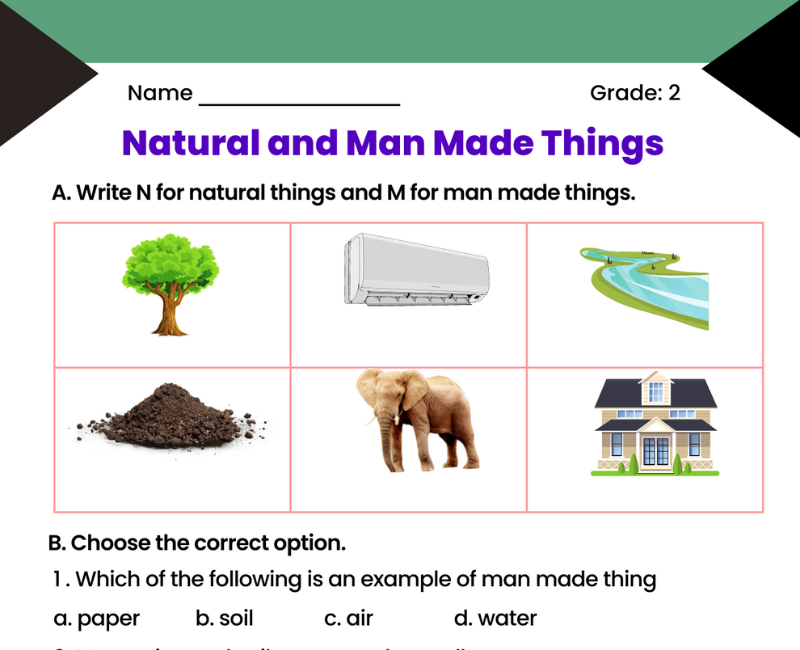
Natural and Man Made Things Class 2 Worksheet with Online Activities
Discover what occurs in nature, what people make and how natural materials become useful everyday objects.
Look closely
Explore real photos and labelled diagrams.
Listen and explain
Hear instructions and share reasons.
Read and record
Describe materials and origin evidence.
Make and investigate
Build, shape, compare and draw.
Combine the learning modes that help you. Use the existing page download option for the printable worksheet.
Natural and Man Made Things Online Quiz for Class 2
Look closely at the photographs, diagrams and tables.
7. A shirt is made from cotton fabric. What is the finished shirt?
0/20 answered
Quiz instructions
There are 20 questions and 20 minutes. The timer starts with your first answer or question navigation. Selecting an answer saves it and moves to the next question.
Revisit questions with Previous or the numbered buttons. Your choices remain selected. On the final question, choose your answer and select End Quiz.
Correct answers and explanations appear after submission or timeout. Each correct answer earns one mark, with no negative marking. Restart clears the attempt and pauses the new timer.
Natural and Man Made Things Online Games and Lab Activities
Find objects, connect materials, complete a mind map and build a shared space. Then investigate how people shape and use materials.
0/10 tasks completed
Human-Made Discovery Hunt
Learn: Identify human-made objects within a mixed discovery board.
- Only the eight named pictures are part of this hunt.
- Tap the four things made by people. You can also use Tab and Enter.
Before practical investigations
An adult chooses clean, safe materials and prepares any cutting. Use stable low supports for paper bridges and large counters. Do not handle sharp, dirty or unsafe samples.
Observe plants without damaging them. Clay models are not for food or heating. Use the supplied pictures and examples when real materials are unavailable.
Models simplify real objects. Written observations and drawings are reviewed by an adult. Work remains on this page while it stays open; copy useful records into a notebook before leaving.
Natural and Man Made Things Online Practice for Class 2
Explore GK, word puzzles, a graph and evidence-based explanations.
0/5 practice tasks completed
Natural Resources GK Windows
Learn: Explore natural resources used in manufactured products.
- Open all four fact windows.
- Explain one fact to someone.
Open a fact window.
Parent and Teacher Tips
- Ask how an example came to be, rather than sorting by colour or shape.
- Separate the finished object from the material used to make it.
- Explain that natural things include living and non-living examples.
- Accept “not yet known” when a material or making process is uncertain.
- Connect careful use, suitable reuse and safe repair with reducing waste.
Natural and Man Made Things Class 2 Worksheet Learning Guide
What Are Natural Things?
Natural things occur through natural processes. Examples include trees, animals, clouds, rivers, rocks and the Sun. Some natural things are living, while others are non-living.
A gardener may plant and water a tree, but the growing tree remains a natural living thing. Natural does not mean that people have never cared for or interacted with it.
What Are Man Made Things?
Man made things, also called human-made things, are objects people manufacture, construct or deliberately shape for use. Chairs, books, bridges, bottles and clothes are familiar examples.
This natural and man made things worksheet for Class 2 helps children explain origin through photos, sorting, material connections and observation activities.
Natural Materials and Human-Made Objects
A wooden chair is human-made even though wood comes from trees. People can use clay to make pottery and cotton fibres to make garments. A material’s source and the finished object’s origin are related but different questions.
Materials can also be manufactured. Ordinary paper is made by processing fibres, often from plants or recycled paper. Many glass products are made using silica-rich sand and other ingredients.
Natural Does Not Always Mean Living
A growing tree is natural and living. A rock is natural and non-living. A wooden chair is human-made and non-living. Use the two classification rules separately instead of assuming every natural thing is alive.
Look for Evidence
Colour, shine, smoothness and roughness alone do not establish origin. A natural pebble can be smooth, while a manufactured brick can be rough. A reliable label, a making record or an informed adult can help explain an unfamiliar object.
Using the Worksheet and Online Activities
Begin with the natural and man made things online quiz. Follow with the material-connection game and mind map. Use the paper bridge, clay model and everyday object audit to connect ideas with practical learning.
Natural and man made things Class 2 questions and answers appear in the quiz review after submission. Use the existing page Download option for printable practice.
Revise the wider topic through the things around us worksheet for Class 2 or revisit introductory examples using the our surroundings worksheet for Class 1.
Related Science Worksheets and Online Activities
Natural and Man Made Things Class 2 Worksheet FAQs
What is the difference between natural and man made things?
Natural things occur through natural processes. Human-made objects are manufactured, constructed or deliberately shaped by people.
What are five natural things and five man made things?
Natural examples include the Sun, clouds, rocks, trees and butterflies. Human-made examples include books, chairs, bags, bridges and bottles.
Are all natural things living?
No. Trees and animals are living, but rocks, water, air and the Sun are natural and non-living.
Is a wooden chair natural or man made?
The finished chair is human-made. Its wooden material came from trees, but people shaped and assembled the chair.
Is paper a natural or human-made material?
Ordinary paper is manufactured by processing fibres. Those fibres often come from plants or recycled paper, but the finished paper is made by people.
Is a plant in a garden human-made?
A growing plant remains a natural living thing even when people plant or water it. The plant and a manufactured pot should be considered separately.
Are people natural living things?
Yes. People are living things and part of nature. Human-made describes objects manufactured or constructed by people.
Can colour or texture tell us whether an object is natural?
Not reliably. Natural and manufactured examples can share colours and textures. Look for information about the material and making process.
Is a paper leaf natural because it looks like a leaf?
No. A paper leaf cut or folded by a person is a human-made model. A copied shape does not change how the object was made.
Are natural things always safe and human-made things always harmful?
No. These labels describe origin, not safety or value. Consider the actual thing, its purpose and how it is used.
What practical activity helps teach this topic?
With adult help, shape a safe material or change the form of scrap paper. Discuss the starting material, what the person changed and the resulting object.
Where are the worksheet download and online quiz answers?
Use the existing Download option on this page for the worksheet. Quiz answers and explanations appear after End Quiz or timeout.
Photo Credits and Learning References
Cotton: Katie Nichols / Alabama Extension. Wooden chair: Amitbalani. Both source files are marked CC0.
Material reference: USGS: Minerals in everyday products. Photographs load from Wikimedia Commons. A labelled illustration appears if a photograph cannot load.
 Download