🧒 Class 2 Science • Young Body Engineers
Explore bones, muscles and joints with picture questions, moving models and STEM investigations.
↓ Start exploring below.
Bones and Muscles Diagram Quiz for Class 2
Look closely at each picture before choosing.
Question 1 of 20 • Easy • Answered 0/20
Which part does label A point to?
Look at the diagram. Tap an answer to continue.
Quiz instructions
There are 20 diagram-based questions: ten easy, five average and five thinking questions. Earn one mark for each correct answer, with no negative marking.
The 20-minute timer starts with your first answer or question change. Selecting an answer opens the next question. Question 20 stays open until you end the quiz. Answers and explanations appear after End Quiz or timeout.
The diagrams are simplified learning pictures, not anatomical drawings to scale. An adult can read the questions aloud.
Bones and Muscles Online Games for Class 2
Build a working connection, curl a robot finger and assemble a supporting framework.
1. 🛠️ Build a Bending Elbow
Try both connectors with the same pull setting. Which design lets the model bend?
💡 The pin models a joint. The red band represents pulling; this is a designed model, not a force measurement.
Ready to explore.
2. 🤖 Make a Robot Finger Curl
Build movable connections, pull the cord and compare the straight and curled positions.
💡 Real tendons connect muscles to bones. A person supplies the pull in a string model.
Ready to explore.
3. 🛡️ Build the Body Protectors
Choose a protector, then choose its location. Place both structures and inspect your model.
💡 This shows location and protective structure. It does not simulate an impact.
Ready to explore.
4. 🎯 Reach the Science Stars
Move the joint in steps to reach three targets. The firm bars keep the same lengths.
Mission 1 of 3 • Joint turn 0°
💡 The step angles describe this on-screen model. You do not need to copy them with your body.
Ready to explore.
5. 🧩 Assemble the Skeleton Explorer
Choose a missing group and then its location. Watch your supporting framework grow.
Ready to explore.
Bones and Joints STEM Activities for Class 2
Predict, test, notice what changes and improve your design.
6. 💪 Explore a Muscle Team
Use the two pull actions to bend and straighten a model. Record both observations.
Straight: the model returns as the other pulling part acts.
💡 The coloured bands simplify muscle teamwork; they do not show exact muscle anatomy.
Ready to explore.
7. 🧪 Predict and Run a Fair Test
Compare locked and movable joints while keeping the bars and pull setting the same.
💡 These are programmed model results, not measurements of a real child or a laboratory force test.
Ready to explore.
8. 🌀 Build a Flexible Backbone Model
Turn a chain of four firm pieces. Compare it with the same chain locked straight.
💡 The real backbone contains many bones and other tissues. This chain explores one idea, not the full spine.
Ready to explore.
9. 🔧 Repair the Movement Machine
Inspect each fault, choose an improvement and test the repaired design.
Repair 1 of 3: Missing pull cord
Ready to explore.
10. 🎨 Design Your Own Moving Model
Draw two firm pieces, a joint and a pull cord. Explain what should move. An adult reviews your design.
Ready to explore.
0 of 10 investigations completed.
Bones and Muscles Online Practice for Class 2
Explore diagrams, count model pieces and record discoveries.
1. 🔍 Explore the Body Map
Choose a region and reveal its job. Explore all three.
Ready to explore.
2. 📏 Measure What Stays the Same
Use the two positions of the same model. Count its firm bars before and after bending.
Ready to explore.
3. 🧭 Plan a Fair Investigation
Tap the cards in order: predict, build, test, improve. Undo to revise.
Your plan is empty.
Ready to explore.
4. 📊 Read a Model Results Table
The same model was tested at three settings. Find the setting that reached the highest target.
| Setting | Joint turn | Target height |
|---|---|---|
| 1 | 0° | Low |
| 2 | 45° | Middle |
| 3 | 90° | High |
Ready to explore.
5. 📓 My Paper Model Investigation
Optional with an adult: join two card strips with a movable paper fastener, then compare with a fixed taped join. An adult prepares materials and any holes.
💡 Keep the strip lengths the same. Move the card models gently; never attach the model to a body part. You may instead describe the on-screen models.
Your observation card appears here.
Ready to explore.
0 of 5 practice tasks completed.
Bones and Muscles Learning Tips
Five Parent and Teacher Tips
- Ask for a prediction before running a model.
- Change one design feature at a time when comparing results.
- Connect model parts with bones, joints and pulling muscles.
- Accept pointing, speaking, drawing or adult-supported typing.
- Ask what a model shows well and what it leaves out.
Bones and Muscles Worksheet for Class 2
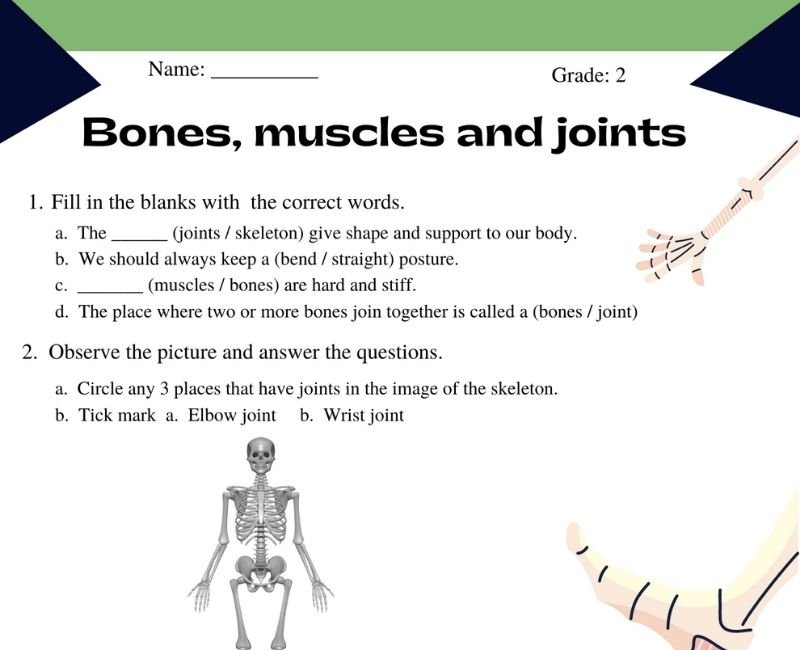
Use the existing worksheet download option on this page for printable practice. The online quiz and STEM activities are separate learning resources; the online score is out of 20.
Read the Bones and Muscles Learning Guide
Bones and muscles for Class 2
This bones and muscles worksheet for Class 2 topic connects body-part names with support, protection and movement. Children explore a skeleton diagram, identify familiar joints and investigate how a pulling action changes a model’s position. The aim is to explain what happens, rather than memorise a list without understanding.
The skeletal system for kids
The skeleton is the framework of bones inside the body. Bones help support the body, give it shape and protect important organs. The skull protects the brain. The rib cage helps protect the heart and lungs. The backbone contains many bones arranged along the back. A simple skeletal system diagram helps children connect each structure with its location and job.
For more naming practice, use the parts of the body worksheet for Class 2. Children who need an easier introduction can begin with the parts of the body worksheet for Class 1.
How bones muscles and joints work together
Muscles attached to bones pull on them to help produce movement. When a muscle contracts, it becomes shorter. Different muscle groups coordinate movement in different directions. A joint is a place where bones meet. Many joints allow movement, including elbows and knees, although not every joint moves freely.
The online arm model uses firm bars, a movable connection and a pulling band. These represent supporting bones, a joint and a pulling action. The model does not include every muscle, tendon, ligament or message from the nervous system. Its purpose is to make one relationship easier to observe.
Bones and joints activities through STEM learning
STEM activities for kids connect science with designing, testing and explaining. In the elbow investigation, children compare a movable pin with a fixed connection. Keeping the bars and pull setting the same helps them focus on the feature being changed. The robot finger model explores how connected firm pieces can curl when their angles change.
These bones and muscles activities include prediction, observation, construction, simple measurement and improvement. The model repair task asks children to identify a missing pulling part or blocked connection, install a change and test again. The design notebook welcomes original explanations rather than automatically grading a drawing.
Bones and muscles questions and answers
What is a skeleton? It is the body’s framework of bones. What do muscles do? They contract and help produce movement. Where does an arm bend? It bends at the elbow joint; its firm bones do not fold like paper. Why does the backbone have many bones? A series of connected bones supports the body while allowing movement between parts.
Human body worksheets and practical learning
Use printable human body worksheets for written revision and return to the online models when a child needs another explanation. Ask children to identify what changed, what stayed the same and which observation supports their answer. The parts of the body worksheet for Class 3 offers related extension practice.
For an optional hands-on activity, an adult can prepare two card strips and a movable paper fastener. Compare this with a fixed taped connection. Keep the strips the same length and observe the difference. Children can participate entirely on screen instead; no particular physical movement is required.
Learning about healthy growing bodies
A varied diet, suitable activity and rest support growth. Different foods provide different nutrients. Connect the lesson with the our food worksheet for Class 2 and discuss healthy habits without comparing children’s bodies or abilities.
Bones and Muscles Worksheet FAQs
What should children learn about bones and muscles in Class 2?
Begin with the skeleton, support, protection, familiar joints and how muscles help movement. Use pictures and simple models before detailed terminology.
What is the skeleton?
The skeleton is the framework of bones inside the body. It supports the body and protects important organs.
What is the difference between bones and muscles?
Bones are hard supporting structures. Muscles are softer tissues that can contract and help produce movement.
How do bones muscles and joints work together?
Muscles pull on attached bones. Many joints allow those bones to move relative to each other.
Which bones protect the brain heart and lungs?
The skull protects the brain. The rib cage helps protect the heart and lungs.
Where are the elbow and knee joints?
An elbow is in an arm. A knee is in a leg.
Does a bone fold when an arm bends?
No. The bones stay firm while their positions change at the elbow joint.
Why use a moving arm model?
It makes the relationship between firm support, a moving connection and a pulling action easier to observe. It simplifies the real body.
What makes an investigation a fair comparison?
Change the feature you want to investigate while keeping other relevant features the same. For these models, compare the connectors using equal bar lengths and the same pull setting.
Are the model results real measurements?
No. These are designed on-screen models. Their movement illustrates specific ideas rather than measuring real muscles or forces.
Can children learn without performing the movements?
Yes. They can use the controls, point to pictures, speak or work with an adult. Physical imitation is optional.
Where are the printable worksheet and quiz answers?
Use the existing download option for the printable resource. The separate online quiz shows answers and explanations after End Quiz or timeout.
 Download