CLASS 2 SCIENCE • THE AIR DISCOVERY LAB
Air Around Us Class 2 Worksheet
with Online Activities and Quiz
Catch the clues of invisible air. Investigate a trapped-air cup, compare a paper strip and steer a model sailboat. Then solve a fresh picture quiz about everyday air discoveries.
Air Around Us Class 2 Online Quiz
Question 1 of 20 • Easy • Answered 0/20
An adult adds air to pouch B and closes it. Why does B become fuller?
Look at the picture. Tap an answer to continue.
Quiz instructions
Answer 10 easy, five average and five thinking questions in 20 minutes. The timer starts with your first answer or move to a different question. Answers advance automatically except on Question 20. Use the numbered buttons to review and change choices. End Quiz or timeout reveals your score, unanswered questions and explanations. Restart clears answers and pauses the timer.
Air Discovery Games
1. 🕵️ Hunt for Moving-Air Clues
Tap the three labelled clues showing effects of moving air. A still bench is not evidence of wind.
Tap the picture to begin.
2. 🥤 Investigate the Trapped-Air Cup
Predict, lower the inverted cup and then tilt it. This is a simplified on-screen model.
Tap the picture to begin.
3. 🎏 Follow the Ribbon Direction
Read the ribbon picture and choose where the air is moving toward. We use left and right, not compass wind names.
Tap the picture to begin.
4. 🧠 Complete the Air Uses Mind Map
Choose each picture and connect it with the matching use or effect of air.
Tap the picture to begin.
5. 🃏 Match Air Clues and Ideas
Reveal two cards to pair a picture with its lesson idea. Find four pairs.
Tap the picture to begin.
Air Around Us Online Activities
6. 📏 Compare the Paper-Strip Model
Try Off, Low and High. Keep the model strip and fan position fixed. Then choose the observation that matches the model.
Tap the picture to begin.
7. ⛵ Move the Model Sailboat
Place the virtual fan on the side that pushes the boat toward the target.
Tap the picture to begin.
8. 🔬 Set Up a Fair Airflow Test
We want to change only the airflow setting. Choose the three conditions to keep the same, then check.
Tap the picture to begin.
9. 🏘️ Improve the Air-Care Street
Choose three helpful actions in the street plan. These reduce sources or care for the environment; they do not prove the air is pollution-free.
Tap the picture to begin.
10. 📒 Read the Wind Observation Log
Inspect all three trial pictures, then tap the number of trials showing a moving flag. These are illustrated records, not local weather measurements.
Tap the picture to begin.
0 of 10 missions completed.
About the air models
Games and activities share one active main workspace. Extra practice is independent. These simplified models illustrate ideas rather than measure real airflow, weather or air quality. Real outcomes depend on materials and conditions. An adult should supervise practical work and manage fans and water. Keep loose objects and fingers away from fan blades.
Air Around Us Extra Practice
1. 🧩 Complete the Air Evidence Map
Connect each pictured example with the idea it supports.
Tap the picture to begin.
2. 🔧 Repair the Air Facts
Replace three mistaken statements with careful science facts.
Tap the picture to begin.
3. 💭 Sort Predictions and Observations
A prediction says what may happen. An observation describes what was noticed. Read each note.
Tap the picture to begin.
4. 🤝 Plan a Safe Air Investigation
Choose three suitable parts of a supervised paper-strip investigation.
Tap the picture to begin.
5. 🎨 Create an Air Learning Poster
Add picture stamps. Explain one air property and one air-care action to an adult. This is creative practice.
Tap the picture to begin.
0 of 5 practice tasks explored.
Five Parent and Teacher Tips
Ask for evidence
Ask “What changed?” and “What did you notice?” Encourage children to point to the picture or model rather than guess.
Let children predict before testing
Accept a prediction, run the model and compare it with the observation. A different result is a chance to learn.
Change one thing at a time
When comparing airflow, keep the strip, fan position and observation time fixed. Discuss why changing several things makes a result harder to explain.
Connect the worksheet with the lab
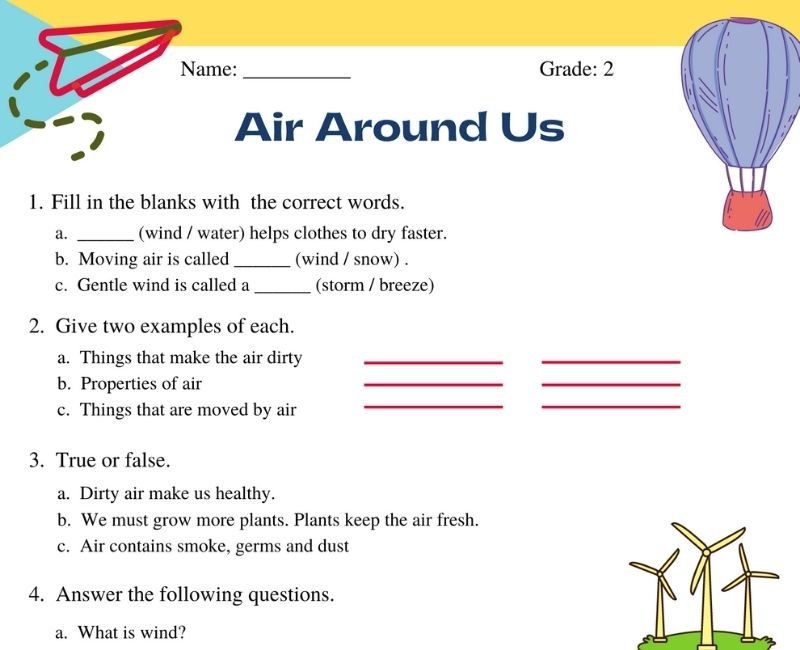
Use the worksheet download on this page for written practice. Ask the child to draw one observation and add a short explanation after an online activity.
Distinguish models from real observations
The activities illustrate ideas. If you repeat a practical task with adult help, record what actually happens rather than copying the model result.
Air Around Us Class 2 Notes and Learning Guide
What is air?
Air is a mixture of gases around us, mainly nitrogen and oxygen. We breathe air and our bodies use oxygen from it. Air is present inside ordinary rooms as well as outdoors. It usually cannot be seen directly, but its effects can be observed.
Properties of air for Class 2
Air takes up space. A pouch becomes fuller when air is added, and trapped air in an inverted cup can limit water entering. Air also has mass and can exert a push. In these Class 2 online activities, children connect visible changes with the presence of invisible air.
Moving air and everyday uses
Moving air is called wind. It can move leaves, turn a pinwheel and push against a sail. Air can be pumped into inflatable balls and tyres. Moving air can also help wet clothes dry and carry some suitably shaped seeds. These examples do not mean every seed is spread by wind or that air is the only factor in drying.
Learning through observations
A prediction describes what might happen. An observation describes what was noticed. The picture quiz uses everyday situations such as seed travel, curtains, laundry and a toy parachute. The activities use different missions, including a cup investigation, ribbon clues, a paper-strip comparison and a sailboat model.
Air pollution and air care
Smoke, vehicle exhaust and other sources can add harmful substances to air. Clear-looking air can still contain pollution. Avoiding rubbish burning and unnecessary engine idling helps reduce pollution at its source. Plants are valuable, but they cannot remove every pollutant. Children should ask an adult about local air-quality guidance.
Using the worksheet with online activities and quiz
Use this Air Around Us worksheet for Class 2 for written practice alongside the interactive missions. Revisit the Air Around Us Worksheet for Class 1 with Online Quiz for foundational examples. Extend the topic with Air Water and Weather Worksheets for Class 3.
Related Worksheets and Class 2 Science Practice
Air Around Us Class 2 Questions and Answers
What is air for Class 2?
Air is a mixture of gases around us. It contains mainly nitrogen and oxygen, with smaller amounts of other gases.
Can we see air?
We usually cannot see air itself. We can notice effects such as a moving curtain, waving flag or a pouch filling with air.
What is moving air called?
Moving air is called wind. A breeze is gently moving air.
Does air take up space?
Yes. Air occupies space. Adding air can make a closed pouch fuller or inflate a suitable ball.
Is there air in an empty-looking cup?
An ordinary cup open to the room contains air even when no liquid or solid object is visible inside it.
Why do we need air?
We breathe air. Our bodies use oxygen from it to release energy from food.
Is air only oxygen?
No. Air is a mixture. Nitrogen makes up the largest share, followed by oxygen.
What are some uses of air?
Air is needed for breathing and can fill inflatable balls and tyres. Moving air can turn pinwheels, push sails and help some seeds travel.
What is air pollution?
Air pollution is the presence of harmful substances in air. Sources can include vehicle exhaust, smoke and dust.
Does clear-looking air always mean clean air?
No. Some pollution cannot be seen. Appearance alone is not an air-quality measurement.
How can children help care for air?
Children can learn why rubbish should not be burned, discuss avoiding unnecessary engine idling with adults and care for plants. Reducing pollution sources matters.
How can I teach Air Around Us through activities?
Use picture clues, predictions and supervised comparisons. Ask children to record what changed and explain it. Combine the worksheet on this page with the online quiz and air investigations.
 Download