🌱 Class 2 Science • Plant Discovery Workshop
Pack plant foods, weave a mat and discover how plants become useful products through a picture quiz and online activities.
↓ Tap, investigate and discover below.
Uses of Plants Online Quiz for Class 2
Look at the pictures and connect plants with their uses.
Question 1 of 20 • Easy • Answered 0/20
Which picture shows fibres used to make cotton clothes?
Look at the picture and choose. Your answer opens the next question.
Quiz instructions
There are 20 questions: ten easy, five average and five thinking questions. Each correct answer earns one mark, with no negative marking.
The 20-minute timer starts with your first answer or question change. Your answers remain selected when you revisit questions. Question 20 stays open until you press End Quiz. Answers and explanations appear after submission or timeout.
An adult can read aloud. The pictures are simplified learning illustrations.
Uses of Plants Online Games for Class 2
Answer by tapping the pictures inside each scene.
1. 🧺 Pack a Plant Food Picnic
Tap three plant foods to pack the basket. Tap again to remove. Then tap Check basket inside the picture.
Tap the picture to begin.
2. 🔗 Connect Plant Sources and Products
Tap a source on the left, then its product on the right. Make three connections.
Tap the picture to begin.
3. 🥕 Harvest the Part We Eat
A recipe changes each round. Tap the plant part in the drawing that the recipe needs.
Tap the picture to begin.
4. 🧵 Build the Cotton Journey
Tap the picture tiles in the order that turns cotton fibres into a shirt. Use the on-screen Undo if needed.
Tap the picture to begin.
5. 🏠 Find Plant Materials at Home
Tap the three labelled household objects made using plant materials. Each discovery reveals its source.
Tap the picture to begin.
Uses of Plants Online Activities and STEM Learning
Move, design, process and investigate useful plant materials.
6. 🌳 Place a Tree to Shade the Bench
In this overhead-sun model, tap a ground position to move the tree. Record the bench both in sun and in shade.
Tap the picture to begin.
7. 🧺 Weave a Plant Fibre Mat
Tap each pale horizontal strip to weave it across the vertical fibres. Tap a strip again to remove it.
Tap the picture to begin.
8. 📄 Design a Paper Saving Notebook
Fill eight writing sides by tapping the front and back panels of four sheets. Watch how many sheets you use.
Tap the picture to begin.
9. 🪴 Plan Food and Fibre Beds
Choose carrot or cotton from the picture palette, then tap beds. Design four beds with two food crops and two fibre crops.
Tap the picture to begin.
10. 🌾 Run the Wheat to Roti Workshop
Tap the workshop stations in a useful order. Watch the material change from grain to food.
Tap the picture to begin.
0 of 10 tasks explored.
Uses of Plants Online Practice for Class 2
Explore more products and create your own plant-uses poster.
1. 🔍 Reveal More Plant Products
Tap each picture to discover another plant product. These are learning clues, not tasting tasks.
Tap the picture to begin.
2. 🌿 Explore Useful Plant Care
Tap the three plant-learning signs. Read each fact with an adult.
Tap the picture to begin.
3. ♻️ Choose Plant Compost Inputs
Tap the two plant materials suitable for this simple compost-input picture. Then inspect the pile.
Tap the picture to begin.
4. 🧮 Pack Two Plant Material Orders
Order 1 needs two cotton shirts. Order 2 needs three wooden chairs. Tap products into the order and inspect.
Tap the picture to begin.
5. 🎨 Make a Plant Uses Poster
Tap picture stamps to add them to your poster. Use Undo to change it. Explain your poster to an adult.
Tap the picture to begin.
0 of 5 practice tasks explored.
Uses of Plants Learning Tips
Five Parent and Teacher Tips
- Begin with familiar objects such as a cotton shirt, paper book or fruit.
- Ask “What plant material was used?” rather than assuming objects grow ready-made.
- Connect science with counting, designing, processing and reducing waste.
- Let children point, tap, speak or work with adult support.
- Use pictures for medicinal plants; do not prepare remedies or taste unknown plants.
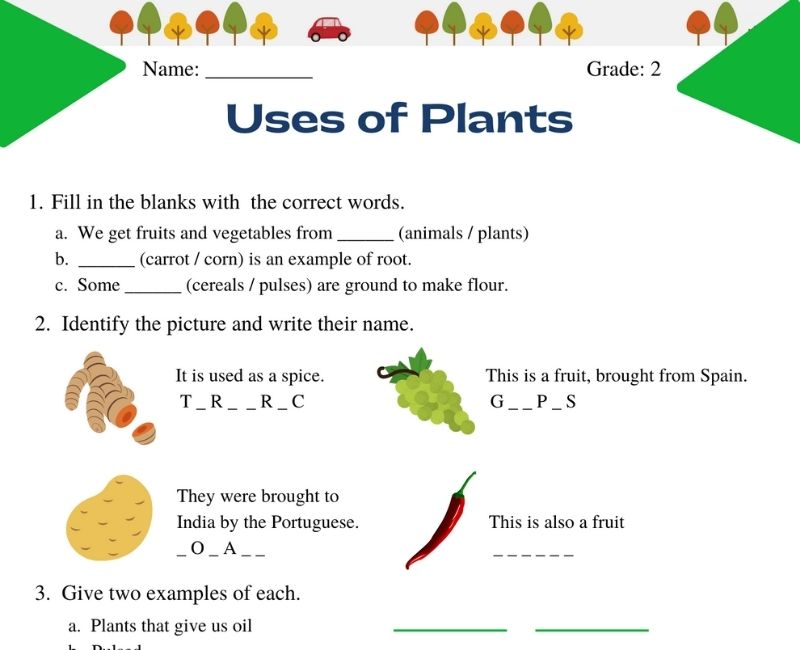
Uses of Plants Worksheet for Class 2
Use the existing worksheet download option on this page for printable practice. The online activities and quiz are separate resources; the online quiz is scored out of 20.
Read the Uses of Plants Class 2 Learning Guide
Uses of plants in our daily life
A uses of plants worksheet for Class 2 helps children notice the plant materials around them. Plants provide food, fibres, wood and substances used in many products. Trees and other plants also provide shade and habitats for animals. Begin with familiar examples, then trace a finished item back to its source.
These uses of plants online activities connect observation with practical thinking. Children pack plant foods, connect sources with products, arrange a cotton journey and plan food and fibre beds. The picture quiz checks understanding through labelled examples and simple reasoning.
Food we get from plants
Food from plants includes fruits, vegetables, grains, pulses, oils and spices. Different foods come from different plant parts. Carrots are roots, spinach provides edible leaves, mangoes are fruits, and rice grains are seeds. Lentils are seeds too. These examples help children connect the food on a plate with a growing plant.
For further practice, explore the our food worksheet for Class 2 and the food we eat worksheet for Class 2. The illustrated activities are learning models, not instructions to eat unfamiliar plants.
Cotton and jute plant fibres
Cotton and jute are useful sources of plant fibres. Cotton fibres grow around the seeds inside cotton bolls. They can be spun into yarn and made into cloth. Cotton cloth is used in many clothes and household fabrics. Jute fibres are obtained from stems and are often used in sacks, ropes and mats.
The cotton-to-shirt activity shows a simplified manufacturing journey. A shirt does not grow directly on a cotton plant. People harvest and process plant materials, make yarn and cloth, and turn those materials into finished products.
Wood paper and other plant products
Wood from trees can be used for furniture and building materials. Much paper is made using wood fibres, although paper can also use recycled fibres and other plant sources. The wooden chair and paper book activities help children identify the material in a product without assuming every chair or every household object comes from plants.
Plants also provide ingredients for products such as sunflower oil, sugar from sugar cane, tea and some perfumes. These products often need processing before use. Ask children to explain the difference between a raw material and a finished item in their own words.
Why plants are important
Plants help support life. They provide food and habitats, and they release oxygen during photosynthesis. Tree canopies can block direct sunlight and create shade. The tree-and-bench model explores shade under an overhead sun; real shadows change with the sun’s position and the shape of the tree.
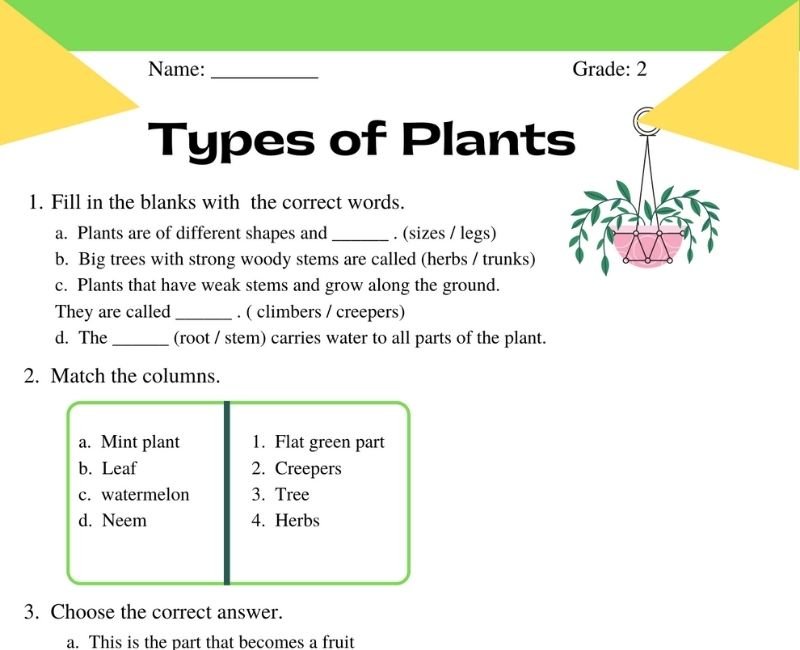
Continue the topic with the types of plants worksheet for Class 2 or the parts of a plant worksheet for Class 3. Knowing the basic parts of a plant makes it easier to discuss where useful materials come from.
STEM activities about plant uses
STEM learning connects science with designing, making and mathematical reasoning. Children weave a crossing-strip pattern, plan a small garden and count how many writing sides four sheets provide. These activities encourage testing a plan and changing it when it does not meet the task’s goal.
The garden is a planning model rather than a real crop-spacing guide. The woven mat illustrates a pattern rather than measuring strength. The paper-saving task demonstrates that using both sides of four sheets provides eight writing sides. Explain what each model shows and what would need a real investigation.
Caring for useful plants
Care for plants by giving suitable growing conditions and avoiding unnecessary damage. Use paper thoughtfully, reuse suitable materials and keep glass and plastic out of a plant-compost pile. Some plant materials can decompose under suitable composting conditions.
Some plants provide substances used in medicines, but this topic does not require children to make remedies. An adult should supervise any real gardening or material-handling activity. The online scenes allow participation without touching, tasting or collecting plants.
Uses of Plants Class 2 Questions and FAQs
What are five uses of plants for Class 2?
Plants provide food, fibres for clothing, wood, materials for paper and substances used in medicines. Trees can also provide shade and shelter for animals.
What food do we get from plants?
We get fruits, vegetables, grains, pulses, oils and spices. Examples include mangoes, carrots, rice, lentils and sunflower oil.
Which parts of plants do we eat?
We eat different parts of different food plants. Examples include carrot roots, spinach leaves, mango fruits and rice seeds.
Which plants give us fibres?
Cotton and jute are common examples. Cotton fibres are used in cloth, while jute fibres are often used for sacks, ropes and mats.
How is cotton used to make clothes?
Cotton fibres are processed and spun into yarn. Yarn is made into cloth, and cloth can be cut and sewn into clothes.
What are two uses of wood?
Wood can be used to make furniture and building parts. A wooden chair and a wooden door are familiar examples.
Is paper made from plants?
Much paper is made from wood fibres. Paper can also contain recycled fibres or fibres from other plant sources.
Which plants give us oil sugar and tea?
Sunflower seeds can provide oil, sugar cane provides sugar, and processed tea leaves are used to make tea.
What are medicinal plants?
They are plants used as sources of substances in medicines or traditional preparations. Tulsi and neem are commonly introduced as examples in early science lessons. Children should not prepare or take plant remedies as a classroom activity.
Why are plants important for people and animals?
Plants provide food, useful materials and habitats. They release oxygen during photosynthesis, and trees can provide shade and shelter.
How can I teach uses of plants through activities?
Trace familiar objects to their materials, sort plant foods, arrange a cotton-to-shirt journey, weave a paper-strip pattern and design a simple food-and-fibre garden plan.
Where are the worksheet download and online quiz answers?
Use the existing download option on this page for the printable worksheet. The separate online quiz displays correct answers and explanations after End Quiz or timeout.
 Download