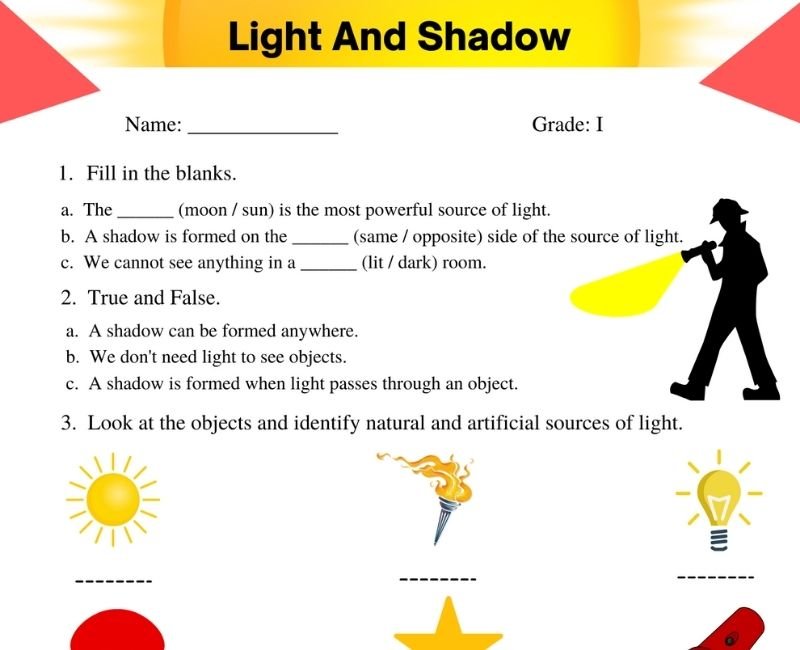
CLASS 2 SCIENCE • THE LIGHT AND SHADOW DISCOVERY LAB
Light and Shadow Class 2 Worksheet
with Online Activities and Quiz
Discover which objects produce light, test how materials affect it and investigate how shadows change. Build a small mind map, sort sources, match silhouettes, draw a scene and try five practical labs with adult help.
Light and Shadow Class 2 Picture Quiz
Question 1 of 20 • Easy • Answered 0/20
Which label marks the dark shadow on the screen?
Look at the picture. Tap an answer to continue.
Quiz instructions
Answer 10 easy, five average and five thinking questions in 20 minutes. The timer begins with your first answer or move to another question. Answers advance automatically except on Question 20. Use the numbered buttons to review and change choices. End Quiz or timeout reveals the score and explanations. Restart clears answers and pauses the timer. Optional read-aloud uses available browser speech; the written question remains available.
Light and Shadow Learning Games
Start with the function mind map and source sorting. Then use memory, drawing and a listening story to apply the ideas. Each game gives its own steps and learning goal.
1. 🧠 Build the Light-and-Shadow Mind Map
Connect each part of a shadow setup with its function.
You will learn: what the source, blocking object and surface contribute.
- Choose a picture below the small mind map.
- Tap the branch describing its job.
- Complete four links and explain why a source alone does not make every shadow.
Tap the picture to begin.
2. 🧺 Sort Natural and Human-Made Light Sources
Classify sources that produce light rather than merely reflect it.
You will learn: to distinguish natural light producers from human-made light producers.
- Drag a source card into a basket. On a phone, tap the card and then the basket.
- Classify the source itself, not where it happens to be.
- Sort all four. The Moon is not included because it reflects sunlight.
Tap the picture to begin.
3. 🃏 Object-and-Silhouette Memory Game
Pair each front-view object picture with its matching silhouette.
You will learn: that an outline can reveal shape but not every colour or detail.
- Reveal two cards.
- Match an object with the same front-view outline.
- Find four pairs, then discuss what a silhouette does not tell you.
Tap the picture to begin.
4. ✏️ Draw a Shadow Scene
Draw a source, an object and a shadow in a consistent position.
You will learn: to show the relationship between a light source, an object and a shadow.
- Place a light source on one side and an opaque object in front of a surface. Stamps can help.
- Use black to draw the shadow beyond the object, away from the light. Use red for guide lines.
- Label the source, object and shadow. Explain what blocked the light to an adult.
Tap the picture to begin.
5. 🎧 Rebuild the Puppet-Show Story
Listen or read, then order the events of a shadow investigation.
You will learn: the link between blocking light and creating a shadow.
- Listen to the story or read its transcript.
- Tap the four panels in story order.
- Explain why removing the puppet changes the screen.
Read the transcript
A torch shines onto a white screen. An opaque puppet is placed in the light path. A dark outline appears on the screen. The puppet is removed and the formerly shadowed region receives light again.
Tap the picture to begin.
Light and Shadow Online Activities and Practical Labs
Predict, change one thing and observe. Read the practical setup with an adult before trying the real investigation. Use the models to explore ideas and your notes to record actual results.
6. 📏 Shadow-Size Slider Lab
Move the object while the source and screen stay fixed.
You will learn: how object position affects a shadow on a fixed screen.
- An adult holds the torch steadily toward the screen.
- Keep the object’s size and the source and screen positions unchanged.
- Move the object toward the torch, then toward the screen.
- Compare the shadow sizes. Keep the torch away from eyes.
Practical setup and observation
You need: a torch, an opaque card shape, a white wall or screen and an adult helper.
Record: Which position gave a larger shadow? Record actual results and any blur.
Tap the picture to begin.
7. 🔍 Material Light-Tester Lab
Compare clear, scattering and strongly blocking samples.
You will learn: to distinguish transparent, translucent and opaque behaviour.
- An adult keeps the torch and screen fixed.
- Place each sample in the same position between them.
- Observe how much light reaches the screen and whether a clear view remains.
- Compare results without assuming every sample behaves exactly like the model.
Practical setup and observation
You need: a torch, clear plastic, tracing paper, cardboard and a screen.
Record: Describe each sample: clear transmission, scattered transmission or strong blocking.
Tap the picture to begin.
8. ☀️ Trace Shadow Direction Lab
Compare shadows when the model light comes from different positions.
You will learn: that a shadow forms away from the light source and can change position.
- Keep the object in one place on the paper.
- Move the torch to different sides and trace the shadow each time.
- Label the source position beside each tracing.
- For an outdoor observation, use adult supervision and never look directly at the Sun.
Practical setup and observation
You need: a small upright object, paper, a torch and an adult helper.
Record: Draw at least two source positions and their shadows. Do not assume these model positions are local clock times.
Tap the picture to begin.
9. 🎭 Make a Shadow-Puppet Scene
Choose silhouettes and move them across a pretend screen.
You will learn: to use blocked light to create and communicate shapes.
- An adult prepares simple opaque cutouts and handles any cutting.
- Place one cutout between the torch and the screen.
- Move the cutout to tell a short story with its silhouette.
- Keep the light away from eyes and leave enough room to move safely.
Practical setup and observation
You need: adult-prepared card cutouts, a torch and a white screen.
Record: Which outline was easy to recognise? Which details were missing?
Tap the picture to begin.
10. 🎯 Align the Light Openings Lab
Align three openings so a straight light path can reach the screen.
You will learn: that light travels approximately in straight lines through clear openings in this setup.
- An adult prepares the openings and stands the cards securely.
- Place the cards between the torch and the white surface.
- Adjust their positions to line up the openings.
- Compare an aligned and a misaligned arrangement without shining the torch into eyes.
Practical setup and observation
You need: three adult-prepared card screens with openings, a torch and a white surface.
Record: When could you see light on the final surface?
Tap the picture to begin.
0 of 10 missions completed.
About the shadow models
The size model uses a small point-like source, a fixed screen and straight guide lines. Real torches have a source size and can give blurred edges. Coloured paths represent diagram guides, not a claim that light is always visible from the side in clean air. Adults manage cutting and equipment. Keep torches away from eyes and never look directly at the Sun. Games and labs share one main active workspace; extra practice is independent.
Light GK and Simple Reasoning Practice
Discover Moon and Sun facts, recall functions, build an observation graph, plan a fair test and explain an investigation.
1. 🌍 Open the Light GK Explorer
Discover four facts beyond the basic shadow setup.
You will learn: connections between everyday light, the Sun, the Moon and shadows.
- Open each picture window.
- Read or listen to the fact.
- Explain one fact to an adult without looking.
Choose a discovery window.
Tap the picture to begin.
2. 🕵️ Solve Light Function Riddles
Use each function clue to recall the correct word.
You will learn: to explain what a source, opaque material, translucent material and screen do.
- Read or listen to the clue.
- Type the answer using the word bank.
- Solve four riddles, then give an example of one answer.
I produce the light used in a shadow investigation.
Word bank: source • opaque • translucent • screen
Tap the picture to begin.
3. 📊 Build the Shadow Observation Graph
Represent three illustrative shadow-length records.
You will learn: to turn observations into a graph and compare lengths.
- The model records are Trial A: two units, Trial B: one unit and Trial C: three units.
- Tap each bar to cycle its height from zero to three.
- Match the records, then tap the longest-shadow trial. These are model units, not real measurements.
Tap the picture to begin.
4. 🔬 Plan a Fair Shadow-Size Test
Choose three things to keep unchanged while moving the object.
You will learn: to isolate one change so a comparison is easier to explain.
- The question is whether object distance changes its shadow size.
- Select three conditions to keep the same.
- Check the plan and explain why changing everything at once is unhelpful.
Tap the picture to begin.
5. 📝 Explain Your Shadow Investigation
Write or dictate a short explanation, then share it aloud.
You will learn: to connect observations with the idea of light being blocked.
- Name the source, object and surface in an investigation.
- Describe one change you made and what you observed.
- Explain the result using light and shadow. Ask an adult to review it.
Adult review prompts
Does the child name the source, blocking object and surface? Is the observation distinguished from a prediction? Does the explanation connect blocking light with a shadow? Review the reasoning rather than assign an automatic writing score.
Tap the picture to begin.
0 of 5 practice tasks explored.
Five Parent and Teacher Tips
Begin with source object and surface
Ask the child to identify what produces light, what blocks it and where the resulting pattern is seen. Use these parts to explain a shadow.
Offer pictures speech writing and practical work
Children can combine the diagram, read-aloud instructions, transcript, drawing and hands-on investigation. They may dictate observations to an adult when writing is difficult.
Change one factor at a time
For a distance comparison, keep the same object and fix the source and screen. Moving several parts at once makes the result harder to explain.
Record actual observations
A real shadow may be faint, blurry or different from the screen model. Ask what happened and what conditions could explain the result. Do not invent a result to match a picture.
Use supervised investigations and the worksheet together
Adults prepare cutouts and manage equipment. Use ordinary torches rather than flames or lasers. Follow the practical task with a labelled sketch on the worksheet download already provided on this page.
Light and Shadow Class 2 Notes and Learning Guide
What is a source of light?
A source produces light. The Sun and other stars are natural light sources. A switched-on torch and a lit electric bulb are human-made examples. A bright-looking object is not necessarily a source: the Moon and a mirror can reflect light from elsewhere.
Transparent translucent and opaque materials
Transparent materials transmit light with relatively little scattering and can allow a clear view through them. Translucent materials transmit and scatter light, so the view is not clear. Opaque materials block light from passing through. Actual samples vary with thickness and material. Clear objects can still reflect or bend some light and may produce faint or complex patterns.
How does a shadow form?
A shadow forms where an object blocks light from a source. In the simple torch setup, an opaque object lies between the source and a screen. The screen receives less direct light in the blocked region. This connects the functions of the source, blocking object and surface.
How can shadows change?
Shadow size and position depend on the source, object and surface arrangement. With a small source and fixed screen, the same object generally makes a larger shadow when moved nearer the source. Moving the source to another side changes where the shadow appears. Real light-source size and surrounding light affect the edges and darkness.
What can a silhouette tell us?
A silhouette can show an outline without showing every internal colour or detail. Different objects can sometimes make similar outlines from one direction. The memory game uses matching front-view examples, while the puppet lab encourages children to explore real shapes and movements.
Using the worksheet with online activities and quiz
Combine this light and shadow worksheet for Class 2 with the source sorting game, function mind map, drawing and practical investigations. Use the existing worksheet download for paper practice. Explore the Shadow Story Class 2 Worksheet for a related shape connection and the Light Sound and Force Worksheet for Class 3 as a higher-grade extension.
Related Light Worksheets and Class 2 Science Practice
Light and Shadow Class 2 Questions and Answers
What is a source of light for Class 2?
A source produces light. Examples include the Sun, stars, a switched-on torch and a lit electric bulb.
What are natural and human-made light sources?
Natural light producers occur in nature, such as the Sun and stars. Human-made light producers include electric bulbs and torches when they are on.
Does the Moon produce its own light?
The Moon is visible mainly because it reflects sunlight. It does not produce the sunlight we call moonlight.
How is a shadow formed?
A shadow forms where an object blocks light from a source. The region behind the object receives less light from that source.
What do we need for a simple shadow experiment?
A light source, an object that blocks light and a surface where the resulting pattern can be observed. Place the object in the light path.
What is an opaque material?
An opaque material does not transmit light through it. Cardboard is a familiar example used in these investigations.
What is the difference between transparent and translucent materials?
Transparent materials allow a clear view with little scattering. Translucent materials transmit and scatter light, so objects are not seen clearly through them.
Why does shadow size change?
The source, object and surface positions affect shadow size. In a small-source model with a fixed screen, moving the same object nearer the source enlarges its shadow on that screen.
Why can shadows move during the day?
The Sun’s apparent position changes as Earth rotates. This changes the direction of sunlight and the positions of shadows. Actual observations depend on place and time.
Do clear objects always make no shadow?
No. A clear object can reflect or bend some light and may make a faint or complex pattern. Test the actual sample rather than apply an absolute rule.
Does a shadow show every colour of an object?
No. A shadow or silhouette mainly shows the pattern of blocked light and an outline. It does not reproduce every internal colour and detail.
Which light and shadow activities can Class 2 students try?
With adult help, children can compare shadow size, test material samples, trace changes in direction, perform a puppet story and align card openings. They can record and explain the results using the worksheet on this page.
 Download