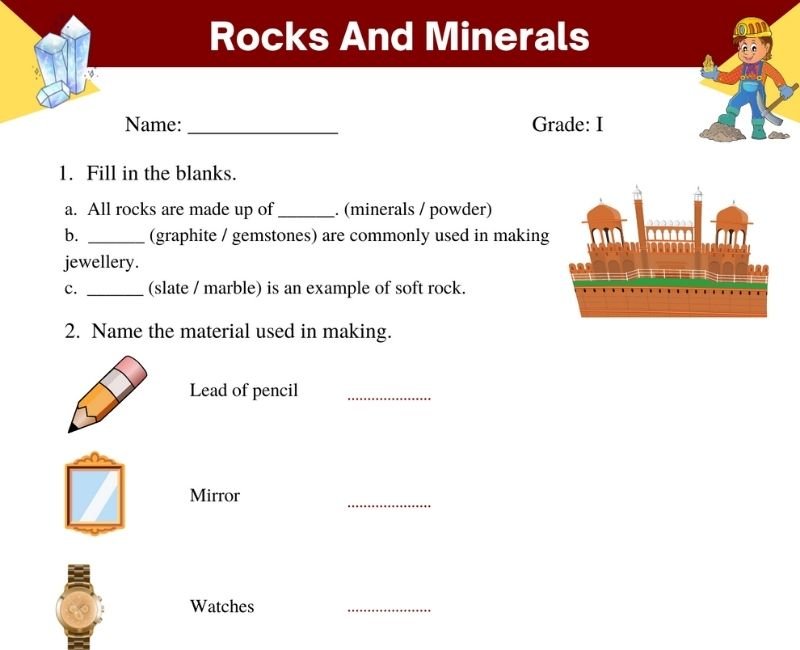
Rocks and Minerals Class 2 Worksheet with Online Activities
Become a rock detective. Explore mineral grains, discover everyday uses and practise describing what you can see.
Look closely
Explore labelled specimens and diagrams.
Listen and explain
Hear clues or read them with an adult.
Read and record
Write observations and explanations.
Try and create
Sort, investigate and draw.
Choose and combine the learning modes that help you. Use the existing page download option for the printable worksheet.
Rocks and Minerals Online Quiz for Class 2
Look carefully, read the choices and select your answer.
1. What is a rock?
0 of 20 answered
Quiz instructions
There are 20 questions and 20 minutes. The timer starts when you answer a question or use question navigation. Selecting an answer saves it and moves to the next question.
Revisit questions using the numbered buttons. Your choices are retained. Select End Quiz after the last question. Answers and explanations appear only when the quiz ends or time runs out.
Each correct answer earns one mark. There is no negative marking. Restart clears the attempt and pauses the new timer until you begin.
Rocks and Minerals Online Games and Lab Activities
Start with sorting and matching. Then explore evidence through observations, mineral grains, a scratch-test model and real samples.
0/10 tasks completed
Rock or Mineral Sorting
Learn: Classify named examples as rocks or minerals.
- Select a specimen card.
- Select the Rock or Mineral tray. Correct cards move into that tray.
Before trying a real sample activity
Ask an adult to choose clean samples without sharp edges. Do not taste specimens, create dust or break them with a hammer. Use supplied pictures or data when real samples are unavailable.
The diagrams simplify real specimens. Colours and shapes are illustrations, not a reliable identification key. Written records stay on this page while it remains open; copy them to a notebook if you want to keep them.
Rocks and Minerals Online Practice for Class 2
Explore geology facts, read a graph and explain your evidence.
0/5 practice tasks completed
Geology GK Windows
Learn: Explore geology facts and explain one.
- Open all four fact windows.
- Choose one fact and explain it to someone.
Open a fact window.
Parent and Teacher Tips
- Begin with describing a sample before asking children to name it.
- Accept “I need more evidence” as a useful scientific response.
- Read instructions aloud when helpful and invite spoken explanations.
- Use the same conditions when comparing samples and record differences.
- Review drawings and written observations together without treating them as automatically graded answers.
Rocks and Minerals Class 2 Worksheet Learning Guide
What Are Rocks and Minerals?
Rocks are natural solid Earth materials. Many rocks are made of one or more minerals. Granite commonly contains different minerals that appear as separate grains. Quartz, feldspar, mica and graphite are examples of minerals.
The difference between rocks and minerals can be introduced through a simple idea: many rocks contain mineral ingredients. Some rocks also contain other naturally occurring materials, so avoid saying every rock is made only of minerals.
Properties of Rocks and Minerals
In this rocks and minerals worksheet for Class 2, begin with colour, shape, visible grains and texture. Texture describes how a surface feels. Hardness describes resistance to scratching. Lustre describes how light reflects from a mineral surface.
Smoothness and hardness are different properties. A polished surface can feel smooth without telling us exactly how hard the mineral is. Colour alone is also insufficient for identifying a specimen.
Uses of Rocks and Minerals
Granite is commonly used for worktops and building stone. Marble is used in flooring, sculpture and decorative stonework. Slate can be split into sheets used for roofing. Graphite mixed with clay forms the writing core of an ordinary pencil.
How to Use This Grade 2 Science Worksheet Page
Start with the picture-based rocks and minerals online quiz. Use the sorting game and mind map to organise examples. Follow with observation activities and finish by explaining what the evidence shows.
The rocks and minerals Class 2 questions and answers appear in the quiz review after submission. For printable practice, use the page’s existing worksheet download option.
A Small Extension
Older or curious learners can explore three broad rock groups: igneous, sedimentary and metamorphic. Keep the Class 2 foundation focused on observing specimens, recognising familiar examples and understanding everyday uses.
Extend the topic through the soil worksheet for Class 3 or connect building materials with the types of houses worksheet for Class 2.
Related Science Worksheets and Online Activities
Rocks and Minerals Class 2 Worksheet FAQs
What is a rock for Class 2?
A rock is a natural solid Earth material. Many rocks contain one or more minerals.
What are examples of rocks and minerals?
Granite, marble and slate are rocks. Quartz, feldspar, mica and graphite are minerals.
What is the difference between a rock and a mineral?
A mineral is a naturally occurring solid with a particular composition and internal structure. A rock can contain one or more minerals or other natural materials. For Class 2, begin with examples and visible grains.
How are rocks and minerals useful in everyday life?
They provide materials for buildings, roads, decorative objects and many products. Granite is used for worktops, slate for roof tiles and graphite in ordinary pencil cores.
Which mineral is used in pencils?
Ordinary pencil cores contain graphite mixed with clay. The core is often called pencil lead, but it is not made of lead metal.
Are all rocks hard and rough?
No. Rocks differ in hardness and texture. A surface may be rough or smooth, and polishing can change how it feels.
Can children identify a mineral from its colour?
Colour can be a clue, but it is not enough on its own. Different minerals can share a colour, and one mineral can occur in several colours.
Does shiny mean that a stone is a diamond?
No. Many materials can shine. Identifying a diamond requires more evidence than appearance alone.
Which rock activities are suitable for Class 2?
Suitable activities include describing adult-selected samples, sorting named examples, exploring visible grains, matching everyday uses and drawing labelled observations.
Are the online activities the same as the quiz questions?
The concepts connect, but the tasks differ. The quiz uses multiple-choice questions, while the activities involve sorting, memory, matching, recording, drawing and using evidence.
How do I see the quiz answers?
Select End Quiz or wait until the timer finishes. The review shows your selected answers, correct answers and explanations. Restart begins a fresh attempt.
Where can I download the rocks and minerals worksheet?
Use the existing Download option on this worksheet page. These online activities do not add a separate PDF download or change the website’s access requirements.
 Download