🐾 Class 2 Science • Animal Discovery Missions
Explore animals around us through a picture quiz, clickable mind maps, food missions and animal-care activities.
↓ Your animal missions are below.
Animals Around Us Online Quiz for Class 2
Use the pictures and clues to choose your answers.
Question 1 of 20 • Easy • Answered 0/20
Which pictured animal is a wild animal?
Look at the picture. Tap an answer to continue.
Quiz instructions
There are 20 questions: ten easy, five average and five thinking questions. Each correct answer earns one mark, with no negative marking.
The 20-minute timer starts with your first answer or question change. Selecting an answer opens the next question. Question 20 stays open until you press End Quiz. Answers and explanations appear after submission or timeout.
Your selections remain saved while you move between questions. An adult may read aloud. The animal pictures are simplified learning illustrations.
Animals Around Us Online Games for Class 2
Complete animal maps, solve food missions and find memory connections.
1. 🧠 Complete the Animal Group Map
Sort six animal cards into domestic and wild groups. A pet dog belongs to the domestic group too.
Tap the picture to begin.
2. 🏡 Complete the Animal Homes Map
Choose an animal, then connect it with the suitable shelter shown.
Tap the picture to begin.
3. 🥣 Solve the Animal Food Missions
Build the pictured food example for each animal. Tap foods to select or remove, then deliver the meal card. This is not a real feeding activity.
Tap the picture to begin.
4. 👶 Reunite the Young Ones
Complete the parent-and-young map. The special names are shown on the branches.
Tap the picture to begin.
5. 🃏 Animal Sound Memory
Find three animal-and-sound pairs. These are written sound clues; an adult may read them aloud.
Tap the picture to begin.
Animals Around Us Online Activities for Class 2
Explore body features, repair animal notes and make thoughtful care choices.
6. 🧰 Repair the Animal Care Scenes
Choose a care action on the right, then tap the scene that needs it.
Tap the picture to begin.
7. 🐾 Build the Movement Record
One animal can move in more than one way. Select all movement cards requested for each example, then record.
Tap the picture to begin.
8. 🔎 Explore the Bird Body Map
Read each job clue and tap the body region on the bird picture.
Tap the picture to begin.
9. 🧶 Complete the Animal Products Map
Match animal examples with familiar products. Animals also have their own needs and deserve care.
Tap the picture to begin.
10. 🕵️ Repair the Mixed-Up Animal Notes
Each illustrated note contains a mistake. Tap the replacement that repairs it.
Tap the picture to begin.
0 of 10 missions completed.
Animals Around Us Class 2 Extra Practice
Use clues, count carefully and create an animal discovery poster.
1. 🧩 Solve Three Animal Clues
Tap the picture that matches each clue. Learn from the explanation if you need another try.
Tap the picture to begin.
2. 🔢 Count the Adult Ant’s Legs
Tap each of the six numbered leg markers once, then record the count. The ant diagram shows all six legs.
Tap the picture to begin.
3. 💧 Add Water to the Care Cards
Tap each animal card to add a water symbol. This records an animal need, not a complete care plan.
Tap the picture to begin.
4. 🔄 Order a Respectful Observation
Build a short plan: go with an adult, watch quietly, record a feature, leave the animal undisturbed. Tap cards in order.
Tap the picture to begin.
5. 🎨 Create an Animal Discovery Poster
Tap animal stamps to create a poster. Explain one feature of an animal to an adult. Your artwork is not automatically graded.
Tap the picture to begin.
0 of 5 practice tasks explored.
Animals Around Us Learning Tips
Five Parent and Teacher Tips
- Ask children to explain each animal-map connection.
- Keep domestic animal groups separate from the idea of an individual pet.
- Compare visible body features as well as movement.
- Use the food cards as examples rather than complete feeding plans.
- Accept pointing, tapping, speaking and adult-supported responses.
Animals Around Us Worksheet for Class 2
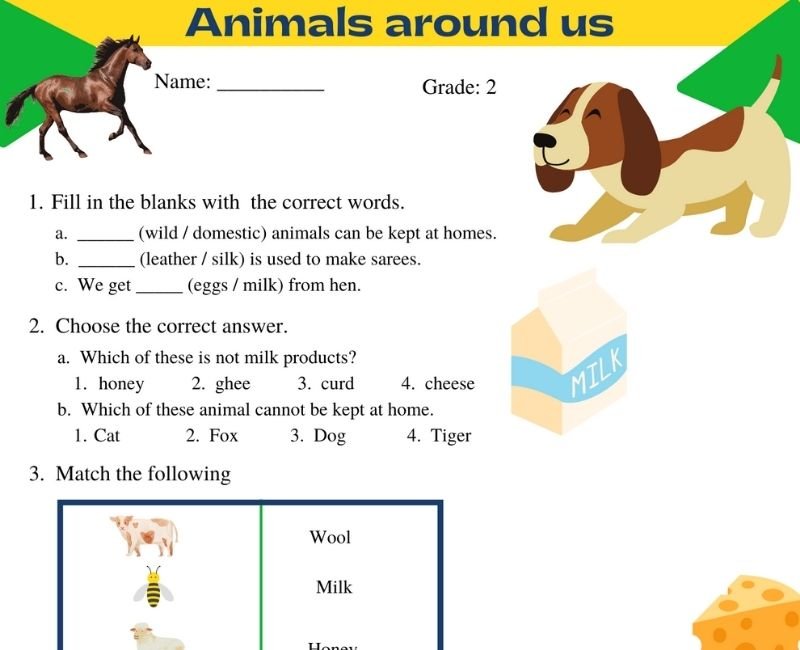
Use the existing worksheet download option on this page for written practice. The online quiz, games and activities are separate learning resources; the quiz score is out of 20.
Read the Animals Around Us Class 2 Learning Guide
Domestic animals wild animals and pets
This animals around us worksheet for Class 2 topic connects familiar animals with their groups, food, shelters and young ones. Begin with a picture, identify what can be observed and explain the connection. The online activities provide practice through mind maps, sorting, matching, memory and short reasoning missions.
Domestic animals are kinds that people have bred over many generations to live alongside them. Cows, goats, sheep and dogs are examples. A pet is an animal kept for companionship. These descriptions can overlap: a pet dog is also a domestic animal. Wild animals can live in forests, grasslands, deserts, water and places close to people. Being near a house does not automatically make an animal domestic.
Extend this comparison with the wild animals worksheet for Class 2 and revisit easier examples in the animals around us worksheet for Class 1.
Animals and their homes food and young ones
Animal homes worksheets help children connect shelter with protection and care. A stable may shelter a horse, a coop may shelter domestic chickens, and a bee colony can live in a hive. Wild rabbits may use burrows. Many birds build nests for eggs and young; a nest is not necessarily a bird’s year-round home.
Animals need different foods. Grass is a familiar example for a cow, meat for a lion, and grains and insects for a hen. These are introductory examples rather than complete diets or instructions for feeding real animals. Use the eating habits of animals worksheet for Class 3 for further food-group learning.
The names of young animals also build vocabulary. A young cow is a calf, a young goat is a kid, a young dog is a puppy and a young cat is a kitten. Connecting a parent picture with its young-one name is more useful than memorising an isolated list.
Body features movement and animal products
Birds have feathers. Many birds fly, but flying alone does not identify a bird: insects and bats can fly too. Adult insects have six legs. The ant-counting activity shows all six legs so children can count a clear diagram rather than guess from a tiny side-view picture.
One animal can move in several ways. A duck can walk, swim and fly; a frog can hop and swim. The movement activity allows more than one connection instead of forcing every animal into a single movement group.
Familiar animal products include milk from cows, eggs from hens, wool from sheep and honey made by honey bees. Animals also have their own needs and should be treated with care. The product map teaches a relationship without presenting animals only as resources.
Learning through online activities
These animals around us online activities ask children to classify, connect, observe and repair mistakes. Use a clue after an error, explain why a connection fits and then try another example. The quiz answers appear only after the attempt ends, while activity feedback supports learning during practice.
The food and shelter for animals worksheet for Class 1 provides related support. For real observations, stay with an adult, watch quietly and leave nests, eggs and unfamiliar animals undisturbed. Tell an adult about an animal that appears injured rather than attempting to handle it.
Animals Around Us Class 2 Questions and FAQs
What do children learn in Animals Around Us for Class 2?
Children compare familiar animals, domestic and wild groups, shelters, food, young ones, body features and movement. They also learn respectful animal care.
What are domestic animals?
Domestic animals are kinds that people have bred over many generations to live alongside them. Cows, goats, sheep and dogs are examples.
What is the difference between a pet and a domestic animal?
A pet is an animal kept for companionship. Domestic describes a kind of animal with a long history of breeding alongside people. A pet dog is also a domestic animal.
Do all wild animals live in forests?
No. Different wild animals live in grasslands, deserts, water and other habitats. Some also live near people.
What are the young ones of a cow goat dog and cat called?
A young cow is a calf, a young goat is a kid, a young dog is a puppy and a young cat is a kitten.
What are some examples of animal homes?
A stable can shelter a horse, a coop can shelter domestic chickens, a hive can house a bee colony and a burrow can shelter a wild rabbit.
What do different animals eat?
Different animals need different foods. Cows commonly eat grass, lions eat other animals, and hens can eat grains and insects. These are examples rather than complete feeding plans.
Are birds and insects also animals?
Yes. Birds and insects belong to the animal kingdom. The word animal does not mean only a large four-legged creature.
Can all birds fly and is a bat a bird?
Not all birds can fly. A bat is a mammal, not a bird. Feathers help identify birds; flying alone does not.
What useful products do we get from animals?
Familiar examples include milk from cows, eggs from hens, wool from sheep and honey made by honey bees. Animals also deserve suitable care and respect.
How can children observe animals safely?
Observe with an adult, keep a respectful distance and avoid chasing or handling unfamiliar animals. Leave nests and eggs undisturbed and tell an adult about an injured animal.
Where are the printable worksheet and quiz answers?
Use the page’s existing download option for the printable resource. The separate online quiz displays answers and explanations after End Quiz or timeout.
 Download