Class 2 Science • Water explorers
Little drops.
Big discoveries.
Explore where water comes from, how we use it and how every drop can be cared for.
Water Class 2 Quiz
20 questions — 10 easy, 5 average and 5 thinking questions. Learn at your own pace, then check your explanations.
Which is a natural source of water?
The timer starts with your first answer or question change. It stays inside this quiz.
Play • investigate • explain
Water Discovery Studio
Choose a raised game card. On a phone, swipe the cards to explore all ten.
Source Sort
Tap an item, then tap its group. Sort all six.
Think a little deeper
Is a tap the place water begins, or a way to bring it to us?
A tap delivers water through pipes. Rivers, lakes and groundwater are natural water sources.
STEM discoveries beyond the screen
Predict first. Try with an adult. Notice what happens and explain what you observed.
Which cloth dries first?
Wet two matching small cloths with the same amount of water. Place one in a sunny spot and one in shade. Start together and check them together.
Think What will you keep the same? Which cloth do you predict will dry first? Wind and temperature can affect the result.
Design a rain collector
Draw a wide opening, a container and a way to stop it tipping over. Ask an adult to help you compare two designs outdoors.
Think How could you compare them fairly during the same rain? Collected rainwater is for observing or suitable outdoor uses, not drinking.
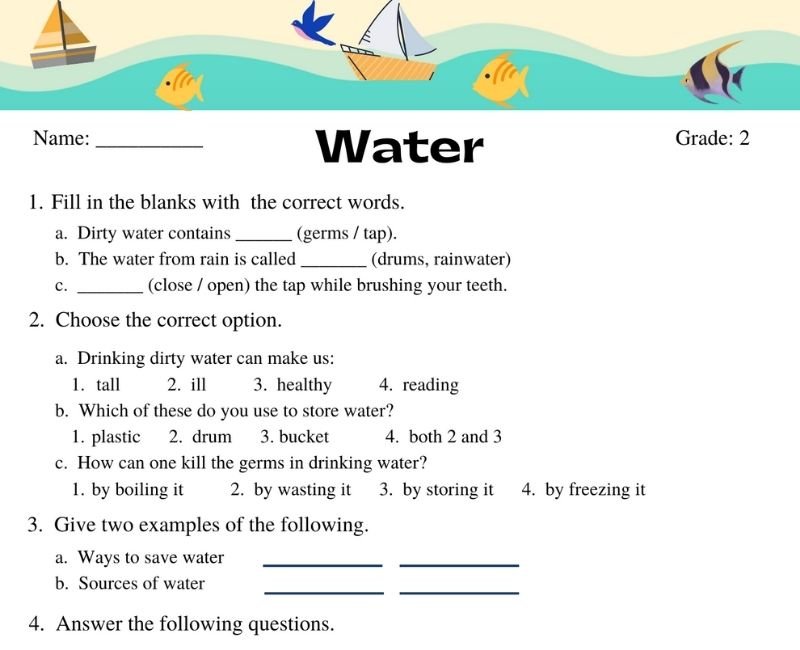
Water Worksheet for Class 2
Use the worksheet download already provided near the top of this page for paper practice. Then try these online activities to explain your answers and practise saving water.
Read the Water Class 2 study guide and questions ↓
Sources of water for Class 2
Rain, rivers, lakes and groundwater are important sources of water. Wells and hand pumps help people reach groundwater. Taps carry water through pipes; they do not make water. A bucket is a container for collecting or carrying water.
Uses of water in everyday life
We use water for drinking, preparing food, bathing, washing clothes and cleaning. Plants need water to grow, and animals need water too. Fish live in water. Try naming five uses of water, then explain which ones you noticed at home today.
Save water activities for kids
Turn off the tap while brushing your teeth, use only the water you need and tell an adult about leaks. Water plants carefully near their roots. Do not leave a tap running when nobody is using it. Saving water means using it wisely while still meeting our needs.
Clean water and safe drinking water
Water can look clear and still contain things that could make us ill. Drink water supplied by a trusted safe source and follow an adult's guidance. Do not drink from a pond, stream or a classroom experiment. A simple cloth strainer can catch some pieces of dirt, but it does not make water safe to drink.
Properties of water for Class 2
Pure water has no colour, smell or taste of its own. Liquid water flows and takes the shape of its container. Ice is solid water. Water vapour is water in its gas form and is invisible. Everyday tap water can contain dissolved minerals, so we never taste unknown water to identify it.
Water science activities and thinking questions
Investigate whether a particular object floats, compare what happens when sugar and sand are stirred into water, and observe water drying from a wet cloth. Test an object instead of guessing only from its size. Sugar seems to disappear because it dissolves; it is still in the water. Sand does not dissolve in this simple classroom test.
Water Class 2 questions with explanations
Why should we save water? People, plants and animals need water, and safe usable water is valuable. Is a tap a natural source? No. It is part of a water supply system. Can we drink seawater? Ordinary seawater is salty and unsuitable for drinking. Why is a closed tap helpful? It stops unnecessary flow.
Water worksheet online practice
This page combines a printable water worksheet, a 20-question quiz and 10 interactive games. Children identify sources, explore uses, solve pipe and measuring challenges, test simple models and discuss evidence. It is general Class 2 science and EVS practice, rather than a worksheet tied to a particular NCERT chapter.
Questions children ask about water
What are three sources of water?
Rain, rivers and lakes are three examples. Water is also found underground.
What are five uses of water?
Drinking, cooking, bathing, washing clothes and watering plants.
How can children save water?
Close taps when they are not needed, avoid spilling usable water and tell an adult about leaks.
Is all clear water safe to drink?
No. Clear water may contain harmful germs or chemicals. Use a trusted safe drinking-water source with an adult's guidance.
Does sugar disappear when it dissolves?
It spreads through the water in very tiny parts. It is still there even when we cannot see the grains.
Do all small objects float?
No. A small steel spoon usually sinks, while a larger empty sealed plastic bottle can float. Material, shape and the whole object matter.
What is evaporation?
Evaporation happens when liquid water changes to water vapour. It helps wet things dry.
Are these activities based on a particular textbook?
No. These are general Class 2 water activities for science and EVS learning.
 Download