Class 9 Advanced Maths · Exploring Some More Progressions Worksheet
Exploring Some More Progressions Class 9 Advanced Maths Worksheet with Online Quiz, Games and Activities
How can infinitely many numbers add up to a finite sum, and how far does a bouncing ball travel before it stops? Find out with this Progressions worksheet for Class 9 Advanced Maths: take the Exploring Some More Progressions Class 9 online quiz, build geometric progressions in hands-on activities, try three maths experiments in the Virtual Lab and play interactive games online.
Flip the cards and try the GP Builder Lab, then tap the Games, Labs, Challenges or Virtual Lab button.
Exploring Some More Progressions Class 9 Online Quiz
20 questions · tap an answer to move on · full review at the end
Flip the cards, try the GP Builder Lab, then play the games, do the labs and take the challenges. Earn up to 3 stars in every activity.
Fact cards: tap a card to flip it
GP Builder Lab
Three geometric progressions to build with your hands. Set the first term a and the common ratio r with the buttons, watch the bars and sums change, then press Check. A wrong choice shows what goes wrong, so you can try again.
Challenge marks: 0 / 15 (0 of 5 challenges done)
Finish all 5 challenges to see your comment.
Virtual Lab: do real experiments step by step
Practice sheet
Exploring Some More Progressions Class 9 Advanced Maths Activities
Build geometric progressions in the GP Builder Lab, sort APs and GPs, find next terms and sums, add infinite GPs and climb difference ladders, then halve a paper square, measure a bouncing ball and stack block towers in the Virtual Lab. Earn up to 3 stars in every activity.
Progressions in Class 9 Advanced Maths
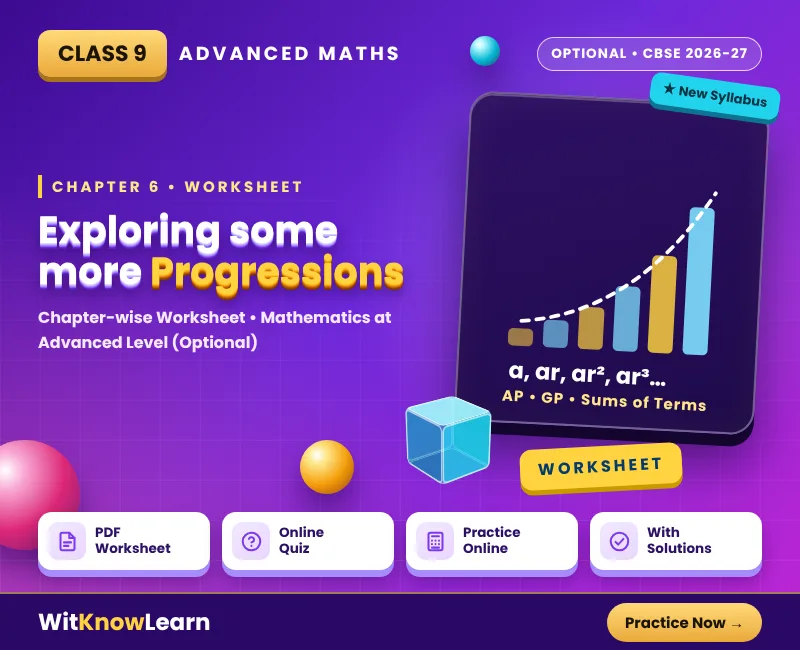
A geometric progression (GP) is a sequence in which each term is the previous term multiplied by a fixed number r, the common ratio. Its nth term is tₙ = arⁿ⁻¹, and three numbers a, b, c are in GP when b² = ac.
Sums of a GP
The sum of the first n terms is Sₙ = a(1 − rⁿ) ÷ (1 − r) for r ≠ 1. When −1 < r < 1 the terms shrink towards zero and the infinite GP has a finite sum S∞ = a ÷ (1 − r). This turns recurring decimals into fractions and gives the total distance of a bouncing ball.
Method of differences
Some series such as 1, 3, 6, 10, … are neither AP nor GP, but their differences form an AP. Then the nth term is a quadratic in n and the sum can be found using Σk and Σk².
Exploring Some More Progressions Class 9 Advanced Maths
A geometric progression (GP) is a sequence in which every term after the first is obtained by multiplying the previous term by a fixed non-zero number called the common ratio r. The sequence 3, 6, 12, 24, … is a GP with first term a = 3 and r = 2, and 64, 16, 4, 1, … is a GP with r = 1/4. Three numbers a, b, c are in GP exactly when b² = ac; b is then called the geometric mean of a and c.
nth term and sum of n terms
| Quantity | Formula | Example: 3, 6, 12, … |
|---|---|---|
| Common ratio | r = t₂ ÷ t₁ | r = 2 |
| nth term | tₙ = arⁿ⁻¹ | t₈ = 3 × 2⁷ = 384 |
| Sum of n terms | Sₙ = a(rⁿ − 1) ÷ (r − 1) | S₅ = 3 × 31 = 93 |
| When r = 1 | Sₙ = na | 2 + 2 + 2 = 6 |
Infinite geometric progression
When −1 < r < 1, the terms get smaller and smaller and their sum approaches the value S∞ = a ÷ (1 − r). For example 16 + 8 + 4 + … = 32 and 1/2 + 1/4 + 1/8 + … = 1. If |r| ≥ 1 the sum keeps growing or keeps jumping, so there is no finite sum; for 1 − 1 + 1 − … the partial sums switch between 1 and 0.
Special series
| Series | Trick | Result |
|---|---|---|
| 0.666… | 0.6 + 0.06 + … | 2/3 |
| 0.9 + 0.99 + 0.999 + … | (1 − 0.1) + (1 − 0.01) + … | n − (1/9)(1 − 10⁻ⁿ) |
| 5 + 55 + 555 + … | (5/9)[(10 − 1) + (100 − 1) + …] | (50/81)(10ⁿ − 1) − 5n/9 |
Real-life geometric progressions
Compound interest grows as a GP: ₹10000 at 10% a year becomes 10000 × 1.1ⁿ after n years. A ball dropped from h metres that rebounds to a fraction r of each height travels h + 2 × hr ÷ (1 − r) in all; from 64 m with r = 1/2 that is 192 m. Population growth, radioactive decay and chain messages are other examples.
Method of differences
Some series, such as 1, 3, 6, 10, 15, …, are neither AP nor GP, but their differences 2, 3, 4, 5, … form an AP. If the series starts with b and the differences have first term a and common difference d, then tₙ = b + a(n − 1) + d(n − 1)(n − 2) ÷ 2. Sums then use Σk = n(n + 1) ÷ 2 and Σk² = n(n + 1)(2n + 1) ÷ 6, so 1 + 4 + 9 + … + 100 = 385.
Worked examples
Example 1. In a GP, t₂ = 6 and t₅ = 162. Then r³ = 27, r = 3, a = 2 and t₄ = 54.
Example 2. If S∞ is 4 times the first term, a ÷ (1 − r) = 4a, so r = 3/4.
Example 3. For 2, 6, 12, 20, 30, … the differences 4, 6, 8, 10 form an AP and tₙ = n(n + 1).
Common mistakes
| Mistake | Correct idea |
|---|---|
| Using S∞ when |r| ≥ 1 | S∞ exists only for −1 < r < 1. |
| Writing tₙ = arⁿ | The first term has power 0, so tₙ = arⁿ⁻¹. |
| Counting the first drop of a ball twice | Only the rebounds go up and down. |
| Calling 1, 4, 9, 16 a GP | Its differences form an AP; it is not a GP. |
Step by step solutions for every exercise of this chapter are linked below.
Related Class 9 Advanced Maths Solutions
- Progressions Class 9 Advanced Maths Solutions
- Sets Class 9 Advanced Maths Solutions
- Logarithms Class 9 Advanced Maths Solutions
- Relations and Functions Class 9 Advanced Maths Solutions
- Coordinate Geometry Class 9 Advanced Maths Solutions
- Combinatorics Class 9 Advanced Maths Solutions
- The World of Numbers Class 9 Solutions
- Sequences and Progressions Class 9 Solutions
Frequently Asked Questions
 Download