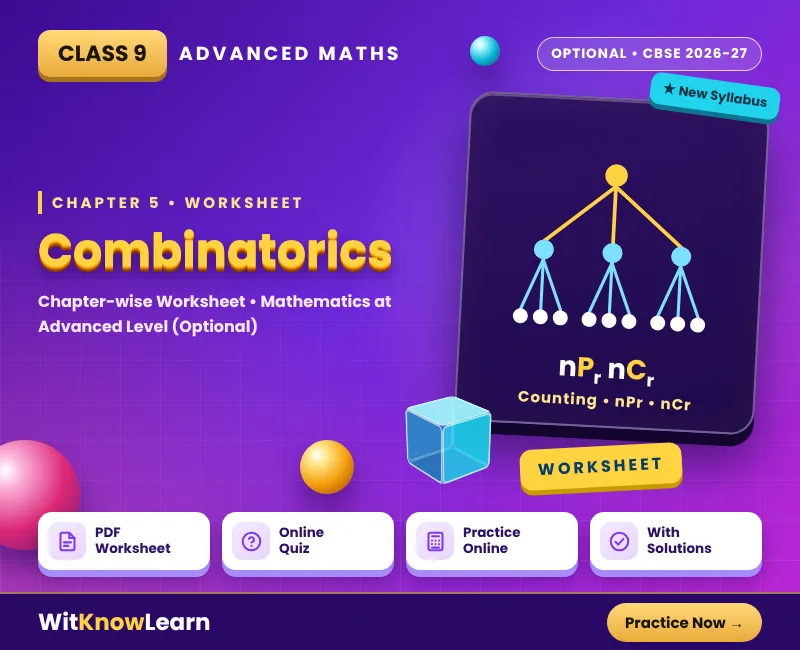
Class 9 Advanced Maths · Combinatorics Worksheet
Combinatorics Class 9 Advanced Maths Worksheet with Online Quiz, Games and Activities
How many PIN codes, number plates or team selections are possible without listing them all? Find out with this Combinatorics worksheet for Class 9 Advanced Maths: take the Combinatorics Class 9 online quiz, fill counting slots in hands-on activities, try three maths experiments in the Virtual Lab and play interactive games online.
Flip the cards and try the Slot Counting Lab, then tap the Games, Labs, Challenges or Virtual Lab button.
Combinatorics Class 9 Online Quiz
20 questions · tap an answer to move on · full review at the end
Flip the cards, try the Slot Counting Lab, then play the games, do the labs and take the challenges. Earn up to 3 stars in every activity.
Fact cards: tap a card to flip it
Slot Counting Lab
Three counting problems to solve with your hands. Set the number of choices for each slot with the buttons, watch the product build up, then press Check. A wrong choice shows what goes wrong, so you can try again.
Challenge marks: 0 / 15 (0 of 5 challenges done)
Finish all 5 challenges to see your comment.
Virtual Lab: do real experiments step by step
Practice sheet
Combinatorics Class 9 Advanced Maths Activities
Fill counting slots in the Slot Counting Lab, sort situations into permutations and combinations, match factorial values, count restricted arrangements and polygon diagonals, then draw outfit trees, count handshakes and arrange letter tiles in the Virtual Lab. Earn up to 3 stars in every activity.
Combinatorics in Class 9 Advanced Maths
Combinatorics is the mathematics of counting without listing. The fundamental principle of counting says that if one task can be done in m ways and the next in n ways, both can be done in m × n ways. If a task can be done in m ways or in n other ways, there are m + n ways.
Factorials and permutations
n! = n × (n − 1) × … × 2 × 1, with 0! = 1. A permutation is an arrangement in which order matters. The number of arrangements of r objects chosen from n different objects is ⁿPᵣ = n! ÷ (n − r)!, and n objects can be arranged in n! ways.
Combinations
A combination is a selection in which order does not matter. The number of ways to choose r objects from n is ⁿCᵣ = n! ÷ [r!(n − r)!], and ⁿCᵣ = ⁿCₙ₋ᵣ. Combinations count teams, handshakes, lines, triangles and diagonals.
Combinatorics Class 9 Advanced Maths
Combinatorics is the branch of mathematics that deals with counting, arranging and selecting objects. Instead of listing every possibility, it uses a few simple rules to count them quickly. It is the basis of probability and is used in computer science, cryptography, sports scheduling and everyday questions such as how many PIN codes or number plates are possible.
Fundamental principle of counting
If one task can be done in m ways and, after it, a second task can be done in n ways, then both tasks can be done in m × n ways. This is the multiplication principle. If a task can be done in m ways or in n other ways, it can be done in m + n ways; this is the addition principle. In slot problems, always fill the restricted slot first, such as the units digit of an even number.
Factorial notation
The product of the first n natural numbers is written n! (n factorial): n! = n × (n − 1) × … × 2 × 1. So 5! = 120 and 6! = 720. By definition 0! = 1, which agrees with n! = n × (n − 1)! for n = 1.
Permutations and combinations
| Permutation | Combination | |
|---|---|---|
| Meaning | arrangement; order matters | selection; order does not matter |
| Formula | ⁿPᵣ = n! ÷ (n − r)! | ⁿCᵣ = n! ÷ [r!(n − r)!] |
| Example | captain and vice-captain from 11: ¹¹P₂ = 110 | 2 players from 11: ¹¹C₂ = 55 |
| Special values | ⁿPₙ = n!, ⁿP₁ = n | ⁿC₀ = ⁿCₙ = 1, ⁿCᵣ = ⁿCₙ₋ᵣ |
The two are linked by ⁿPᵣ = r! × ⁿCᵣ, because every selection of r objects can be arranged in r! ways.
Problems with conditions
| Condition | Method | Example |
|---|---|---|
| Some objects together | tie them into one unit, then arrange inside | vowels of ORANGE together: 4! × 3! = 144 |
| Not together | total − together | 720 − 144 = 576 |
| At least one | total − none | teams with at least one girl |
| Fixed position | place it first, arrange the rest | words starting with T |
Counting in geometry
From n points with no three collinear we get ⁿC₂ lines and ⁿC₃ triangles. If k of the points are collinear, subtract ᵏC₃ from the triangles. An n-sided polygon has ⁿC₂ − n diagonals. Shortest paths on a grid of m right steps and n up steps number ⁽ᵐ⁺ⁿ⁾Cₙ.
Worked examples
Example 1. 4-digit numbers with all digits different: 9 × 9 × 8 × 7 = 4536, so 9000 − 4536 = 4464 have a repeated digit.
Example 2. In NUMBER, putting U and E in even places gives ³P₂ × 4! = 6 × 24 = 144 words.
Example 3. A team of 4 from 5 boys and 4 girls with at least one girl: ⁹C₄ − ⁵C₄ = 126 − 5 = 121.
Common mistakes
| Mistake | Correct idea |
|---|---|
| Using C for seating or codes | Order matters, so use P. |
| Letting 0 be the first digit | Count the first place separately. |
| Forgetting arrangements inside a tied unit | Multiply by the internal arrangements. |
| Adding steps that happen together | Use multiplication for AND. |
Step by step solutions for every exercise of this chapter are linked below.
Related Class 9 Advanced Maths Solutions
- Combinatorics Class 9 Advanced Maths Solutions
- Sets Class 9 Advanced Maths Solutions
- Logarithms Class 9 Advanced Maths Solutions
- Relations and Functions Class 9 Advanced Maths Solutions
- Coordinate Geometry Class 9 Advanced Maths Solutions
- Progressions Class 9 Advanced Maths Solutions
- The World of Numbers Class 9 Solutions
- Probability Class 9 Solutions
Frequently Asked Questions
 Download