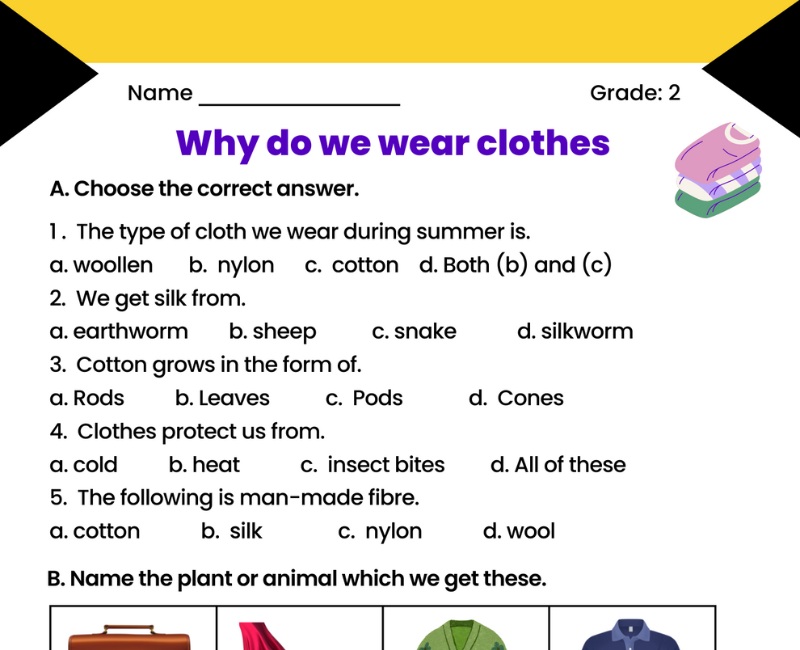
Clothes We Wear Class 2 Worksheet with Online Activities
Become a clothing detective. Explore weather choices, fibre sources, fabric properties and ways to care for clothes.
Look closely
Study photos, labels and diagrams.
Listen and explain
Hear clues and share reasons.
Read and record
Write observations and plans.
Make and investigate
Weave, test and design.
Combine the learning modes that help you. Use the existing page download option for the printable worksheet.
Clothes We Wear Online Quiz for Class 2
Look at the photos, diagrams and tables before choosing.
1. The photo shows cotton fibres. Where does cotton grow?

0/20 answered
Quiz instructions
There are 20 questions and 20 minutes. The timer starts when you answer or navigate between questions. Selecting an answer saves it and opens the next question.
Use Previous or the numbered buttons to revisit questions. On the final question, choose your answer and select End Quiz. Answers and explanations appear after submission or timeout.
Each correct answer earns one mark, with no negative marking. Restart clears the attempt and pauses the new timer until you begin.
Clothes We Wear Online Games and Lab Activities
Pack for forecasts, sort fibres and complete a clothing journey. Then weave a pattern, investigate fabrics and design useful clothing.
0/10 tasks completed
Pack for Three Forecasts
Learn: Connect clothing choices to actual weather.
- Read the forecast. Select the two useful items.
- Check your bag to unlock the next forecast.
Hot sunny walk
Before practical activities
Ask an adult to provide safe scraps and prepare paper strips. Use room-temperature water on a tray, away from devices. Adults handle cutting, needles, detergents and garment repairs.
The weaving and air-gap diagrams are simplified models. Record real observations without forcing an expected result. Written records and designs are reviewed by an adult.
Work stays on this page while it remains open. Copy useful observations into a notebook before leaving or resetting.
Clothes We Wear Online Practice for Class 2
Explore GK, solve word puzzles, build a graph and explain a plan.
0/5 practice tasks completed
Clothing GK Windows
Learn: Learn useful clothing facts.
- Open all four fact windows.
- Explain one new fact aloud.
Choose a fact window.
Parent and Teacher Tips
- Ask children to explain the job of an item, rather than only naming it.
- Connect clothing choices with actual weather and the planned activity.
- Read material labels together instead of identifying fibres from appearance alone.
- Keep fabric-test conditions consistent and accept unexpected observations.
- Respect different clothing styles, sensory needs, cultures and personal comfort.
Clothes We Wear Class 2 Worksheet Learning Guide
Why Do We Wear Clothes?
Clothes help protect our bodies from weather and support comfort, activities and everyday routines. People also choose clothing for work, celebrations, culture and personal expression.
This Clothes We Wear Class 2 worksheet page connects familiar garments with their purposes through photo questions, online activities and practical observations.
Clothes for Different Seasons and Weather
Light, loose clothing can be comfortable in hot weather. Cotton is a commonly used fibre for such garments. Warm layers, including suitable woollen clothing, help in cold conditions. Rainwear is designed to reduce water getting through.
Choose for the actual weather rather than the season name alone. A hill town may feel cold when another place is hot. A garment’s thickness, fit, construction and finish also affect comfort.
Where Do Clothing Fibres Come From?
Cotton and jute are plant fibres. Wool commonly comes from sheep, while silk comes from silkworms. Nylon and polyester are manufactured synthetic fibres. A garment can contain a blend of fibres.
Fibres can be spun into yarn. Fabric can be made by methods including weaving and knitting. The cotton-to-shirt activity introduces a simplified production sequence.
Why Do Woollen Clothes Help in Winter?
Wool’s crimp and the structure of a suitable fabric can trap pockets of still air. This helps slow heat loss from the body. A sweater does not create body heat, and wool is not the only material used in warm clothing.
Uniforms and Clothing for Different Occasions
Some schools and workplaces use uniforms to identify a group or role. Protective workwear has particular safety purposes. An ordinary costume or similar-looking garment does not replace properly designed protective equipment.
Clothing styles vary within and across communities. Avoid assuming that everyone in one region wears the same outfit or that a garment tells us everything about a person.
Caring for Clothes
Read garment care instructions with an adult. Washing, drying, ironing and storage needs can differ. Suitable cleaning, drying and safe repairs help keep clothes useful.
Use the Clothes We Wear Class 2 questions and answers in the quiz review after submission. For printable practice, use the existing worksheet download option.
Revise the basics with the why do we wear clothes worksheet for Class 1 or extend the topic through the housing and clothing worksheet for Class 3.
Related Worksheets and Online Activities
Clothes We Wear Class 2 Worksheet FAQs
Why do we wear clothes?
Clothes help protect us from weather and support comfort, activities, work and everyday routines. They can also express culture and personal choices.
Which clothes are suitable for summer?
Light, loose clothing can be comfortable in hot weather. Cotton is commonly used, but garment thickness, fit, activity and actual conditions also matter.
Why do we wear woollen clothes in winter?
Suitable woollen fabrics trap pockets of still air that help slow heat loss. Other materials and layered garments can also provide warmth.
What do we wear during rain?
Suitable raincoats, rain jackets and waterproof boots help keep rain out. Check the garment’s intended use rather than guessing from its appearance.
Where do cotton wool and silk come from?
Cotton comes from cotton plants. Wool commonly comes from sheep. Silk comes from silkworms.
What are synthetic fibres?
Synthetic fibres are manufactured fibres such as nylon and polyester. They are used alone or blended with other fibres in many products.
Is every nylon garment waterproof?
No. A fibre name alone does not prove waterproof performance. Fabric construction, coatings, seams and garment design can affect how well rain is kept out.
Why do some people wear uniforms?
Uniforms can identify a school, team or work role. Some specialised workwear also has protective functions. Uniform rules differ between organisations.
Who stitches or alters clothes?
A tailor makes or alters stitched garments. Many other workers also help produce fibres, yarn, fabric and finished clothing.
How should children care for clothes?
Read care labels with an adult, put dirty clothes in the appropriate place, let washed clothes dry as directed and ask about safe repairs when needed.
What practical clothing activity can Class 2 children try?
With adult help, compare two safe fabric scraps using equal drops of room-temperature water and the same waiting time. Record absorption or beading without assuming the result.
Where are the worksheet download and quiz answers?
Use the existing Download option on this page for the worksheet. Quiz answers and explanations appear after End Quiz or timeout.
Photo Credits and Learning References
Cotton photograph: Katie Nichols / Alabama Extension. Yarn photograph: Lesekreis. Both source files are marked CC0.
References: Woolmark fibre information and American Cleaning Institute fabric care. Photos load from Wikimedia Commons. A labelled illustration appears if a photo cannot load.
 Download