Class 3 Mathematics
Time Worksheets for Class 3 with Online Activities & Quiz
Read the clock, learn hours and minutes, find how long things take and solve time word problems. Use the printable PDF worksheet, then practise online.
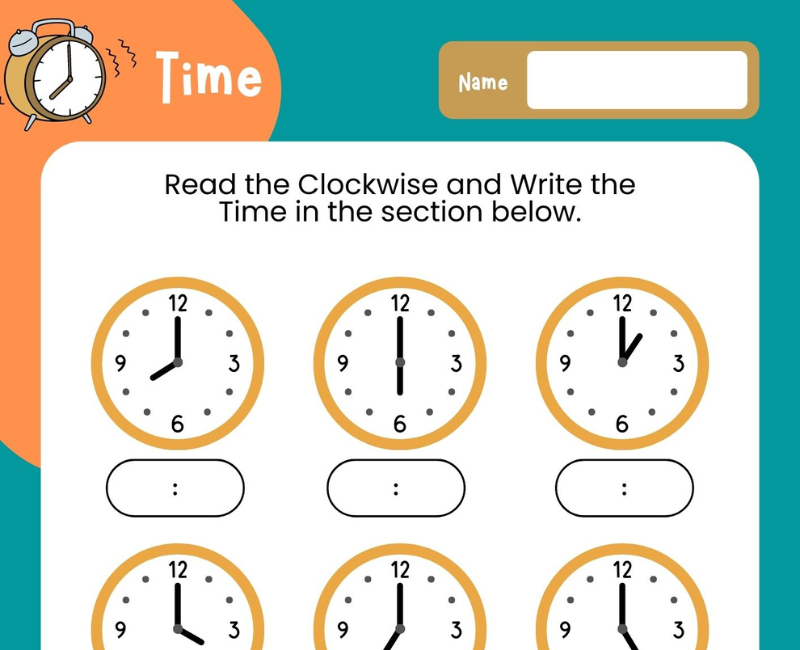
Explore WitKnowLearn’s time worksheet for Class 3 with online quiz and online activities. Read analog clocks, set the hands yourself, match clocks with digital times, count minutes in fives and work out how long a film, a train journey or a class lasts. Every activity uses a clock face or a short story you can tap.
Time Online Quiz for Class 3
Which hand of a clock is the short one, and what does it show?
Time Online Activities for Class 3
Read the Clock
Game 1 of 5Goal: Read analog clocks and tap the right time.
How to play: Look at the clock, tap a time and press Check.
Round 1 of 5: Read the clock. Tap the time it shows.
Time for Class 3: complete topic guide
This guide supports the time worksheets for Class 3 on this page. It covers telling time on an analog clock, reading a digital clock, hours and minutes, elapsed time, adding and subtracting time and time word problems. It follows the Class 3 maths time topic taught in CBSE and NCERT style classrooms. Use it with the printable PDF worksheet, the online quiz and the 15 online activities above.
What is time?
Time tells us when something happens and how long it takes. We measure time in seconds, minutes, hours and days. A clock helps us read the time. Knowing how to tell time is one of the most useful skills in Class 3 maths.
Units of time
| Unit | Equal to | Used for |
|---|---|---|
| 1 minute | 60 seconds | Brushing teeth, a short song |
| 1 hour | 60 minutes | A lesson, a film, a car journey |
| Half an hour | 30 minutes | Break time, a short walk |
| Quarter of an hour | 15 minutes | A short game |
| 1 day | 24 hours | From morning to the next morning |
Parts of an analog clock
An analog clock has a round face with the numbers 1 to 12 and two hands. The short, thick hand is the hour hand. It shows the hour. The long, thin hand is the minute hand. It shows the minutes. The hands move clockwise, the same way for every clock.
How to read an analog clock
Each number on the clock face stands for 5 minutes. When the minute hand points to 1 it is 5 minutes. At 2 it is 10 minutes, at 3 it is 15 minutes, and so on. Count in fives to read the minutes: 5, 10, 15, 20, 25, 30, 35, 40, 45, 50, 55, 60. When the minute hand has gone all the way round to 12 again, one full hour has passed.
| Minute hand points to | Minutes | We say |
|---|---|---|
| 12 | 0 | o’clock, for example 4 o’clock |
| 3 | 15 | quarter past, for example quarter past 4 |
| 6 | 30 | half past, for example half past 4 |
| 9 | 45 | quarter to, for example quarter to 5 |
Telling time to the hour
When the minute hand points to 12, the time is exactly on the hour. The hour hand shows which hour it is. If the hour hand points to 7 and the minute hand points to 12, the time is 7 o’clock. We write it as 7:00. Telling time to the hour is the first step before reading half hours, quarter hours and minutes.
Half past and quarter past
Half past means 30 minutes after the hour. The minute hand points to 6 and the hour hand is halfway between two numbers. For example, 8:30 is half past 8. Quarter past means 15 minutes after the hour. The minute hand points to 3. For example, 2:15 is quarter past 2.
Quarter to
Quarter to means 15 minutes before the next hour. The minute hand points to 9, which is 45 minutes. For example, 5:45 is quarter to 6, because 15 more minutes make 6 o’clock.
Telling time to the minute
To read a time such as 3:40, look at the hour hand. It is between 3 and 4, so the hour is 3 and the hour is not 4 yet. Then count in fives to the minute hand. It points to 8, and 8 × 5 = 40. The time is 3:40. We can also say twenty minutes to 4.
Analog and digital clocks
An analog clock uses a round face and two hands. A digital clock shows numbers only, such as 6:45. The number before the colon is the hour and the number after the colon is the minutes. Both clocks can show the same time. Learning to move between analog and digital time is a key skill in Class 3 time worksheets.
Morning and night: a.m. and p.m.
A day has 24 hours, but a clock face shows only 12 hours. So each time of the day happens twice. We write a.m. for the hours from midnight to noon and p.m. for the hours from noon to midnight. For example, 7:00 a.m. is breakfast time and 7:00 p.m. is evening time.
Elapsed time: how long did it take?
Elapsed time is the time that passes between a start time and an end time. To find it, count on from the start time. First count to the next hour, then count the remaining hours and minutes. For example, from 8:20 to 9:05 is 40 minutes to reach 9:00, plus 5 more minutes, which makes 45 minutes.
Adding and subtracting time
To add hours, add to the hour number and keep the minutes. For example, 2:00 + 3 hours = 5:00. To add minutes, count on in fives or jump to the next hour first. For example, 8:45 + 40 minutes: 15 minutes make 9:00, and 25 more minutes make 9:25. To subtract hours, take away from the hour number and keep the minutes. For example, 3:45 − 2 hours = 1:45.
Time word problems
Time word problems are short stories about a start time, an end time or a length of time. Read the story and decide what is missing. If the end time is missing, add the length of time to the start time. If the length is missing, count from the start time to the end time. If the start time is missing, subtract the length from the end time. Write a number sentence and then write the answer with its unit.
Solved examples
Common mistakes
| Mistake | Correction |
|---|---|
| Mixing up the hour hand and the minute hand | The short thick hand shows the hour. The long thin hand shows the minutes. |
| Reading the number 6 as 6 minutes | Each number is 5 minutes. The number 6 means 30 minutes. |
| Reading the hour as the next number when the time is 3:40 | The hour hand is between 3 and 4. The hour is still 3 until the minute hand comes back to 12. |
| Thinking 1 hour is 100 minutes | 1 hour is 60 minutes. |
| Writing 8:85 after adding minutes | After 59 minutes the next number is a new hour. 8:45 plus 15 minutes is 9:00. |
Time in daily life
We use time every day. We check the clock to reach school on time, to know when lunch is, to see how long a film lasts and to plan a bus or train journey. Practising time with real events, such as a school timetable, makes the topic easier to remember.
What your child learns in the Class 3 time worksheet
- Telling time to the hour, half hour and quarter hour on analog clocks
- Reading time to the minute by counting in fives
- Matching analog clocks with digital times
- Drawing the hands of a clock for a given time
- Knowing that 1 hour is 60 minutes and 1 day is 24 hours
- Finding elapsed time between a start and an end time
- Adding and subtracting time in simple time sums
- Solving time word problems
Tips for parents and teachers
Let your child wear a watch or use a simple wall clock at home. Ask them to say the time at key moments of the day, such as bedtime or dinner. Use the printable PDF worksheet for written practice and the online activities for quick, fun revision. Revisit the common mistakes table when you see the same error twice.
Related Maths Worksheets
- Time and Calendar worksheet for Class 3Days, weeks and months
- Money addition and subtraction worksheet for Class 3Add and take away amounts
- Addition and Subtraction word problems for Class 3Practise story problems
- Data Handling Class 3 worksheet with online activities and quizRead and draw simple charts
- Division Class 3 worksheet with online activities and quizShare into equal groups
- Give and Take Class 3 worksheetsMore addition and subtraction
- Perimeter and Area worksheet for Class 3Measure edges and space
- Geometry Class 3 worksheet with online activities and quizShapes and their sides
- Measurement of Weight worksheet for Class 3More Class 3 measurement
- Measurement Long and Short worksheet for Class 3Measure lengths in cm and m
- Multiplication worksheets for Class 3Count in equal groups
- Fractions Class 3 worksheet with online activities and quizHalf and quarter of a whole
Frequently Asked Questions
How do I tell the time on an analog clock?
Look at the short hour hand to find the hour. Then look at the long minute hand and count in fives to find the minutes. If the hour hand is on 3 and the minute hand is on 12, the time is 3 o’clock.
What is the difference between the hour hand and the minute hand?
The hour hand is short and thick and it shows the hour. The minute hand is long and thin and it shows the minutes.
How many minutes are in an hour and how many seconds are in a minute?
There are 60 minutes in 1 hour and 60 seconds in 1 minute. There are 24 hours in 1 day.
What do half past and quarter past mean?
Half past means 30 minutes after the hour, for example 8:30. Quarter past means 15 minutes after the hour, for example 2:15.
What does quarter to mean?
Quarter to means 15 minutes before the next hour. The time 5:45 is quarter to 6.
How do I read the minutes on a clock?
Each number on the clock is 5 minutes. Count in fives from 12 to the number the minute hand points to. If the minute hand points to 8, then 8 × 5 = 40 minutes.
What is elapsed time?
Elapsed time is the time that passes between a start time and an end time. For example, from 8:20 to 9:05 is 45 minutes.
How do I add time in Class 3?
To add hours, add to the hour number and keep the minutes. For example, 4:30 + 1 hour = 5:30. To add minutes, jump to the next hour first and then add the rest.
How do I subtract time in Class 3?
To take away hours, subtract from the hour number and keep the minutes. For example, 3:45 − 2 hours = 1:45. To find the difference between two times, count on from the earlier time to the later time.
How do I solve a time word problem?
Read the story and find what is missing: the start time, the end time or the length of time. Then add or count on to find it. Write the answer with its unit, such as minutes or hours.
What is the difference between an analog clock and a digital clock?
An analog clock has a round face with hands. A digital clock shows the time with numbers, such as 6:45. Both can show the same time.
What is included on this Time page for Class 3?
This page has a printable PDF time worksheet for Class 3, a 20-question online quiz and 15 online activities. The activities include clock reading, setting the clock, matching clocks with digital times, elapsed time and time word problems.
 Download