Class 3 Mathematics
Money Addition and Subtraction Worksheet Class 3 with Online Quiz
Add and subtract money, find the total cost of several items, work out the change and compare prices to find the best buy. Use the printable PDF worksheet, then practise online.
Explore WitKnowLearn’s money addition and subtraction worksheet for Class 3 with online quiz and online activities. Add prices to find a bill, subtract to find the money left, work out the change, add rupees and paise together and compare shop prices. Every activity uses coins, notes, price tags or short shopping stories you can tap.
Money Addition and Subtraction Online Quiz for Class 3
Add: ₹35 + ₹24
Money Addition and Subtraction Online Activities for Class 3
Add or Subtract
Game 1 of 5Goal: Sort money questions into add or subtract.
How to play: Tap a question, then tap a group. Press Check.
Money Addition and Subtraction for Class 3: complete guide to total cost, change and best buys
This guide supports the money addition and subtraction worksheet for Class 3 on this page. It covers adding and subtracting rupees, adding rupees and paise, finding the total cost of several items, finding the money left, making change, the cost of several items of the same kind, comparing prices to find the best buy and money word problems. It follows the Class 3 maths money topic taught in CBSE and NCERT style classrooms. Use it with the printable PDF worksheet, the online quiz and the 15 online activities above.
What is money addition?
Money addition means putting amounts of money together to find a total. We add the prices of things we want to buy, or the money we have in different places. Words such as total, altogether, in all and together tell us to add. The answer is written with the rupee sign, for example ₹59.
What is money subtraction?
Money subtraction means taking an amount of money away. We subtract to find the money left, the change, how much more money is needed and how much we save. Words such as left, change, more, less and save tell us to subtract.
Adding rupees
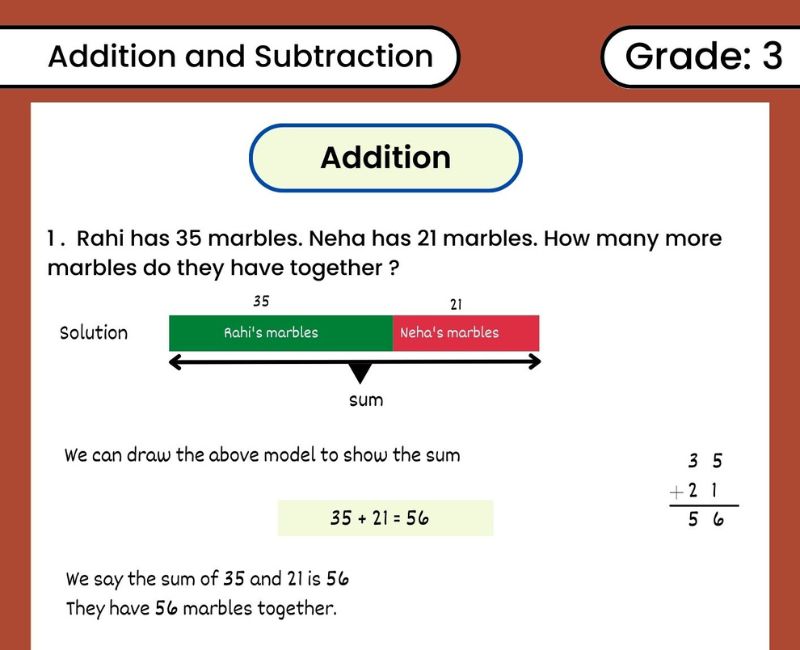
Write the amounts in columns with the ones, tens and hundreds lined up. Add the ones first and carry when a column makes 10 or more. For example, ₹125 + ₹148: ones 5 + 8 = 13, write 3 and carry 1. Tens 2 + 4 + 1 = 7. Hundreds 1 + 1 = 2. The sum is ₹273.
Subtracting rupees
Write the bigger amount on top. Subtract the ones first and regroup a ten when the top digit is too small. For example, ₹100 − ₹64 = ₹36. We can check the answer by adding: 64 + 36 = 100.
Adding rupees and paise
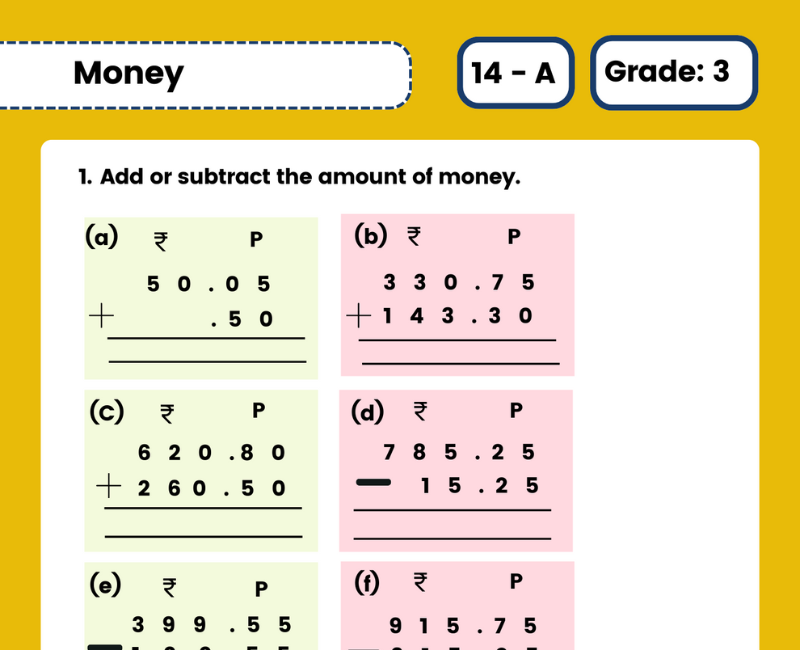
1 rupee = 100 paise. When an amount has rupees and paise, add the paise to the paise and the rupees to the rupees. If the paise make 100 or more, change 100 paise into ₹1 and add it to the rupees. For example, ₹2 and 75 paise + ₹1 and 50 paise: paise 75 + 50 = 125 paise, which is ₹1 and 25 paise. Rupees 2 + 1 + 1 = 4. The total is ₹4 and 25 paise.
Finding the total cost of several items
To find the total cost of two or three things, add all the prices. Add two prices first and then add the third price to that total. For example, a pen for ₹18, a notebook for ₹45 and an eraser for ₹7 cost 18 + 45 + 7 = ₹70 in all.
Finding the money left
Money left = money you had − money you spent. If Riya has ₹500 and buys a toy for ₹275, she has 500 − 275 = ₹225 left. If you buy more than one thing, add their prices first and then subtract the total from the money you had.
What is change?
Change is the money the shopkeeper gives back when you pay more than the price. Change = money paid − price. If a toy costs ₹30 and you pay ₹50, the change is ₹20. You can check the change by counting on from the price: ₹30 plus ₹20 makes ₹50.
The cost of several items of the same kind
If one notebook costs ₹18, then 4 notebooks cost 4 × 18. You can break 18 into 10 and 8: 4 × 10 = 40 and 4 × 8 = 32, so 40 + 32 = ₹72. This is the same as adding ₹18 four times.
Comparing prices and finding the best buy
To compare two prices, compare the hundreds, then the tens, then the ones. The smaller price is cheaper. To find how much you save, subtract the smaller price from the bigger price. If Shop A sells a box for ₹85 and Shop B sells it for ₹78, you save 85 − 78 = ₹7 at Shop B. When items come in different sizes, find the price of one unit. If 2 kg of rice cost ₹104, then 1 kg costs ₹52.
Money word problems
Read the story slowly and underline the numbers. Decide whether to add, subtract or multiply. Write the number sentence, solve it and write the answer with the unit ₹. For example, Ravi wants a football that costs ₹350 and has saved ₹275. He needs 350 − 275 = ₹75 more.
Solved examples
Common mistakes
| Mistake | Correction |
|---|---|
| Adding when the story asks for change | Change means money paid minus price, so subtract. |
| Forgetting to carry or regroup | Add or subtract the ones first and carry or regroup when you need to. |
| Subtracting the bigger number from the smaller one | Always take the smaller amount from the bigger amount. |
| Writing paise over 99 in the paise place | Change 100 paise into ₹1 and add it to the rupees. |
| Forgetting to add all the items before finding the change | Find the total cost first. Then subtract it from the money paid. |
| Leaving out the ₹ sign | Always write the unit with the number. |
Money in daily life
We use addition and subtraction of money when we pay a shop bill, check the change, save for a toy or compare prices at two shops. Practising with a play shop, real prices from a shopping list or a school canteen menu helps children remember the rules.
What your child learns in the Class 3 money addition and subtraction worksheet
- Adding and subtracting amounts in rupees
- Adding rupees and paise and regrouping 100 paise as ₹1
- Finding the total cost of several items
- Finding the money left after shopping
- Making change from a payment
- Finding the cost of several items of the same kind
- Comparing prices to find the best buy and the saving
- Solving money word problems about buying and selling
Tips for parents and teachers
Set up a play shop at home with price tags and real or toy money. Ask your child to add up a bill and then to work out the change. Say the clue words aloud: “total means add, change means subtract.” Use the printable PDF worksheet for written practice and the online activities for quick revision. Revisit the common mistakes table when you see the same error twice.
Related Maths Worksheets
- Rupees and Paise worksheets for Class 3 with online activities and quizRupees to paise and back
- Addition and Subtraction word problems for Class 3Practise story problems
- Give and Take Class 3 worksheetsMore addition and subtraction
- Mental Maths worksheet for Class 3Quick sums in your head
- Equal sharing worksheet for Class 3Share money equally
- House of Hundreds II Class 3 worksheetNCERT Maths Mela practice
- Place Value Class 3 worksheet with online activities and quizHundreds, tens and ones
- Multiplication worksheets for Class 3Cost of several items
- Division Class 3 worksheet with online activities and quizShare into equal groups
- Data Handling Class 3 worksheet with online activities and quizRead simple charts
- Time worksheets for Class 3Hours and minutes
- Fractions Class 3 worksheet with online activities and quizParts of a whole
Frequently Asked Questions
What is money addition?
Money addition means putting amounts of money together to find a total. We add the prices of things we buy. Words such as total, altogether and in all tell us to add.
What is money subtraction?
Money subtraction means taking an amount away from another amount. We use it to find the money left, the change, how much more is needed and how much we save.
How do I add rupees and paise?
Add the paise to the paise and the rupees to the rupees. If the paise make 100 or more, change 100 paise into ₹1 and add it to the rupees. For example, 75 paise + 50 paise = 125 paise = ₹1 and 25 paise.
How do I find the total cost of several items?
Add all the prices. Add two prices first and then add the third price to that total. Write the answer with the ₹ sign.
How do I find the money left?
Subtract the money you spent from the money you had. If you bought more than one thing, add their prices first and then subtract the total.
What is change in money?
Change is the money you get back when you pay more than the price. Change = money paid − price. For example, 50 − 30 = ₹20.
How do I check the change I get?
Count on from the price to the money you paid, or add the price and the change. They should make the money you paid. For example, 30 + 20 = 50.
How do I find the cost of several items of the same kind?
Multiply the price of one item by the number of items. For example, 4 notebooks at ₹18 each cost 4 × 18 = ₹72.
How do I find the best buy?
Compare the prices for the same amount. The smaller price is cheaper. Subtract the prices to find how much you save. For different sizes, find the price of one unit first.
Which words tell me to add or subtract in a money story?
Total, altogether, in all and together mean add. Left, change, more, less and save mean subtract.
What are common mistakes in money addition and subtraction?
The most common mistakes are adding when the story asks for change, forgetting to carry or regroup, and forgetting to find the total cost before finding the change.
What is included on this money addition and subtraction page for Class 3?
This page has a printable PDF worksheet on money for Class 3, a 20-question online quiz and 15 online activities. The activities include giving change, adding price boards, finding the money left, adding rupees and paise and finding the better buy.
 Download