Class 3 Mathematics · NCERT Maths Mela Chapter 1
What’s in a Name Class 3 Maths Worksheet NCERT with Quiz and Activities
Count with marks, compare the lengths of names, read numbers and write number names. Learn Class 3 Maths Chapter 1 from the NCERT Maths Mela book, then use the What’s in a Name Class 3 worksheet and play the What’s in a Name Class 3 quiz and What’s in a Name Class 3 activities online.
What’s in a Name Class 3 Online Quiz
What’s in a Name Class 3 Activities
Explore the What’s in a Name Class 3 worksheet for NCERT Maths Mela Chapter 1 with a free online quiz and online activities. Use the Name Lab to see one box for every letter, spell and write number names, turn number names back into numbers, play number bingo, make marks on a wall, sort things that need electricity and solve number name riddles. Every activity is a game you can tap or type.
Practice sheet
What’s in a Name Class 3 Complete Guide
This guide supports the What’s in a Name Class 3 maths worksheet on this page. It covers Class 3 Maths Chapter 1 from the NCERT Maths Mela book, which is part of the latest NCERT syllabus for CBSE schools. Topics include counting with marks on a wall, one to one matching, comparing the lengths of animal names and friends’ names, counting letters, number cards and number names, number name puzzles, grouping and sorting things and a hair style table. Use it with the printable What’s in a Name worksheets for Class 3, the What’s in a Name Class 3 quiz and the 15 What’s in a Name Class 3 activities above.
Introduction to NCERT Class 3 Maths Chapter 1 What’s in a Name?
Book: Maths Mela, the NCERT Mathematics textbook for Class 3 (Grade 3). Chapter: 1, What’s in a Name? Board: CBSE and other schools that follow NCERT. This is the first chapter of the NCERT Class 3 maths book. It opens with a story about two cowherds, Deba and Deep, who keep track of their cows with marks on a wall, and it carries on with names, number names and groups. The chapter shows that children can count, compare and sort things long before they work with big numbers.
What is there in the chapter?
- The story of Deba and Deep and the marks on the wall, and Hemant’s cows and sheep
- The animal team game: find the captains with the longest and shortest names
- Friends’ names: longest, shortest, starting letters and ending letters
- Teji and Jojo’s number cards, number names and counting their letters
- Let Us Think: numbers between 1 and 99 with 8 letters
- Number name puzzles, and a fun fact about place names in India
- Grouping picture cards and household objects, including things that need electricity
- The hair styles table
NCERT Class 3 learning objectives for this chapter
These objectives are written from the content of the chapter. They are not copied from the book.
- To keep track of a group of things using marks and one to one matching
- To compare names by counting their letters
- To write the number name of a number up to 99 and to read a number name and write the number
- To count the letters in number names and compare them
- To look for what is common in numbers that have the same number of letters
- To put things into groups using a rule and to say the rule
- To collect simple information about the class and record it in a table
Learning outcomes
After this chapter and the practice on this page a Class 3 child should be able to:
- make a mark for each thing and strike one out for each thing that comes back, and say whether anything is missing
- find the longest and the shortest name in a list by counting letters
- write the number name of any number up to 99 with the right spelling and a dash where needed
- read a number name and write the number in digits
- count the letters in a number name
- solve a simple number name puzzle by using the clues one by one
- sort objects into two groups, such as things that need electricity and things that do not, and explain the rule
- fill in and read a table about hair styles in the class
What’s in a Name Class 3 resources on this page
- What’s in a Name Class 3 worksheet: a printable NCERT style worksheet on counting, comparing names, number names and grouping.
- What’s in a Name Class 3 quiz: a free 20-question online quiz with easy, average and thinking questions, picture questions and instant marks with a reason for every answer.
- What’s in a Name Class 3 activities: 15 free online activities, made of 5 games, 5 workshops and 5 challenges, with marks and a comment after the challenges.
- Practice sheet: 16 questions you can type and check, with a Show answers button.
What is Class 3 Maths Chapter 1 What’s in a Name?
Chapter 1 of the NCERT Class 3 Maths book Maths Mela is called What’s in a Name? The chapter uses stories, names and everyday things to help children count, compare, group and keep records. Children do not need big numbers here. They need to look carefully, count one by one and explain what they notice.
Counting with marks: Deba and Deep
The chapter begins with a cowherd family in Tarakeshwar. Every day Deba and Deep take the cows out to graze, and they come back together in the late evening. One day Deba asks how they can know that no cow is lost. They do not know how to count. Their friend tells them to make a mark on the wall for each cow that leaves the gate, and to strike out one mark each time a cow comes back in through the gate. The next day all the marks are struck out when they get home.
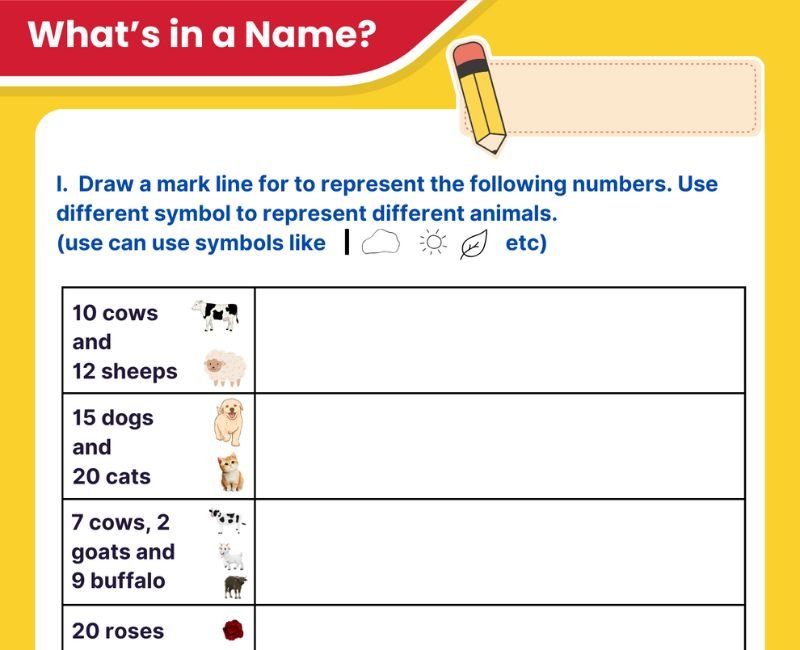
Years later they have many more cows. When they return, two marks are still left on the wall, but they cannot see any cows outside. They worry, search and find the missing cows in a nearby field. The children think about why Deba and Deep were worried and how many cows reached home. This idea is called one to one matching. One mark matches one cow. Then the book asks children to help Hemant, who has 36 cows and 23 sheep, keep track of them by making marks in the same way.
Comparing the lengths of names
Some animals and birds get together to play a game and want to make two teams. The captain of the first team is the one with the longest name, which means the most letters. The captain of the second team is the one with the shortest name, which means the fewest letters. The ten animals in the book are tiger, snake, dog, lion, goat, elephant, ox, deer, monkey and rat. Children count the letters to find both captains. The book then asks whether any animal has a longer name than the first captain, and who has a longer name when two children compare theirs.
Next children write the names of their friends and tick the longest name and cross the shortest. They find the starting letter of their own name, count the names that start with the same letter, find the most used starting letter, count names with the same ending letter and list the letters that are not the start of any name.
| Animal name | Letters | Longer or shorter |
|---|---|---|
| ox | 2 | Shortest in the list (second team captain) |
| rat | 3 | Short |
| deer | 4 | Medium |
| tiger | 5 | Medium |
| monkey | 6 | Long |
| elephant | 8 | Longest in the list (first team captain) |
Number cards and number names
Teji and Jojo make numbers using cards with words such as one, two, ten, twenty and ninety. Teji makes her roll number 43 with the cards forty and three. Its number name has 10 letters. Jojo makes his roll number 17 with the card seventeen, and children count its letters. Then children write their own roll number with the cards, count the letters and write other numbers and their names in a notebook.
Teji and Jojo also find that fifty-six has 8 letters, because fifty has 5 letters and six has 3 letters. The Let Us Think box asks for other numbers between 1 and 99 whose names have 8 letters. forty-two is one example. We do not count the dash. The teacher’s note asks children to observe what is common in numbers that have the same number of letters.
| Number | Number name | Letters |
|---|---|---|
| 6 | six | 3 |
| 9 | nine | 4 |
| 17 | seventeen | 9 |
| 43 | forty-three | 10 |
| 56 | fifty-six | 8 |
| 70 | seventy | 7 |
| 77 | seventy-seven | 12 |
Writing number names
This chapter asks children to write numbers in words and to read number names and write the numbers. Learn the names in three steps. First learn one to nineteen, because some of them are special: eleven, twelve and the names ending in teen. Second learn the tens: twenty, thirty, forty, fifty, sixty, seventy, eighty and ninety. Third join a tens word and a ones word with a dash for numbers from 21 to 99, such as forty-two or sixty-five.
| Number | Number name | Number | Number name |
|---|---|---|---|
| 1 | one | 11 | eleven |
| 2 | two | 12 | twelve |
| 3 | three | 13 | thirteen |
| 4 | four | 14 | fourteen |
| 5 | five | 15 | fifteen |
| 8 | eight | 18 | eighteen |
| 20 | twenty | 40 | forty |
| 30 | thirty | 50 | fifty |
| 60 | sixty | 90 | ninety |
Spelling tips: forty has no u, unlike four and fourteen. Eighteen has only one t after the h. Ninety keeps its e, unlike nine. To turn a name back into a number, write the tens digit from the tens word and the ones digit from the ones word. sixty-seven is 60 + 7 = 67.
Number name puzzles
The chapter asks children to find the numbers between 1 and 99 whose names are the longest. Then there are riddles. In one, a number name has two words, the first with 6 letters and the second with 5 letters, and the number is very near 100. In the other, the numbers from 63 to 78 are friends and the one with the smallest name is the answer. That answer is seventy, with 7 letters. Children then make riddles of their own and ask classmates. Write each number name, count the letters and cross off the ones that do not fit every clue.
Grouping and sorting
Teji puts picture cards into two groups, those that eat food and those that do not. Jojo arranges the same cards differently and children say what is common in each of his groups. Then children write household objects, which are a TV, a lamp, a chair, a bed, a clock, a pillow, a fan and a blanket, into the groups things that need electricity and things that do not. They group the objects in a different way too. The teacher’s note says every object must belong to one group or the other and that more than one way of grouping can be right, so children should say their rule.
Hair styles table
Mala is going to school and her mother has combed her hair into two ponytails. Children look at the children in their class, notice that everyone combs their hair in different ways, and fill in a table of hair style and number of children. Counting each style and adding the counts gives the number of children in the class.
Types of questions to practise
Questions on this chapter ask children to count marks on a wall, find the longest and shortest names, write number names and count their letters, solve number name puzzles, sort things into groups and fill in a hair styles table. The online quiz on this page mixes choice questions, true or false questions and typed answers, and the practice sheet has 16 typed answers.
Solved examples
Common mistakes
| Mistake | Correction |
|---|---|
| Writing fourty for 40 | 40 is spelt forty, with no u. |
| Writing the number name without a dash, such as sixty four | Use a dash from 21 to 99. 64 is sixty-four. |
| Counting the dash in a number name | Count only the letters. fifty-six has 8 letters. |
| Skipping or counting a letter twice | Touch each letter once, or tick it as you count. |
| Thinking a bigger number always has a longer name | Not always. 70 is seventy with 7 letters, but 66 is sixty-six with 8 letters. |
| Striking out a mark when a cow goes out | Make a mark when a cow goes out. Strike a mark out when a cow comes back. |
| Losing count of a long row of marks | Tick each mark as you count, or group the marks in fives. |
| Giving only one rule for grouping | Many rules can work. Say the rule you used. |
Counting and names in daily life
We use these skills when we count children in a line, check that all the bags came back from a trip or keep score in a game with marks. Ask your child to count the letters in family names, find the shortest name in the family and sort things at home by a rule they choose.
What your child learns from the What’s in a Name worksheet
- Counting with one to one matching
- Keeping records with marks on a wall
- Comparing the lengths of names
- Number names from 1 to 100
- Counting letters and finding patterns
- Solving number name puzzles
- Grouping and sorting by a rule
- Reading a simple hair style table
Tips for parents and teachers
Use real things, such as pebbles, to match one to one, and let your child keep track of who enters and leaves the room with marks. Write names on paper strips and compare them side by side. Let your child choose the rule for sorting and explain it. Praise careful counting more than speed, and ask how your child knows the answer.
Related Maths Worksheets
- Mental Maths Worksheet Class 3
- Fractions Worksheet Class 3
- Data Handling Worksheet Class 3
- Place Value Worksheet Class 3
- Addition and Subtraction Word Problems Worksheet Class 3
- Play with Patterns Worksheet Class 3
- Multiplication Worksheet Class 3
- Addition and Subtraction Worksheet Class 3
- Measurement Long and Short Worksheet Class 3
- Measurement of Weight Worksheet Class 3
- Front Top and Side View Worksheet Class 3
- Geometry Worksheet Class 3
Frequently Asked Questions
What is Class 3 Maths Chapter 1 What’s in a Name?
It is the first chapter of the NCERT Class 3 Maths book Maths Mela. Children count with marks, compare the lengths of names, count the letters in number names, group things and read a simple survey.
Who are Deba and Deep in the chapter?
Deba and Deep are two cowherds from Tarakeshwar. They make a mark on the wall for each cow that leaves the gate and strike out a mark for each cow that comes back, to check that no cow is lost.
How did Deba and Deep count their cows?
They used one to one matching. One mark stands for one cow. Once, two marks were left after the cows came back, so they went looking and found the missing cows in a nearby field.
How do I find the longest and shortest name?
Count the letters in each name. In the book’s animal game, elephant has the most letters and is first team captain. ox has the fewest letters and is second team captain.
How do I read a number name and write the number?
Find the tens word and the ones word. sixty-seven has the tens word sixty, which is 60, and the ones word seven. Write 6 in the tens place and 7 in the ones place to get 67. fifty-six has 8 letters, if you are asked to count them.
Which number between 63 and 78 has the shortest name?
The number 70, seventy, has the shortest name. It has 7 letters. sixty-six has 8 letters and seventy-seven has 12 letters.
How do I write a number name from 21 to 99?
Write the tens word, then a dash, then the ones word. 42 is forty-two, 65 is sixty-five and 99 is ninety-nine. Numbers like 20, 30 and 90 have only the tens word.
How can I count a large group without numbers?
Make one mark for each thing that goes out and strike out one mark for each thing that comes back, as Deba and Deep did. If marks are left, something is missing. You can group the marks in fives so a long row is easy to read.
How do I group things in this chapter?
Pick a rule and put each thing in one group or the other. A TV, a lamp and a fan need electricity. A chair, a bed, a pillow and a blanket do not. A clock is also in the book’s list. You can also group by use. More than one rule can be right.
How do I fill in the hair styles table?
Look at the children in your class and write each hair style, such as one ponytail, two ponytails or a plait. Count how many children have each style and write the number in the table.
Does this page have What’s in a Name Class 3 questions and answers?
Yes. The online quiz shows the right answer and the reason after you finish, and the practice sheet has a Show answers button. The printable worksheet is the 6-page PDF download for this chapter.
What is included on this page?
This page has a free 20-question What’s in a Name Class 3 online quiz with instant marks, 15 online activities made of 5 games, 5 workshops and 5 challenges, a Name Lab, a 16-question practice sheet and a complete guide with solved examples.
 Download