Class 3 Mathematics · NCERT Maths Mela Chapter 14
The Surajkund Fair Class 3 Maths Worksheet NCERT with Quiz and Activities
Learn symmetry with malas, rangolis and masks, find mirror images, tile a path with no gaps and read a map of a fair. Learn Class 3 Maths Chapter 14 from the NCERT Maths Mela book, then use The Surajkund Fair Class 3 worksheet and play The Surajkund Fair Class 3 quiz and The Surajkund Fair Class 3 activities online.
The Surajkund Fair Class 3 Online Quiz
True or false: The two halves of a symmetrical object are exactly the same.
The Surajkund Fair Class 3 Activities
Read the idea, try the lab, then tap Games, Workshops or Challenges to play.
Explore the The Surajkund Fair Class 3 worksheet for NCERT Maths Mela Chapter 14 with a free online quiz and online activities. Use the Add and Subtract lab to see blocks, carrying and opening a ten, jump on a number grid, choose the sentence for a box diagram, pay exact amounts with notes and coins, estimate to the nearest hundred and make the biggest sum from number cards. Every activity is a game you can tap or type.
Mirror lab
Tap squares on the left side to colour them. The right side shows the mirror image. The red dotted line is the line of symmetry.
4 coloured squares on each side
- A square next to the line on the left has its mirror square next to the line on the right.
- Row stays the same. The distance from the line stays the same.
- If you fold the picture along the line, the two halves fit exactly on each other. The picture is symmetrical.
Mirror Counters
Game 1 of 5Goal: Place counters as the mirror image of the others.
How to play: Tap squares on the blue side. Press Check.
Task 1 of 3: The red counters are on one side. Tap the squares on the other side to place the blue counters as their mirror image. Press Check.
Practice sheet
Type your answers in the boxes. For word answers write in small letters. Press Check when you finish.
ASymmetry
BMalas and boxes
CTiles
DMap of the fair
The Surajkund Fair Class 3 Complete Guide
This guide supports The Surajkund Fair Class 3 maths worksheet on this page. It covers Class 3 Maths Chapter 14 from the NCERT Maths Mela book, which is part of the latest NCERT syllabus for CBSE schools. Topics include symmetry, symmetrical malas and rangolis, mirror images, the mirror game, tiling a path with no gaps and no overlaps, making tiles and paths, reading a map and giving directions. Use it with the printable The Surajkund Fair worksheets for Class 3, The Surajkund Fair Class 3 quiz and the 15 The Surajkund Fair Class 3 activities above.
Introduction to NCERT Class 3 Maths Chapter 14 The Surajkund Fair
Book: Maths Mela, the NCERT Mathematics textbook for Class 3 (Grade 3). Chapter: 14, The Surajkund Fair. Board: CBSE and other schools that follow NCERT. Soni and Avi visit a fair at Surajkund in Faridabad district, Haryana with their grandparents. At the stalls they make malas, draw rangolis, make masks, play a mirror game, tile a path and read a map of the fair. Through these everyday scenes children learn what symmetry is, how mirror images work and how to find places using directions.
What is there in the chapter?
- A picture of the fair and a discussion on things that look the same from the left and right side
- Making malas with 8 beads of two colours and finding which malas are symmetrical
- Kolam and rangoli, drawing lines that divide a rangoli into two identical halves and tracing and folding
- Completing symmetrical rangolis such as pookalam from Kerala and aipan from Uttarakhand
- Making a mask by folding paper and finding why a mask that is not symmetrical is hard to see through
- A story about a painter and a mirror, to see that a mirror shows the other half
- The mirror game with counters on two sides of a line
- Odd one out, filling boxes with two colours so that one side is the mirror image of the other, and shape cutouts that fit
- Tiling the paths with shapes with no gaps and no overlaps and making tiles with two or more shapes
- Reading words such as near, in front of, second and next to in order to find a stall
- A map of the fair with signs, lanes, turns and exits, and finding the way to the chaupal and the ATM
- A maze to exit the fair
NCERT Class 3 learning objectives for this chapter
These objectives are written from the content of the chapter. They are not copied from the book.
- To know that a symmetrical object has two halves that match exactly
- To find and draw a line that divides a shape into two equal halves
- To complete a pattern so that it is symmetrical
- To use a mirror or paper folding to check symmetry
- To place objects as the mirror image of other objects
- To fill a space with tiles with no gaps and no overlaps
- To read a simple map and use words such as left, right, forward and back
- To describe a path from one place to another
Learning outcomes
After this chapter and the practice on this page a Class 3 child should be able to:
- say that a symmetrical mala has two matching halves
- tell which letters, such as A, H, M and T, are symmetrical
- find the mirror image of counters on a grid
- say that hexagon tiles fill a floor with no gaps but round tiles do not
- count tiles on a floor, such as 4 long and 3 wide making 12
- read a map and say which place is to the right of or above another place
- give directions using forward, left and right
- say why a mask with eye holes at different places is not symmetrical
The Surajkund Fair Class 3 resources on this page
- The Surajkund Fair Class 3 worksheet: a printable NCERT style worksheet on symmetry, tiles and maps.
- The Surajkund Fair Class 3 quiz: a free 20-question online quiz with easy, average and thinking questions, picture questions and instant marks with a reason for every answer.
- The Surajkund Fair Class 3 activities: 15 free online activities, made of 5 games, 5 workshops and 5 challenges, with marks and a comment after the challenges.
- Practice sheet: 16 questions you can type and check, with a Show answers button.
What is symmetry?
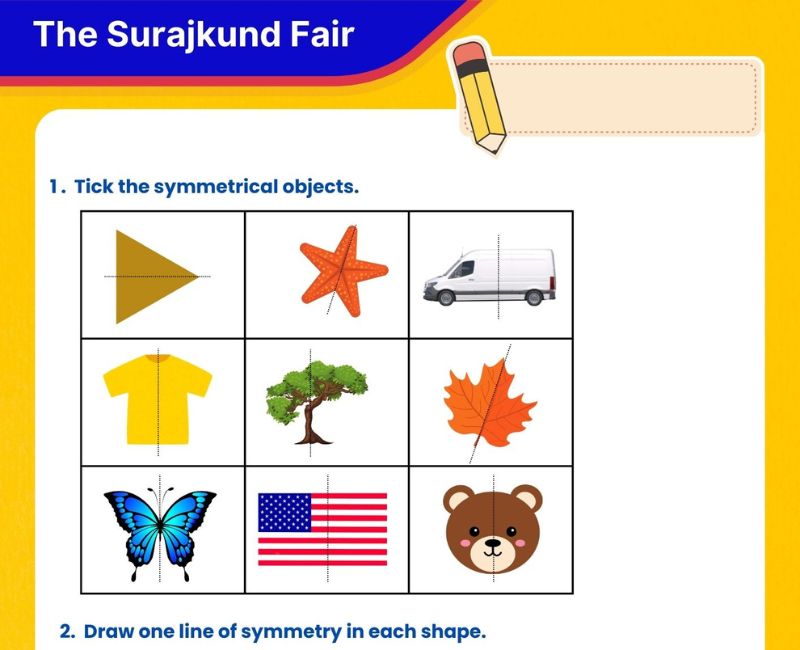
A shape or an object is symmetrical if it can be divided into two halves that are exactly the same, so that one half falls exactly on the other half when folded along a line. This line is called the line of symmetry. A butterfly with open wings, a kite, the letter A and a rangoli with two equal halves are symmetrical. A right triangle, a parallelogram and the letter F are not.
Symmetrical malas
A mala with 8 beads of two colours is symmetrical when the first bead matches the last, the second matches the second last, and so on. R B B R R B B R is symmetrical because the order read from the left is the same as the order read from the right. R R B B B R B R is not. To make a symmetrical mala you only choose the first 4 beads. The other 4 are their mirror image. With 4 red and 4 blue beads the first half must have 2 red and 2 blue, which can be made in 6 ways. With 6 red and 2 blue beads the first half has 3 red and 1 blue, which can be made in 4 ways.
| Mala (8 beads) | Symmetrical? |
|---|---|
| R B B R R B B R | Yes |
| B R R R R R R B | Yes |
| R R B B B R B R | No |
| B B R R R R R R | No |
Rangolis, kolams and masks
Many kolams and rangolis are symmetrical. You can draw a line that divides them into two identical halves. To check, trace the design on paper and fold it so that one half lies exactly on the other half. To complete a symmetrical rangoli, draw each dot or line of the second half as far from the line as it is on the first half, but on the other side. A paper mask cut from a folded sheet has two matching halves. If the eye holes are not made at matching places, the mask is not symmetrical and one hole may not fall in front of the eye.
Mirror images and the mirror game
In the mirror game one player places counters on one side of a line and the other player places counters as the mirror image on the other side. A counter next to the line stays next to the line. A counter far from the line stays far from the line on the other side. The row stays the same. Place a mirror on the line to check. The painter in the story took advantage of this: he drew half a picture and said the other half is the mirror. A mirror shows the other half, but it does not make a real second half.
Tiling the paths
Tiles are used to cover floors and paths. The tiles must fit with no gaps and no overlaps. Squares, rectangles, equilateral triangles and regular hexagons fit well. Round tiles leave gaps. To count tiles on a floor that is 4 tiles long and 3 tiles wide, count the tiles in one row and multiply by the number of rows: 3 × 4 = 12. Two or more shapes can also be joined to make a new tile, which can then be repeated to create a path.
Maps and directions
A map is a picture of a place seen from above. It uses small pictures or signs for the places, such as the entry, parking, restaurant, pond, play area and chaupal. To use a map we use words such as forward, back, left and right, and also near, in front of and next to. On the map on this page forward is up. From the Entry, 1 step forward is the Restaurant and 1 step more to the right is the Pond. Always say where you start, which way you face and how many steps you take.
| Move | On the map on this page |
|---|---|
| Forward | Up one row |
| Back | Down one row |
| Left | One column to the left |
| Right | One column to the right |
Types of questions to practise
Questions on this chapter ask children to find symmetrical objects and malas, draw lines of symmetry, complete patterns, place counters as mirror images, count tiles on a floor, read a map and give directions. The online quiz on this page mixes choice questions, true or false questions, picture questions and typed answers, and the practice sheet has 16 typed answers.
Solved examples
Common mistakes
| Mistake | Correction |
|---|---|
| Thinking a copy of the same picture is a mirror image | A mirror image is flipped. Left becomes right. |
| Putting the mirror counter in the same column number | A counter in column 1 on the left goes to column 4 on the right. |
| Thinking every shape is symmetrical | A right triangle and a parallelogram have no line that makes two matching halves. |
| Drawing a line that cuts the shape in unequal parts | Both halves must match exactly. |
| Thinking round tiles fill a floor | Round tiles leave gaps. Squares and hexagons do not. |
| Counting only one row of tiles | Multiply the tiles in a row by the number of rows. |
| Mixing up left and right on a map | Right is to your right side. Say which way you face first. |
| Counting the start place as a step | Do not count the place you start from. Count each move. |
Symmetry and maps in daily life
We see symmetry in butterflies, leaves, flowers, rangolis, tiles, buildings and letters. We use maps of markets, schools, parks and cities. Ask your child to find symmetrical things at home, to place a mirror on a picture and to tell you the way from the gate to the kitchen using left, right and forward.
What your child learns from The Surajkund Fair worksheet
- What symmetry and a line of symmetry are
- Symmetrical malas, letters, shapes and rangolis
- Mirror images and the mirror game
- Tiles with no gaps and no overlaps
- Counting tiles in rows
- Reading a map
- Giving directions with forward, back, left and right
- Logical thinking by counting ways
Tips for parents and teachers
Give your child a string and beads of two colours to make malas and check whether they are symmetrical. Fold paper and cut shapes to see symmetry. Use a small mirror on a line in a picture. Play the mirror game with coins. Look for tiles on a floor and count the tiles in a row. Draw a simple map of your home or street and give directions to find a hidden object.
Related Maths Worksheets
- Fun with Shapes Worksheet Class 3
- Geometry Worksheet Class 3
- Time Goes On Worksheet Class 3
- Give and Take Worksheet Class 3
- Filling and Lifting Worksheet Class 3
- Fun at Class Party Worksheet Class 3
- Fair Share Worksheet Class 3
- Raksha Bandhan Worksheet Class 3
- Measurement Long and Short Worksheet Class 3
- Play with Patterns Worksheet Class 3
- Data Handling Worksheet Class 3
- Mental Maths Worksheet Class 3
Frequently Asked Questions
What is Class 3 Maths Chapter 14 The Surajkund Fair?
It is the fourteenth chapter of the NCERT Class 3 Maths book Maths Mela. Children learn about symmetry using malas, rangolis and masks, play the mirror game, tile paths with no gaps and read a map of a fair.
What is symmetry?
An object is symmetrical if it can be divided into two halves that match exactly. One half falls on the other half when the object is folded along the line of symmetry.
How do I know if a mala is symmetrical?
The first bead must match the last bead, the second must match the second last bead, and so on. R B B R R B B R is symmetrical.
How many symmetrical malas can be made with 4 red and 4 blue beads?
6. The first 4 beads must have 2 red and 2 blue, which can be arranged in 6 ways, and the other half is the mirror image.
What is a mirror image?
A mirror image is what you see in a mirror placed on a line. Left becomes right and the distance from the line stays the same.
Which letters are symmetrical?
Letters such as A, H, I, M, O, T, U, V, W, X and Y have two matching halves on the left and right of a line down the middle. F, G, R and P do not.
What does tiling with no gaps and no overlaps mean?
It means the tiles cover the whole floor with no empty spaces between them and no tile lying on another. Squares and hexagons do this. Round tiles do not.
How do I count tiles on a floor?
Count the tiles in one row and multiply by the number of rows. A floor 4 tiles long and 3 tiles wide has 3 × 4 = 12 tiles.
How do I read a map?
Find the place where you start, decide which way you face and then follow the steps using forward, back, left and right. Check the signs and names on the map.
Why could Avi see with only one eye in his mask?
His mask was not symmetrical. The eye holes were not at matching places on the two halves, so one hole was not in front of his eye.
Does this page have The Surajkund Fair Class 3 questions and answers?
Yes. The online quiz shows the right answer and the reason after you finish, and the practice sheet has a Show answers button. The printable worksheet is the PDF download for this chapter.
What is included on this page?
This page has a free 20-question The Surajkund Fair Class 3 online quiz with instant marks, 15 online activities made of 5 games, 5 workshops and 5 challenges, a Mirror lab, a 16-question practice sheet and a complete guide with solved examples.
 Download