Class 3 Mathematics · NCERT Maths Mela Chapter 6
House of Hundreds I Class 3 Maths Worksheet NCERT with Quiz and Activities
Count beyond 200 in tens and ones, read hundreds, tens and ones, find houses by floor and column, compare 3-digit numbers with greater than and less than and write number names. Learn Class 3 Maths Chapter 6 from the NCERT Maths Mela book, then use the House of Hundreds I Class 3 worksheet and play the House of Hundreds I Class 3 quiz and House of Hundreds I Class 3 activities online.
House of Hundreds I Class 3 Online Quiz
House of Hundreds I Class 3 Activities
Tap a coloured button to choose what to do.
Explore the House of Hundreds I Class 3 worksheet for NCERT Maths Mela Chapter 6 with a free online quiz and online activities. Use the Hundreds Home lab to find a house by floor and column, build numbers with hundred bundles, ten bundles and loose sticks, jump on the number line, compare numbers with greater than and less than, make the greatest and smallest numbers from three digits and write number names above 200. Every activity is a game you can tap or type.
Practice sheet
House of Hundreds I Class 3 Complete Guide
This guide supports the House of Hundreds I Class 3 maths worksheet on this page. It covers Class 3 Maths Chapter 6 from the NCERT Maths Mela book, which is part of the latest NCERT syllabus for CBSE schools. Topics include counting beyond 200 in tens and ones, number sentences like 200 and 35 more, hundreds tens and ones, number lines, finding houses by floor and column, comparing 3-digit numbers with greater than and less than, forming and ordering numbers and writing number names. Use it with the printable House of Hundreds worksheets for Class 3, the House of Hundreds I Class 3 quiz and the 15 House of Hundreds I Class 3 activities above.
Introduction to NCERT Class 3 Maths Chapter 6 House of Hundreds I
Book: Maths Mela, the NCERT Mathematics textbook for Class 3 (Grade 3). Chapter: 6, House of Hundreds I. Board: CBSE and other schools that follow NCERT. In this chapter children go beyond 200 and learn how 3-digit numbers are built from hundreds, tens and ones. They count in groups of 10, place numbers on number lines, find numbers in a tall building where each floor adds 10, and compare and arrange 3-digit numbers. The next chapter, House of Hundreds II, continues from here.
What is there in the chapter?
- Counting objects in groups of 10 beyond 200 and filling missing numbers
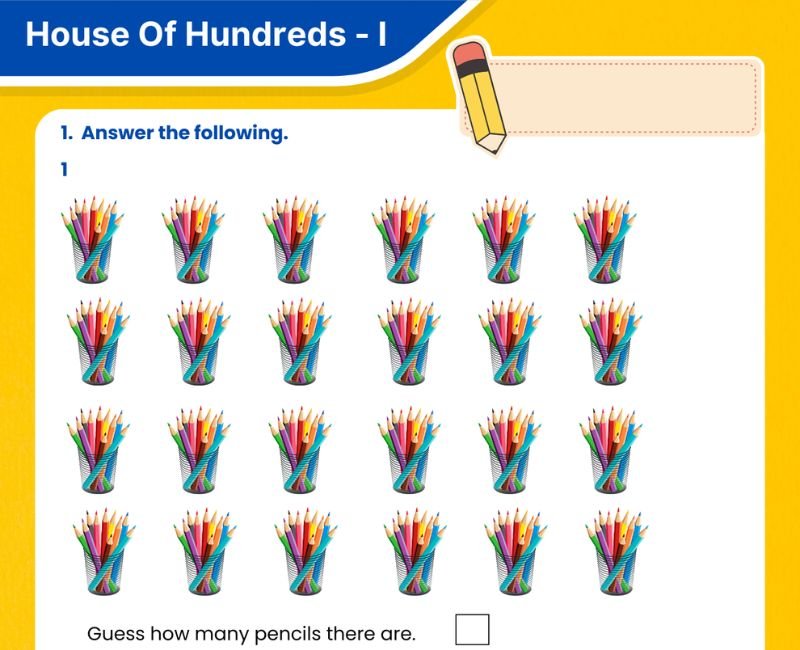
- Estimating how many and checking with matchstick bundles of 100, 10 and 1
- Number sentences such as 200 and 35 more and 15 less than 250
- Placing numbers on number lines such as 0 to 350, 200 to 260 and 320 to 400
- A number slider that increases or decreases a number by 1, 10, 2 or 20
- A guessing game with a hidden number between 200 and 210
- The next hundred, and trays of 100 sweets
- An apartment building where the house number goes up by 10 on each floor and by 1 along each column
- Who am I? digit riddles, sweets in boxes of 100, 10 and 1, and a hunt for numbers with the digit 5
- Comparing 3-digit numbers with greater than and less than
- Making 3-digit numbers from three digits, with and without repeating, and arranging numbers in order
NCERT Class 3 learning objectives for this chapter
These objectives are written from the content of the chapter. They are not copied from the book.
- To count forward and backward in ones and tens beyond 200
- To read, write and show 3-digit numbers using hundreds, tens and ones
- To add or take away 1, 10 or 100 and find the number that results
- To place 3-digit numbers on a number line
- To understand that 10 tens make 100 and to find the next hundred
- To find numbers by floor and column and notice the pattern of 10 and 1
- To compare 3-digit numbers using greater than and less than
- To make and arrange 3-digit numbers from given digits
Learning outcomes
After this chapter and the practice on this page a Class 3 child should be able to:
- count on and back in tens and ones from any 3-digit number
- show a number such as 234 as 2 hundreds, 3 tens and 4 ones
- write the number name of a number such as 235 or 308
- say what 10 more, 10 less, 1 more and 1 less than a number are
- find the number that is a given jump from 400 or 300 on a number line
- find a house one floor above or below, or next to, another house
- compare two 3-digit numbers and put the right sign between them
- make the greatest and smallest 3-digit number from three digits
House of Hundreds I Class 3 resources on this page
- House of Hundreds I Class 3 worksheet: a printable NCERT style worksheet on 3-digit numbers, number names and comparing numbers.
- House of Hundreds I Class 3 quiz: a free 20-question online quiz with easy, average and thinking questions, picture questions and instant marks with a reason for every answer.
- House of Hundreds I Class 3 activities: 15 free online activities, made of 5 games, 5 workshops and 5 challenges, with marks and a comment after the challenges.
- Practice sheet: 16 questions you can type and check, with a Show answers button.
What is Class 3 Maths Chapter 6 House of Hundreds I?
Chapter 6 of the NCERT Class 3 Maths book Maths Mela is called House of Hundreds I. It is about 3-digit numbers. Children already know numbers up to 200. Here they see that 10 tens make 100, that every 3-digit number has hundreds, tens and ones, and that the order of the digits decides how big the number is.
Counting beyond 200 in tens and ones
The chapter starts with counting objects in groups of 10. Ten groups of 10 make 100, so a pile can be 200, 300 or more. Numbers such as 235 are read as 200 and 35 more. To count on from 299 add one and the next number is 300. When a number has 9 tens and 9 ones, one more makes the next hundred. Children also fill the missing numbers in a row and in a table.
| Number | Number sentence | Number name |
|---|---|---|
| 205 | 200 and 5 | two hundred five |
| 235 | 200 and 35 | two hundred thirty-five |
| 299 | 200 and 99 | two hundred ninety-nine |
| 300 | 3 hundreds | three hundred |
| 347 | 300 and 47 | three hundred forty-seven |
Hundreds, tens and ones with bundles
Matchstick bundles help children see place value. One big bundle is 100, a small bundle is 10 and a loose stick is 1. For 234 there are 2 bundles of 100, 3 bundles of 10 and 4 loose sticks. In the sweet shop each box holds 100 sweets, 10 sweets or 1 sweet, and children write the number with H, T and O columns for hundreds, tens and ones. For a number such as 306 there are no tens. For 340 there are no ones.
| Number | H | T | O |
|---|---|---|---|
| 234 | 2 | 3 | 4 |
| 306 | 3 | 0 | 6 |
| 340 | 3 | 4 | 0 |
| 425 | 4 | 2 | 5 |
Number sentences and the number slider
The chapter uses sentences such as 200 and 35 more and 15 less than 250. It also uses a number slider that increases or decreases a number by 1, 10, 2 or 20. Adding 10 changes only the tens digit unless there are 9 tens already. Taking away 10 does the same in reverse. Adding 1 changes the ones digit. 147 plus 10 is 157. 147 minus 10 is 137. 299 plus 1 is 300. 400 minus 1 is 399.
Number line
The chapter shows number lines from 0 to 350, from 200 to 260, from 320 to 400 and from 413 to 493. To place a number find the two tens or hundreds it lies between and count the steps. 235 lies halfway between 230 and 240. To find how far 387 is from 400 jump 3 to 390 and then 10 to 400. The total jump is 13.
Floors, columns and house numbers
Some apartment buildings in the chapter have houses numbered in order. On each floor the house number goes up by 1 as you move to the right along the columns. When you go up one floor the number goes up by 10. If house 234 is on a floor, the house above it is 244 and the house below it is 224. A house on the 4th floor and 6th column of a building that starts at 201 is house 236. Children fill a table of floor and column to find numbers.
| Move | What happens to the number | Example |
|---|---|---|
| One floor up | add 10 | 234 to 244 |
| One floor down | take away 10 | 275 to 265 |
| One house to the right | add 1 | 256 to 257 |
| One house to the left | take away 1 | 256 to 255 |
Who am I and the digit hunt
In Who am I? riddles children use clues about the hundreds, tens and ones digits to find a number. For example, a number with 3 hundreds, 0 tens and 4 ones is 304. They also hunt for all numbers between 200 and 300 that have the digit 5, such as 215, 250 and 255. A systematic list, going through one hundred at a time, helps them find every number.
Comparing 3-digit numbers
To compare two 3-digit numbers look at the hundreds digits first. The number with more hundreds is bigger. If the hundreds are the same, compare the tens. If the tens are also the same, compare the ones. Greater than is written as > and less than is written as <. The open side faces the bigger number. 487 > 423 and 207 < 270.
| Numbers | Compare | Sign |
|---|---|---|
| 356 and 342 | same hundreds, 5 tens is more than 4 tens | 356 > 342 |
| 207 and 270 | same hundreds, 0 tens is less than 7 tens | 207 < 270 |
| 415 and 451 | same hundreds, 1 ten is less than 5 tens | 415 < 451 |
| 518 and 481 | 5 hundreds is more than 4 hundreds | 518 > 481 |
Making and arranging numbers
With the digits 3, 2 and 4 a child can make many 3-digit numbers: 234, 243, 324, 342, 423 and 432. The greatest number puts the biggest digit in the hundreds place, then the next biggest. That gives 432. The smallest puts the smallest digit first. That gives 234. If digits may repeat there are many more numbers, such as 444 and 222. With a 0 take care. A 3-digit number cannot start with 0, so the smallest number from 5, 0 and 7 is 507. Children also arrange numbers in order from the smallest to the greatest.
Types of questions to practise
Questions on this chapter ask children to count on, fill missing numbers, write 3-digit numbers from bundles, find 10 more and 10 less, place numbers on a number line, find houses by floor and column, write number names, compare numbers, make numbers from digits and arrange numbers in order. The online quiz on this page mixes choice questions, true or false questions, picture questions and typed answers, and the practice sheet has 16 typed answers.
Solved examples
Common mistakes
| Mistake | Correction |
|---|---|
| Writing 300 and 6 as 3006 or 360 | 300 and 6 is 306. The ones digit is 6 and there are no tens. |
| Saying 1 less than 300 is 301 | 1 less than 300 is 299. 301 is one more. |
| Mixing up 306 and 360 | 306 has 0 tens and 6 ones. 360 has 6 tens and 0 ones. |
| Thinking 99 is more than 110 because 9 is big | 99 has two digits and 110 has three, so 110 is more. |
| Comparing the ones digit first | Always compare the hundreds first, then the tens, then the ones. |
| Adding 1 when going up a floor | One floor up adds 10. One house to the right adds 1. |
| Starting a 3-digit number with 0 | The smallest 3-digit number from 5, 0 and 7 is 507, not 057. |
| Writing fourty for 40 | 40 is spelt forty, with no u. |
3-digit numbers in daily life
We use these numbers for house numbers, page numbers, bus numbers and the cost of things in rupees. Ask your child to read the house number on a gate, to say the number that is 10 more and to say which of two bus numbers is greater. Count the steps in a staircase and guess how many tens are in a flight.
What your child learns from the House of Hundreds I worksheet
- Counting forward and back in tens and ones beyond 200
- Hundreds, tens and ones with bundles
- 10 more and 10 less than a number
- Number names above 200
- Number lines for 3-digit numbers
- Floors, columns and house numbers
- Comparing with greater than and less than
- Making and ordering 3-digit numbers
Tips for parents and teachers
Use matchsticks, straws or ice cream sticks and a rubber band to make real bundles of 10. Draw a building on paper with 10 floors and 10 houses on each floor and let your child number the houses. Play a guessing game with a hidden number and give hints with bigger or smaller. Ask your child to explain how they compared two numbers, starting with the hundreds.
Related Maths Worksheets
- Mental Maths Worksheet Class 3
- What’s in a Name Worksheet Class 3
- Toy Joy Worksheet Class 3
- Double Century Worksheet Class 3
- Vacation with My Nani Maa Worksheet Class 3
- Fun with Shapes Worksheet Class 3
- House of Hundreds II Worksheet Class 3
- Place Value Worksheet Class 3
- Addition and Subtraction Worksheet Class 3
- Multiplication Worksheet Class 3
- Play with Patterns Worksheet Class 3
- Measurement Long and Short Worksheet Class 3
Frequently Asked Questions
What is Class 3 Maths Chapter 6 House of Hundreds I?
It is the sixth chapter of the NCERT Class 3 Maths book Maths Mela. Children count beyond 200, read and write 3-digit numbers with hundreds, tens and ones, find numbers by floor and column, compare numbers and make numbers from digits.
What are hundreds, tens and ones?
They are the three places in a 3-digit number. In 234 the 2 means 2 hundreds, the 3 means 3 tens and the 4 means 4 ones. So 234 is 200 + 30 + 4.
How many tens make 100?
10 tens make 100. Ten bundles of 10 sticks make a bundle of 100 sticks, and 10 boxes of 10 sweets fit in a box of 100.
How do I find 10 more or 10 less than a number?
Add 1 to the tens digit for 10 more and take 1 from the tens digit for 10 less. 147 has 10 more at 157 and 10 less at 137. For 1 more or 1 less change the ones digit.
What comes after 299?
After 299 comes 300. The ones and tens go back to 0 and the hundreds digit goes up by 1. After 399 comes 400.
How do I write number names above 200?
Write the hundreds first and then the tens and ones. 235 is two hundred thirty-five and 308 is three hundred eight. Use a dash between the tens and ones from 21 to 99.
How do house numbers change on floors and columns?
Moving one house to the right adds 1. Moving one floor up adds 10. Moving one floor down takes away 10. If house 234 is on a floor, the house above it is 244.
How do I compare 3-digit numbers?
Compare the hundreds first. The number with more hundreds is greater. If the hundreds are the same, compare the tens. If those are the same, compare the ones. 356 > 342 and 207 < 270.
How do I make the greatest and smallest number from three digits?
For the greatest number put the biggest digit in the hundreds place, then the next biggest. From 3, 2 and 4 that is 432. For the smallest number put the smallest digit first, but not 0. That gives 234.
How do I show a number on the number line?
Find the two tens it lies between and count the steps. 235 lies halfway between 230 and 240. To reach 400 from 387 jump 3 to 390 and 10 more to 400.
Does this page have House of Hundreds I Class 3 questions and answers?
Yes. The online quiz shows the right answer and the reason after you finish, and the practice sheet has a Show answers button. The printable worksheet is the PDF download for this chapter.
What is included on this page?
This page has a free 20-question House of Hundreds I Class 3 online quiz with instant marks, 15 online activities made of 5 games, 5 workshops and 5 challenges, a Hundreds Home lab, a 16-question practice sheet and a complete guide with solved examples.
 Download