Class 3 Mathematics
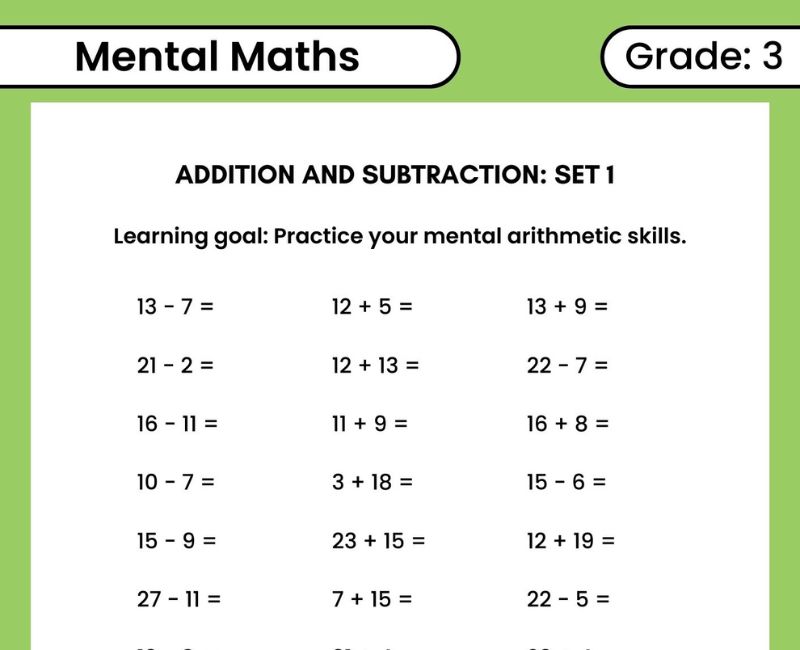
Mental Maths Worksheet for Class 3 with Quiz and Activities
Add, subtract, multiply and divide in your head with quick strategies. Learn number bonds, doubles, tables and rounding, then use the Mental Maths worksheet for Class 3 and play the Mental Maths Class 3 quiz and Mental Maths Class 3 activities online.
Mental Maths Class 3 Online Quiz
True or false: 9 + 6 = 15.
Mental Maths Class 3 Activities
Explore the mental maths worksheet for Class 3 with a free online quiz and online activities. Watch a strategy work step by step in the Strategy Lab, fill a ten frame, hop a frog along a number line, build arrays, share sweets equally, round on a number line and beat a number machine. Every activity is a game you can tap or type.
Strategy lab
Pick a strategy. Press Next step to watch the mental maths happen one step at a time.
8 + 7 = ?
Make a ten first. Ten is an easy number to add to.
Make Ten
Game 1 of 5Goal: Find how many more counters fill the ten frame.
How to play: Look at the frame. Tap the number that makes 10.
Round 1 of 6: The frame has 7 counters. How many more make 10?
Practice sheet
Work in your head. Type your answers. Press Check when you finish.
A. Add and subtract in your head
B. Tables and division
C. Compare and round
D. Number facts
Mental Maths Class 3 Complete Guide
This guide supports the mental maths worksheet for Class 3 on this page. It covers mental addition and subtraction within 100, number bonds, making ten, doubles and halves, rounding to the nearest ten, multiplication tables 1 to 10, division facts, comparing and ordering numbers, place value, number patterns, word problems and higher order thinking questions. It follows the Class 3 maths skills taught in CBSE and NCERT style classrooms. Use it with the printable mental maths worksheets for Class 3, the Mental Maths Class 3 quiz and the 15 Mental Maths Class 3 activities above.
Mental Maths Class 3 resources on this page
- Mental maths worksheet for Class 3: printable worksheets on quick addition and subtraction, tables, division and comparing numbers.
- Mental Maths Class 3 quiz: a free 20-question online quiz with easy, average and thinking questions, number lines, ten frames and instant marks.
- Mental Maths Class 3 activities: 15 free online activities, made of 5 games, 5 workshops and 5 challenges, with marks and a comment after the challenges.
- Practice sheet: 16 questions you can type and check.
What is mental maths?
Mental maths means working out an answer in your head without a written sum. Children use number facts they already know to solve new questions. Good mental maths is fast, but it is also flexible. A child who knows 8 + 2 = 10 can work out 8 + 7 without counting on fingers.
Number bonds and making ten
A number bond is a pair of numbers that add to a total. The bonds of 10 are 1 and 9, 2 and 8, 3 and 7, 4 and 6 and 5 and 5. To add 8 + 7, take 2 from 7 to make 10 with the 8, then add the 5 that is left. The bonds of 100 work the same way with tens, such as 30 and 70 or 65 and 35.
Mental addition within 100
| Strategy | Example | How it works |
|---|---|---|
| Make ten | 8 + 7 | 8 + 2 = 10, then 10 + 5 = 15 |
| Add the tens, then the ones | 46 + 38 | 46 + 30 = 76, then 76 + 8 = 84 |
| Round and adjust | 49 + 26 | 50 + 26 = 76, then 76 − 1 = 75 |
| Doubles and near doubles | 7 + 8 | 7 + 7 = 14, then 14 + 1 = 15 |
Mental subtraction within 100
Subtract the tens first, then the ones. To work out 96 − 38, take away 30 to get 66, then take away 8 to get 58. You can also round and adjust. 96 − 40 = 56, and since you took away 2 too many, add 2 back to get 58. Counting up on a number line also works well when the numbers are close, such as 82 − 78.
Multiplication tables 1 to 10
A multiplication fact is equal groups added again and again. 6 × 4 means 4 groups of 6, which is 6 + 6 + 6 + 6 = 24. Learn the tables in an easy order: 2, 5, 10, then 4 (double the 2s), 3, 6 (double the 3s) and last 7, 8 and 9. The facts have patterns. Every number in the 5 times table ends in 0 or 5. The digits of the 9 times table answers add to 9.
Division facts
Division is the opposite of multiplication and means sharing equally or making equal groups. Because 5 × 9 = 45, you also know 45 ÷ 5 = 9 and 45 ÷ 9 = 5. Ask yourself, what times the divisor gives the total? For bigger numbers, split the number into parts that are easy to share, such as 48 into 40 and 8.
Comparing and ordering numbers
Compare the digits from the left. The number with more hundreds is greater. If the hundreds are equal, compare the tens, then the ones. Use the signs greater than (>), less than (<) and equal to (=). To order numbers, find the smallest first and carry on up, or find the largest first and carry on down.
Place value in mental maths
Place value tells you what each digit is worth. In 483 the 4 means 400, the 8 means 80 and the 3 means 3. Knowing this lets you add 10 or 100 in one jump. 10 more than 47 is 57, and 100 less than 483 is 383.
Rounding to the nearest ten
Find the two tens that the number sits between. If the ones digit is 5 or more, round up. If it is 4 or less, round down. 47 is between 40 and 50 and is closer to 50, so it rounds to 50. 43 rounds down to 40. Rounding helps you estimate answers before you work them out.
Doubles and halves
To double a number, add it to itself. Double 35 is 70. To halve a number, share it into two equal parts. Half of 36 is 18. Doubling and halving help with the 2, 4 and 8 times tables too. 4 × 7 is double 2 × 7, and double 14 is 28.
Word problems and higher order thinking
Read the story and find the key words. More, in all and together usually mean add. Left, fewer and give away mean subtract. Each and groups of mean multiply. Shared equally means divide. Then pick a mental strategy and check that the answer makes sense.
Solved examples
Common mistakes
| Mistake | Correction |
|---|---|
| Counting on fingers for every sum | Use a strategy such as make ten or doubles instead. |
| Adding the ones and forgetting the tens | Add the tens first, then the ones, and write down the middle answer if you need to. |
| Forgetting to adjust after rounding | If you rounded up, take the extra away. If you rounded down, add it back. |
| Mixing up 7 × 8 and 6 × 8 | Build from a fact you know. 7 × 8 is 7 × 7 plus 7. |
| Comparing digits from the right | Always start with the hundreds, then the tens, then the ones. |
| Thinking division is the same order as subtraction | 6 ÷ 3 is not the same as 3 ÷ 6. Use the related multiplication fact. |
Mental maths in daily life
We use mental maths when we add prices in a shop, check change, share sweets equally, work out the time left in a game or estimate how many chairs we need. Ask your child to work out small amounts aloud, such as the cost of two items, so quick thinking becomes a habit.
What your child learns from the mental maths worksheet
- Number bonds of 10 and 100
- Quick addition and subtraction within 100
- Multiplication tables 1 to 10
- Division facts and equal sharing
- Comparing and ordering numbers
- Place value and rounding to the nearest ten
- Doubles and halves
- Word problems and number puzzles
Tips for parents and teachers
Practise for five minutes a day instead of one long session. Ask how your child got the answer, not only what it is. Use dice, cards and a number line for quick games. Praise the strategy as well as the speed, and let your child choose the method that feels easiest.
Related Maths Worksheets
- Multiplication Worksheet Class 3
- Front Top and Side View Worksheet Class 3
- Addition and Subtraction Word Problems Worksheet Class 3
- Place Value Worksheet Class 3
- Addition and Subtraction Worksheet Class 3
- Measurement Long and Short Worksheet Class 3
- Geometry Worksheet Class 3
- Measurement of Weight Worksheet Class 3
- Give and Take Worksheet Class 3
- Play with Patterns Worksheet Class 3
- Fractions Worksheet Class 3
- Data Handling Worksheet Class 3
Frequently Asked Questions
What is mental maths?
Mental maths means working out answers in your head using number facts and strategies, without writing a long sum. In Class 3 it covers quick addition and subtraction, tables, division facts, comparing numbers and rounding.
How do I add two 2-digit numbers in my head?
Add the tens first, then the ones. To work out 46 + 38, add 30 to get 76, then add 8 to get 84. You can also round one number to make a ten and then adjust.
What is the make ten strategy?
Make ten means using a number bond of 10 to add. For 8 + 7, take 2 from the 7 to make 10 with the 8, then add the 5 left over to get 15.
How do I subtract in my head?
Take away the tens first, then the ones. For 96 − 38, take 30 to get 66, then take 8 to get 58. You can also count up on a number line when the numbers are close.
What are doubles and near doubles?
A double adds a number to itself, such as 7 + 7 = 14. A near double has numbers that differ by one, such as 7 + 8. Work out the double and add one more to get 15.
How can my child learn multiplication tables quickly?
Learn the 2, 5 and 10 tables first, then double them to get 4, 6 and 8. Look for patterns, such as every number in the 5 table ending in 0 or 5. Practise a few minutes every day.
How are multiplication and division linked?
Division is the opposite of multiplication. Since 5 × 9 = 45, you also know that 45 ÷ 5 = 9 and 45 ÷ 9 = 5. Use the times table to answer a division fact.
How do I round a number to the nearest ten?
Look at the ones digit. If it is 5 or more, round up to the next ten. If it is 4 or less, round down. 68 rounds up to 70 and 43 rounds down to 40.
How do I compare two 3-digit numbers?
Start with the hundreds digit. The number with more hundreds is greater. If the hundreds match, compare the tens, then the ones. 487 is greater than 478 because 80 is more than 70.
What is a number machine?
A number machine changes every number that goes in by the same rule, such as add 25 or multiply by 4. Apply the rule to each input to find the output.
How can parents help with mental maths at home?
Practise for five minutes a day. Ask your child how they got an answer. Play quick games with dice, cards and a number line, and praise the strategy as well as the speed.
What is included on this page?
This page has a free 20-question Mental Maths Class 3 online quiz with instant marks, 15 online activities made of 5 games, 5 workshops and 5 challenges, a Strategy Lab, a 16-question practice sheet and a complete guide with solved examples. The printable worksheet is the 5-page Mental Maths download for Class 3.
 Download