Class 3 Mathematics
Weight Worksheet for Class 3 with Quiz and Activities
Learn grams and kilograms, read a balance and a kitchen scale, compare weights and change units. Use the Weight worksheet for Class 3, then play the Weight Class 3 quiz and Weight Class 3 activities online.
Explore WitKnowLearn’s measurement of weight worksheet for Class 3 with a free online quiz and online activities. Play with a balance, whack the weights that match a target, merge tiles into a kilo, set the needle on a kitchen scale, type answers on a shop keypad, remember weights in order and race the clock on kilogram and gram sums. Every activity is a game you can tap.
Weight Class 3 Quiz: Online Weight Quiz
Weight Class 3 Activities: Online Weight Games
Now try the 15 activities
Weight Class 3 Complete Guide
This guide supports the measurement of weight worksheet for Class 3 on this page. It covers what weight is, heavy and light, the units gram and kilogram, how to weigh things with a balance and a kitchen scale, comparing weights, finding the difference in weight, changing kilograms to grams and grams to kilograms, adding and subtracting weights, estimating weights and weight word problems. It follows the Class 3 maths measurement chapter taught in CBSE and NCERT style classrooms. Use it with the printable weight worksheet for Class 3 PDF, the Weight Class 3 quiz and the 15 Weight Class 3 activities above.
Weight Class 3 resources on this page
- Weight worksheet for Class 3: a printable PDF with kilogram and gram questions, comparing weights, differences, conversions and answers.
- Weight Class 3 quiz: a free 20-question online quiz with easy, average and thinking questions, balance and scale diagrams and instant marks.
- Weight Class 3 activities: 15 free online activities, made of 5 games, 5 workshops and 5 challenges, with marks and a comment after the challenges.
- Kilogram and gram Class 3 practice: units of weight, scales, balances and conversions in one place.
What is weight?
Weight tells us how heavy or light something is. A feather is light and a brick is heavy. We measure weight with a balance or a weighing scale.
Units of weight: gram and kilogram
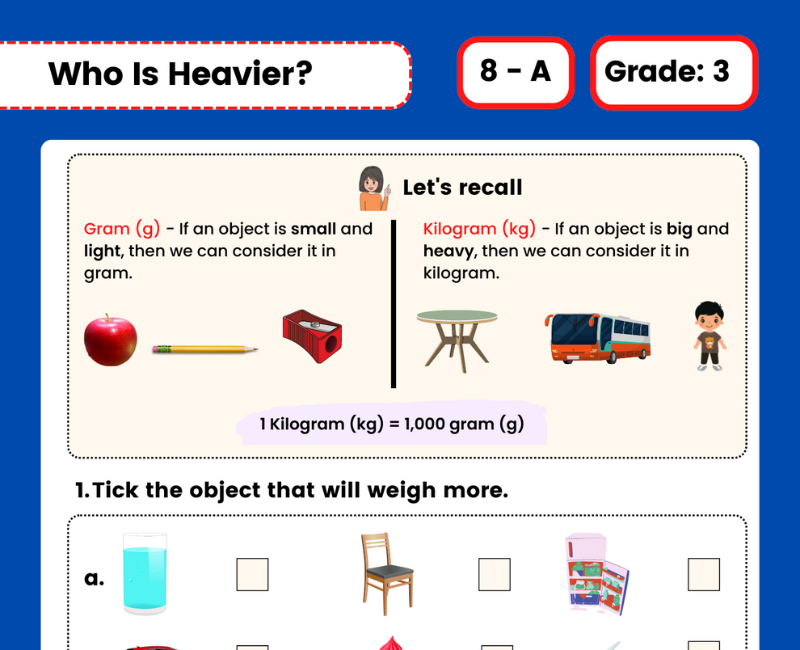
The small unit of weight is the gram, written g. The big unit is the kilogram, written kg. We weigh light things such as a pencil, a coin or a paper clip in grams. We weigh heavy things such as a bag of rice, a watermelon or a school bag in kilograms. A shopkeeper often says kilo for kilogram.
Weighing with a balance
A balance has two pans. Put the object in one pan and weights in the other. If the pans are level, the object and the weights weigh the same. The pan that goes down holds the heavier side.
Reading a kitchen scale
A kitchen scale has a dial with numbers and a needle. Find the last number the needle has passed. If the needle is halfway to the next number, add 500 g. A needle halfway between 2 and 3 shows 2 kg 500 g.
Comparing weights
To compare two weights, write them in the same unit. 900 g and 1 kg cannot be compared until you change 1 kg to 1000 g. Then 900 g is lighter than 1000 g. Use the signs greater than, less than and equal to.
Finding the difference in weight
Subtract the lighter weight from the heavier weight. If a calf weighs 9 kg and a puppy weighs 6 kg, the calf is 9 kg − 6 kg = 3 kg heavier.
Changing kilograms to grams and grams to kilograms
To change kilograms to grams, multiply by 1000. So 3 kg = 3 × 1000 = 3000 g. To change grams to kilograms, find how many thousands there are. So 4500 g = 4000 g + 500 g = 4 kg 500 g.
Adding and subtracting weights
Add or subtract kilograms with kilograms and grams with grams. If the units are mixed, change everything to grams first. 1 kg 300 g + 2 kg 200 g = 1300 g + 2200 g = 3500 g = 3 kg 500 g.
Estimating weights
Estimating means making a sensible guess. A paper clip is about 1 g. A pencil is about 5 g. A bottle of water is about 1 kg. A school bag is a few kilograms. Compare with something you know before you guess.
Weight word problems
Read the story and find the weights. Decide whether to add, subtract or multiply. Change to the same unit and write the answer with its unit. If 4 packets weigh 250 g each, the total is 4 × 250 g = 1000 g, which is 1 kg.
Solved examples
Common mistakes
| Mistake | Correction |
|---|---|
| Writing 1 kg = 100 g | 1 kg is 1000 g. There are three zeros. |
| Comparing 800 g with 1 kg by looking at 800 and 1 | Change to the same unit first. 1 kg = 1000 g. |
| Thinking 1 kg of cotton is heavier than 1 kg of iron | Both weigh the same. Only the size is different. |
| Reading the dial at the next number | Use the last number the needle has passed. |
| Adding kg to g directly | Change both to grams, or add kg with kg and g with g. |
| Leaving out the unit in the answer | Always write g or kg after the number. |
Weight in daily life
Weight is everywhere: vegetables at the market, a bag of atta, a packet of biscuits, a baby’s weight, a parcel at the post office and ingredients in a recipe. Let your child weigh things at home and read the scale aloud.
What your child learns from the weight worksheet for Class 3, the Weight Class 3 quiz and Weight Class 3 activities
- Heavy, light and equal weights
- Units gram and kilogram
- Reading a balance and a kitchen scale
- Comparing weights and finding the difference
- Changing between kilograms and grams
- Adding and subtracting weights
- Estimating the weight of everyday objects
- Weight word problems
Tips for parents and teachers
Use a kitchen scale or a simple balance at home. Let your child guess the weight first and then check. Say the units aloud every time. Use the printable PDF worksheet for written practice and the online activities for quick revision. Revisit the common mistakes table when you see the same error twice.
Related Maths Worksheets
- Multiplication worksheets for Class 3Times tables
- Mental Maths worksheet for Class 3Quick sums
- Addition and Subtraction word problems for Class 3Story problems
- Place Value Class 3 worksheet with online activities and quizTens and ones
- Equal Sharing and Equal Regrouping worksheet for Class 3Division basics
- Division Word Problems worksheet for Class 3Sharing stories
- Geometry Class 3 worksheet with online activities and quizShapes and designs
- Fun with Shapes Class 3 worksheet from NCERTShape fun
- Give and Take Class 3 worksheetsAdd and subtract
- Play with Patterns Class 3 worksheetNumber patterns
- Fractions Class 3 worksheet with online activities and quizEqual parts
- Data Handling Class 3 worksheet with online activities and quizRead charts
Frequently Asked Questions
What is weight?
Weight tells us how heavy or light something is. We measure it in grams and kilograms.
What are the units of weight?
The small unit is the gram (g) and the big unit is the kilogram (kg). Light things are weighed in grams and heavy things in kilograms.
How many grams are in 1 kilogram?
There are 1000 grams in 1 kilogram, so 1 kg = 1000 g.
How many grams are in half a kilogram?
Half a kilogram is 500 g, because 1000 g divided into two equal parts gives 500 g each.
How do I change kilograms to grams?
Multiply the kilograms by 1000. For example, 3 kg = 3 × 1000 = 3000 g.
How do I change grams to kilograms?
Find how many thousands there are in the grams. For example, 4500 g = 4 kg 500 g.
How does a balance work?
A balance has two pans. If the pans are level, both sides weigh the same. The pan that goes down is heavier.
How do I read a kitchen scale?
Find the last number the needle has passed. If it is halfway to the next number, add 500 g.
How do I compare two weights in different units?
Change both weights to the same unit, usually grams, and then compare the numbers.
How do I find how much heavier one thing is?
Subtract the lighter weight from the heavier weight. Use the same unit and write it in the answer.
Is 1 kg of cotton heavier than 1 kg of iron?
No. Both weigh 1 kg. Cotton takes more space but the weight is the same.
What is included on this weight page for Class 3?
This page has a printable weight worksheet for Class 3, a 20-question Weight Class 3 quiz and 15 Weight Class 3 activities online. The activities include a balance explorer, bubble pop, weight whack, make a kilo, a kitchen scale setter, a shop till keypad, weight memory, higher or lower and challenge marks with a comment.
 Download