Class 3 Mathematics
Measurement Long and Short Worksheet for Class 3 with Quiz and Activities
Measure length in centimetres, metres and kilometres, read a ruler from the right start mark, compare long and short objects and change units. Use the Long and Short worksheet for Class 3, then play the Measurement Long and Short Class 3 quiz and Measurement Long and Short Class 3 activities online.
Measurement Long and Short Class 3 Quiz: Online Quiz
Measurement Long and Short Class 3 Activities: Online Games
Explore WitKnowLearn’s measurement long and short worksheet for Class 3 with a free online quiz and online activities. Slide an object along a big ruler, hunt for wrong labels, stretch a ribbon, build a metre from pieces, cut a tape in the right place, put strips in order, sort units on flick cards, flash lengths to add in your head and catch the slip in worked answers. Every activity is a game you can tap.
Practice sheet
Measurement Long and Short Class 3 Complete Guide
This guide supports the measurement long and short worksheet for Class 3 on this page. It covers measuring length in centimetres, metres and kilometres, reading a ruler and a measuring tape, comparing long and short objects, changing metres to centimetres and kilometres to metres, adding and subtracting lengths, estimating length, choosing the right unit, word problems and higher order thinking questions. It follows the Class 3 maths length chapter taught in CBSE and NCERT style classrooms. Use it with the printable long and short worksheets for Class 3, the Measurement Long and Short Class 3 quiz and the 15 Measurement Long and Short Class 3 activities above.
Measurement Long and Short Class 3 resources on this page
- Measurement long and short worksheet for Class 3: printable worksheets on length, ruler reading, comparing lengths, metres and centimetres and word problems.
- Measurement Long and Short Class 3 quiz: a free 20-question online quiz with easy, average and thinking questions, ruler diagrams and instant marks.
- Measurement Long and Short Class 3 activities: 15 free online activities, made of 5 games, 5 workshops and 5 challenges, with marks and a comment after the challenges.
- Length practice: centimetres, metres and kilometres in one place.
What is length?
Length tells us how long or how short something is. A pencil is short and a rope is long. We say tall for height, long for length and far for distance. To compare lengths fairly we use the same unit for every object.
Units of length
| Unit | Short form | Use it for |
|---|---|---|
| Centimetre | cm | Pencils, erasers, books |
| Metre | m | Rooms, ropes, cloth |
| Kilometre | km | Roads and distances between towns |
Measuring with non-standard units
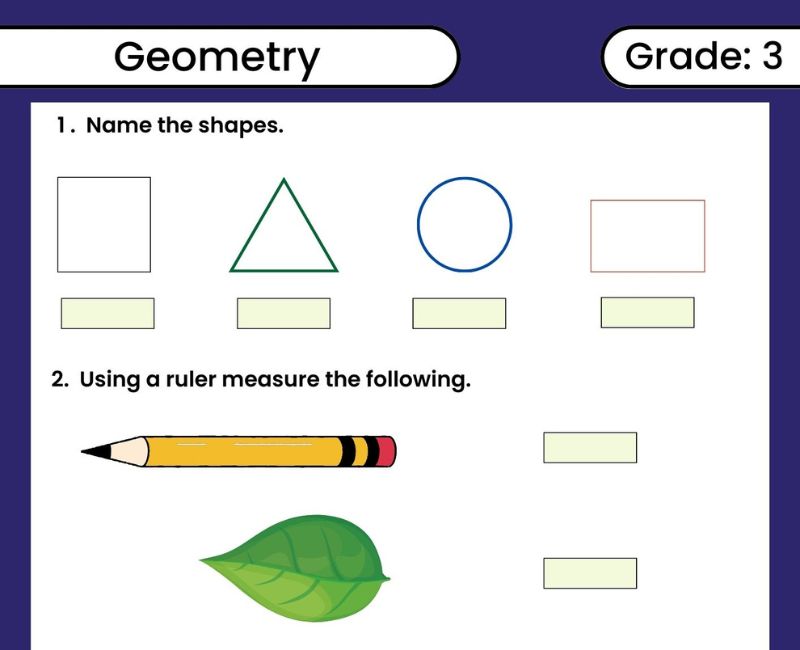
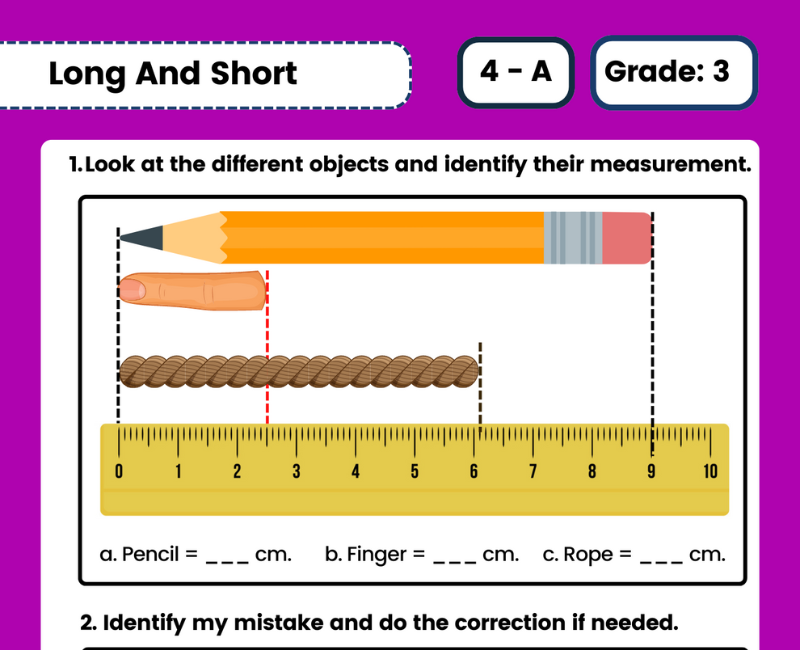
Before we use a ruler we can measure with a hand span, a footstep, a finger or a pencil. These are non-standard units. They are different for every child, so two children can get different answers. This is why we use a standard unit like the centimetre or the metre.
How to use a ruler
- Put the zero mark of the ruler at one end of the object.
- Keep the ruler straight along the object.
- Read the mark at the other end of the object.
- Write the number with its unit, such as 12 cm.
If the object does not start at 0, subtract. A pencil from 2 cm to 10 cm is 10 − 2 = 8 cm long.
Using a measuring tape
A measuring tape is soft and can bend, so it measures round things like a waist or a tin. A tailor uses a tape in centimetres. A shop uses a long tape or a metre scale for cloth. Pull the tape tight and read it at the right mark.
Comparing long and short
To compare two lengths, change both to the same unit. Compare 2 m 40 cm and 250 cm. Change 2 m 40 cm to 240 cm. Then 250 cm is longer than 240 cm. The longer length has the bigger number when the unit is the same.
Changing metres and centimetres
To change metres to centimetres multiply by 100. 3 m = 300 cm. To change centimetres to metres divide by 100. 500 cm = 5 m. For 2 m 35 cm, 2 m = 200 cm and 200 + 35 = 235 cm.
Changing kilometres and metres
1 km = 1000 m, so 2 km = 2000 m and 3000 m = 3 km. If a path is 1 km long and you walked 650 m, you still have 1000 − 650 = 350 m to walk.
Adding and subtracting lengths
Add or subtract lengths that have the same unit. 85 cm + 65 cm = 150 cm = 1 m 50 cm. For 1 m − 35 cm, change 1 m to 100 cm first, then 100 − 35 = 65 cm.
Estimating length
An estimate is a sensible guess. A new pencil is about 15 cm. A door is about 2 m high. A school bus is about 10 m long. Estimate first and then measure to check how close you were.
Word problems and higher order thinking
Read the story twice. Underline each length and its unit. Decide if the lengths are joined together (add) or cut away (subtract). Change all lengths to one unit and then solve. Higher order thinking questions often need two steps, such as finding a piece after a rope is cut into equal parts.
Solved examples
Common mistakes
| Mistake | Correction |
|---|---|
| Reading the end mark when the object does not start at 0 | Subtract the start mark from the end mark. |
| Thinking 1 m = 10 cm | 1 m = 100 cm. |
| Comparing 2 m 5 cm and 250 cm without changing units | Change both to centimetres first. |
| Leaving the unit out of the answer | Always write cm, m or km after the number. |
| Starting to measure at the edge of the ruler instead of at 0 | Line up the object with the zero mark. |
| Adding cm and m directly | Change to one unit, then add. |
Length in daily life
We use length when we buy cloth, cut ribbon, measure a room for a mat, check a child's height, plan a walk to school and read road signs. Ask your child to measure things at home with a ruler and a tape and say each answer with its unit.
What your child learns from the measurement long and short worksheet for Class 3, the Measurement Long and Short Class 3 quiz and Measurement Long and Short Class 3 activities
- Centimetres, metres and kilometres
- Reading a ruler from the start mark
- Comparing long and short lengths
- Changing metres to centimetres and kilometres to metres
- Adding and subtracting lengths
- Estimating length
- Choosing the best unit
- Word problems on length
Tips for parents and teachers
Give your child a ruler, a tape and a metre stick. Let them measure a book, a bed and a corridor and write each length. Ask them to guess first. Use the printable PDF worksheets for written practice and the online activities for quick revision. Revisit the common mistakes table when you see the same error twice.
Related Maths Worksheets
- Multiplication worksheets for Class 3Times tables
- Mental Maths worksheet for Class 3Quick sums
- Addition and Subtraction word problems for Class 3Story problems
- Place Value Class 3 worksheet with online activities and quizTens and ones
- Addition and Subtraction worksheet for Class 33-digit sums
- Division Word Problems worksheet for Class 3Sharing stories
- Money Addition and Subtraction worksheet for Class 3Money sums
- Measurement of Weight worksheet for Class 3Grams and kilograms
- Give and Take Class 3 worksheetsAdd and subtract
- Play with Patterns Class 3 worksheetNumber patterns
- Fractions Class 3 worksheet with online activities and quizEqual parts
- Data Handling Class 3 worksheet with online activities and quizRead charts
Frequently Asked Questions
What are the units of length for Class 3?
The units of length are the centimetre (cm), the metre (m) and the kilometre (km). We use centimetres for small things, metres for rooms and ropes and kilometres for roads and distances.
How many centimetres are in a metre?
There are 100 centimetres in 1 metre. So 2 m = 200 cm and 5 m = 500 cm.
How many metres are in a kilometre?
There are 1000 metres in 1 kilometre. So 3 km = 3000 m.
How do I measure an object with a ruler?
Put the zero mark at one end of the object, keep the ruler straight and read the mark at the other end. Write the number with its unit, such as 8 cm.
What if the object does not start at zero on the ruler?
Subtract the start mark from the end mark. If a pencil is from 2 cm to 10 cm, the length is 10 − 2 = 8 cm.
How do I change metres and centimetres into centimetres?
Change the metres to centimetres by multiplying by 100 and then add the extra centimetres. For 2 m 35 cm, 200 + 35 = 235 cm.
How do I compare two lengths in different units?
Change both lengths to the same unit, usually centimetres, and then compare the numbers. The bigger number is the longer length.
Why do we use standard units instead of hand spans?
Hand spans and footsteps are different for every person, so two people get different answers. Standard units such as the centimetre and the metre are the same for everyone.
What is the difference between a ruler and a measuring tape?
A ruler is hard and straight, so it is best for short flat things. A measuring tape is soft and can bend, so it can measure round things and long distances.
How can I estimate the length of an object?
Compare it with something you know. A new pencil is about 15 cm and a door is about 2 m high. Make a guess, then measure to check.
How do I solve a word problem on length?
Underline each length, change all of them to the same unit and decide whether to add or subtract. Joined or in all means add. Cut off or left means subtract.
What is included on this measurement long and short page for Class 3?
This page has printable long and short worksheets for Class 3, a 20-question Measurement Long and Short Class 3 quiz and 15 Measurement Long and Short Class 3 activities online. The activities include the Ruler Explorer, ruler reader, stretch the ribbon, convert it, length lock, longer length, spot the slip and challenge marks with a comment.
 Download