Class 3 Mathematics · NCERT Maths Mela Chapter 12
Give and Take Class 3 Maths Worksheet NCERT with Quiz and Activities
Add and subtract 3-digit numbers, draw box diagrams, use blocks and number lines, carry and open a ten, work with notes and coins, estimate to the nearest hundred and compare without calculating. Learn Class 3 Maths Chapter 12 from the NCERT Maths Mela book, then use the Give and Take Class 3 worksheet and play the Give and Take Class 3 quiz and Give and Take Class 3 activities online.
Give and Take Class 3 Online Quiz
364 + 52 = ? Type the number.
Give and Take Class 3 Activities
Read the idea, try the lab, then tap Games, Workshops or Challenges to play.
Explore the Give and Take Class 3 worksheet for NCERT Maths Mela Chapter 12 with a free online quiz and online activities. Use the Add and Subtract lab to see blocks, carrying and opening a ten, jump on a number grid, choose the sentence for a box diagram, pay exact amounts with notes and coins, estimate to the nearest hundred and make the biggest sum from number cards. Every activity is a game you can tap or type.
Add and Subtract lab
Make the first number and the second number. Choose + or −. See the blocks and the steps, including carrying and opening a ten.
364 + 52 = 416
- Ones: 4 + 2 = 6
- Tens: 6 + 5 = 11. 10 tens make 1 hundred. Carry 1 hundred.
- Hundreds: 3 + 1 = 4
Add or Take
Game 1 of 5Goal: Add or subtract 100, 10 and 1 from a number.
How to play: Read the task. Tap the answer. Press Check.
Round 1 of 5: Tap the right answer.
Add 100 to 269
Practice sheet
Type your answers in the boxes. For word answers write in small letters. Press Check when you finish.
AAdd and take away 10 and 100
BAdd and subtract
CMoney
DEstimate and compare
Give and Take Class 3 Complete Guide
This guide supports the Give and Take Class 3 maths worksheet on this page. It covers Class 3 Maths Chapter 12 from the NCERT Maths Mela book, which is part of the latest NCERT syllabus for CBSE schools. Topics include adding and subtracting 3-digit numbers, adding and taking away 100, 10 and 1, box diagrams, Dienes blocks, regrouping, number lines and number grids, money with notes and coins, estimating to the nearest hundred, comparing without calculating and making numbers from cards. Use it with the printable Give and Take worksheets for Class 3, the Give and Take Class 3 quiz and the 15 Give and Take Class 3 activities above.
Introduction to NCERT Class 3 Maths Chapter 12 Give and Take
Book: Maths Mela, the NCERT Mathematics textbook for Class 3 (Grade 3). Chapter: 12, Give and Take. Board: CBSE and other schools that follow NCERT. In this chapter children add and subtract 3-digit numbers. They use stories about a plant nursery and a shopkeeper, draw box diagrams, use hundreds, tens and ones blocks and number lines, and learn how to carry and how to open a ten or a hundred. They also work with money and learn to estimate answers.
What is there in the chapter?
- Adding and subtracting small numbers such as 2, 5, 6 and 9 on a number
- Adding 52 to 364 and showing it with a box diagram, blocks and a number line
- Taking 75 from 230 by opening a ten into 10 ones and opening a hundred into 10 tens
- Problems on adding 80 to 309, taking 63 from 456 and finding how many more one number is than another
- Writing word problems for box diagrams
- A number grid from 451 to 530 for sums such as 456 + 10, 481 + 19 and 519 − 40
- Adding 100, 10 and 1 and seeing which digit changes
- Exchange of things in a village and the use of money, notes and coins
- Matching notes and coins, paying exact amounts in at least two ways and finding that five ₹100 notes make ₹500
- Finding the difference between ₹465 and ₹756, adding ₹640 and ₹215, finding change from ₹500 and saving money week by week
- Estimating to the nearest hundred, comparing expressions without calculating, finding equal pairs, number cards and equations such as 265 + 9 and 653 − 356
NCERT Class 3 learning objectives for this chapter
These objectives are written from the content of the chapter. They are not copied from the book.
- To add and subtract 3-digit numbers with and without regrouping
- To use box diagrams, blocks, number lines and grids to solve problems
- To see how the digits change when 100, 10 or 1 is added or taken away
- To solve word problems on adding, taking away and finding a difference
- To know notes and coins and to find an amount in more than one way
- To estimate sums and differences to the nearest hundred
- To compare expressions without calculating them
- To make numbers from digit cards for the biggest sum or the smallest difference
Learning outcomes
After this chapter and the practice on this page a Class 3 child should be able to:
- add numbers such as 364 + 52 and 265 + 9
- subtract numbers such as 230 − 75 and 653 − 356 by opening a ten or a hundred
- draw a box diagram and choose to add or subtract
- say 10 more, 10 less, 100 more and 100 less than a number
- find the change from ₹500 and the total of savings
- say that five ₹100 notes make ₹500
- estimate 156 + 34 as about 200
- say which of 373 + 23 and 373 + 40 is more without adding
Give and Take Class 3 resources on this page
- Give and Take Class 3 worksheet: a printable NCERT style worksheet on adding, subtracting and money.
- Give and Take Class 3 quiz: a free 20-question online quiz with easy, average and thinking questions, picture questions and instant marks with a reason for every answer.
- Give and Take Class 3 activities: 15 free online activities, made of 5 games, 5 workshops and 5 challenges, with marks and a comment after the challenges.
- Practice sheet: 16 questions you can type and check, with a Show answers button.
What is Class 3 Maths Chapter 12 Give and Take?
Chapter 12 of the NCERT Class 3 Maths book Maths Mela is called Give and Take. Giving means adding to what we have and taking means taking away. Children learn to add and subtract numbers up to 1000 using strategies that show what is happening to the hundreds, tens and ones. They first draw a picture of the problem and then solve it.
Box diagrams
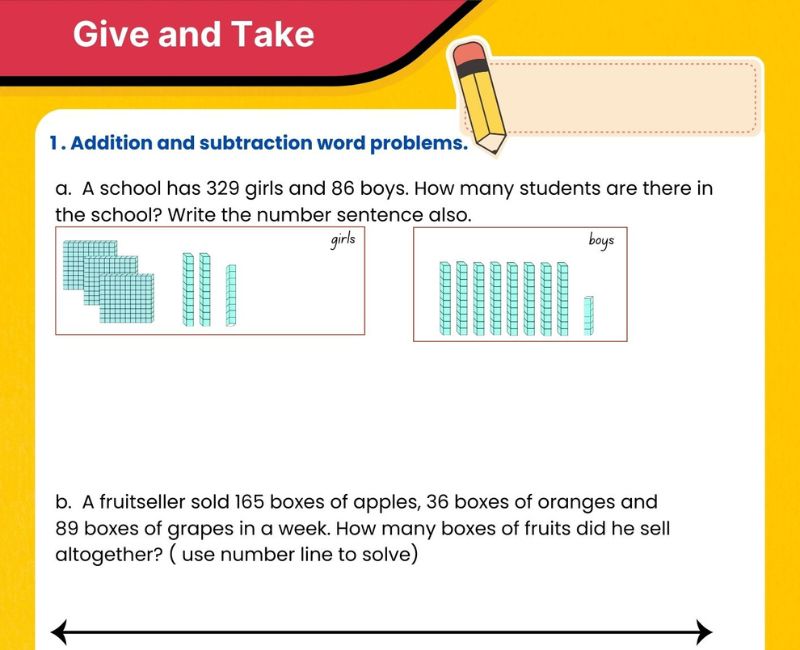
A box diagram is a picture of a problem. The top bar shows the whole. The two bars below show the two parts. When both parts are known and the whole is not, add. When the whole and one part are known, subtract to find the other part. For 364 saplings and 52 more, the whole is unknown, so we add 364 + 52. For an order of 230 saplings with 75 in a box, the part still to pack is 230 − 75.
| What is known | What to do | Example |
|---|---|---|
| Both parts | Add | 364 + 52 |
| Whole and one part | Subtract | 230 − 75 |
Adding with blocks
Add the ones, then the tens, then the hundreds. For 364 + 52, ones are 4 + 2 = 6. Tens are 6 + 5 = 11 tens, which make 1 hundred and 1 ten. Hundreds are 3 + 1 = 4. The answer is 4 hundreds, 1 ten and 6 ones, which is 416. This is called carrying. On a number line from 364, jump 50 to 414 and then 2 more to 416.
Subtracting with blocks
For 230 − 75 there are 0 ones, so 5 ones cannot be taken away. Open 1 ten into 10 ones and take away 5 ones. 5 ones are left. Now there are 2 tens. To take away 70 we need 7 tens, so open 1 hundred into 10 tens. That gives 12 tens. Take away 7 tens and 5 tens are left. Together with 1 hundred and 5 ones the answer is 155.
| Step | Hundreds | Tens | Ones |
|---|---|---|---|
| Start with 230 | 2 | 3 | 0 |
| Open 1 ten | 2 | 2 | 10 |
| Take away 5 ones | 2 | 2 | 5 |
| Open 1 hundred | 1 | 12 | 5 |
| Take away 7 tens | 1 | 5 | 5 |
Adding and subtracting 100, 10 and 1
The number grid shows how digits change. One cell to the right adds 1. One row up adds 10. Ten rows would add 100. So adding 100 changes only the hundreds digit, adding 10 changes the tens digit and adding 1 changes the ones digit. 269 + 100 = 369, 269 + 10 = 279 and 269 + 1 = 270. Taking away works in reverse: 454 − 100 = 354 and 454 − 10 = 444.
Notes and coins
People once exchanged things for what they needed, and the amounts were different for different things. Today we use money. Notes and coins have different values. A ₹10 note can buy one hawa mithai or ten toffees. The same amount can be paid in more than one way, for example ₹55 as ₹50 and ₹5 or as ₹20, ₹20, ₹10 and ₹5. Five notes of ₹100 make a ₹500 note.
Money problems
A box had ₹465 in the morning and ₹756 in the afternoon. The earnings are the difference: 756 − 465 = 291. Sales of rice for ₹640 and sugar for ₹215 make 640 + 215 = ₹855. A customer who gives ₹500 for goods worth ₹209 gets back 500 − 209 = ₹291. A child with ₹150 who adds ₹100 every week has ₹550 after 4 weeks. Savings of ₹250, ₹125 and ₹350 make ₹725.
Estimating to the nearest hundred
Before adding or subtracting, estimate. Round each number to the nearest hundred or friendly number. 156 + 34 is about 200. 125 − 15 is about 100. 205 + 215 is about 400. 505 + 405 is about 900. An estimate tells whether the final answer makes sense.
Comparing without calculating
Look at the numbers before calculating. 373 + 40 is more than 373 + 23 because 40 is more than 23. 345 − 45 is more than 345 − 54 because less is taken away. 900 + 9 is 909 but 890 + 60 is 950, so the second is more. Equal pairs have the same answer, for example 516 + 100 and 816 − 200 are both 616, and 350 + 50 and 450 − 50 are both 400.
Number cards
With the cards 0 to 5, each used once, make two 3-digit numbers. For the biggest sum put the biggest digits in the hundreds places, then the next biggest in the tens and the smallest in the ones: 531 + 420 = 951. For the smallest sum put the smallest digits in the hundreds places. A 3-digit number cannot begin with 0.
Types of questions to practise
Questions on this chapter ask children to add and subtract 3-digit numbers, find 10 and 100 more or less, read box diagrams, use money, find change, estimate, compare expressions and make numbers from cards. The online quiz on this page mixes choice questions, true or false questions, picture questions and typed answers, and the practice sheet has 16 typed answers.
Solved examples
Common mistakes
| Mistake | Correction |
|---|---|
| Forgetting to carry when the tens add to 10 or more | 10 tens make 1 hundred. Carry it to the hundreds. |
| Taking the smaller digit from the bigger one in every column | If the top digit is smaller, open a ten or a hundred. Do not turn the subtraction around. |
| Saying 10 less than 454 is 464 | 10 less is 444. 464 is 10 more. |
| Writing 100 more than 269 as 279 | 100 more is 369. 279 is 10 more. |
| Adding when the problem asks for the difference | Find how much more or less by subtracting. |
| Thinking four ₹100 notes make ₹500 | Five ₹100 notes make ₹500. |
| Giving an estimate that is far from the answer | Round each number to the nearest hundred first. |
| Starting a 3-digit number with 0 in the number cards task | A 3-digit number cannot start with 0. |
Adding and taking away in daily life
We add and take away when we pay for things, count change, share sweets, and check how many pages are left in a book. Ask your child to work out the change when you pay a ₹500 note for a ₹209 bill, to find the total of three prices and to estimate before calculating.
What your child learns from the Give and Take worksheet
- Adding 3-digit numbers with carrying
- Subtracting 3-digit numbers by opening a ten or a hundred
- Box diagrams for word problems
- 10 and 100 more and less
- Notes, coins and exact change
- Estimating to the nearest hundred
- Comparing without calculating
- Number cards for biggest sums and smallest differences
Tips for parents and teachers
Make play money with ₹100, ₹10 and ₹1 notes and let your child trade ten ₹10 notes for one ₹100 note. Use paper blocks for hundreds, tens and ones. Ask your child to draw a box diagram before solving a word problem. Let your child estimate first and then work out the exact answer. Play the number cards game with two players and see who gets the biggest sum.
Related Maths Worksheets
- Addition and Subtraction Worksheet Class 3
- Addition and Subtraction Word Problems Worksheet Class 3
- Place Value Worksheet Class 3
- Filling and Lifting Worksheet Class 3
- Fun at Class Party Worksheet Class 3
- House of Hundreds II Worksheet Class 3
- House of Hundreds I Worksheet Class 3
- Double Century Worksheet Class 3
- Raksha Bandhan Worksheet Class 3
- Fair Share Worksheet Class 3
- Mental Maths Worksheet Class 3
- Multiplication Worksheet Class 3
Frequently Asked Questions
What is Class 3 Maths Chapter 12 Give and Take?
It is the twelfth chapter of the NCERT Class 3 Maths book Maths Mela. Children add and subtract 3-digit numbers, use box diagrams, blocks and number lines, work with money, estimate answers and compare numbers.
What is a box diagram?
A box diagram is a picture of a problem. The top bar is the whole and the two bars below are the parts. Add the parts to find the whole, or subtract a part from the whole to find the other part.
How do I add 364 and 52?
Add ones: 4 + 2 = 6. Add tens: 6 + 5 = 11 tens, which is 1 hundred and 1 ten. Add hundreds: 3 + 1 = 4. The answer is 416.
How do I subtract 75 from 230?
Open 1 ten into 10 ones and take away 5 ones. Then open 1 hundred into 10 tens and take away 7 tens. The answer is 155.
What changes when I add 100, 10 or 1?
Adding 100 changes the hundreds digit, adding 10 changes the tens digit and adding 1 changes the ones digit. 269 + 100 = 369, 269 + 10 = 279 and 269 + 1 = 270.
How many ₹100 notes make a ₹500 note?
Five ₹100 notes make a ₹500 note.
How do I find the change from ₹500?
Subtract the cost from ₹500. For goods worth ₹209 the change is 500 − 209 = ₹291.
How do I estimate to the nearest hundred?
Round each number to the nearest hundred first. 156 + 34 is about 200 because 156 is close to 200 and 34 is small.
How can I compare two expressions without calculating?
Look at the numbers. If the first numbers are the same, the one with more added is bigger, or the one with less taken away is bigger. 373 + 40 is more than 373 + 23.
What are the number cards in this chapter?
You make two 3-digit numbers from the cards 0 to 5 and find the biggest sum or the smallest difference. For the biggest sum put the biggest digits in the hundreds places.
Does this page have Give and Take Class 3 questions and answers?
Yes. The online quiz shows the right answer and the reason after you finish, and the practice sheet has a Show answers button. The printable worksheet is the PDF download for this chapter.
What is included on this page?
This page has a free 20-question Give and Take Class 3 online quiz with instant marks, 15 online activities made of 5 games, 5 workshops and 5 challenges, an Add and Subtract lab, a 16-question practice sheet and a complete guide with solved examples.
 Download