Class 3 Mathematics
Patterns Worksheet Class 3 with Online Quiz and Activities
Spot number patterns, shape patterns, colour patterns and word patterns, find the rule and continue the pattern. Use the printable patterns worksheet for Class 3, then play the patterns Class 3 quiz and patterns Class 3 activities online.
Explore WitKnowLearn’s play with patterns worksheet for Class 3 with a free online quiz and online activities. Pop bubbles with missing numbers, spot the odd shape, repeat a colour pattern from memory, find number rules, count matchsticks in growing patterns and build your own patterns. Every activity uses pictures, shapes or numbers you can tap.
Patterns Class 3 Quiz: Play with Patterns Online Quiz
Patterns Class 3 Activities: Play with Patterns Online Activities
Patterns Class 3 Complete Guide
This guide supports the play with patterns worksheet for Class 3 on this page. It covers what a pattern is, repeating patterns of shapes and colours, number patterns that go up or down, finding the rule, skip counting patterns, growing patterns made of matchsticks, word and object patterns, finding the odd one out and finding the 8th or 10th item of a repeating pattern. It follows the Class 3 maths patterns chapter taught in CBSE and NCERT style classrooms. Use it with the printable patterns worksheet for Class 3, the patterns Class 3 quiz and the 15 patterns Class 3 activities above.
Patterns Class 3 resources on this page
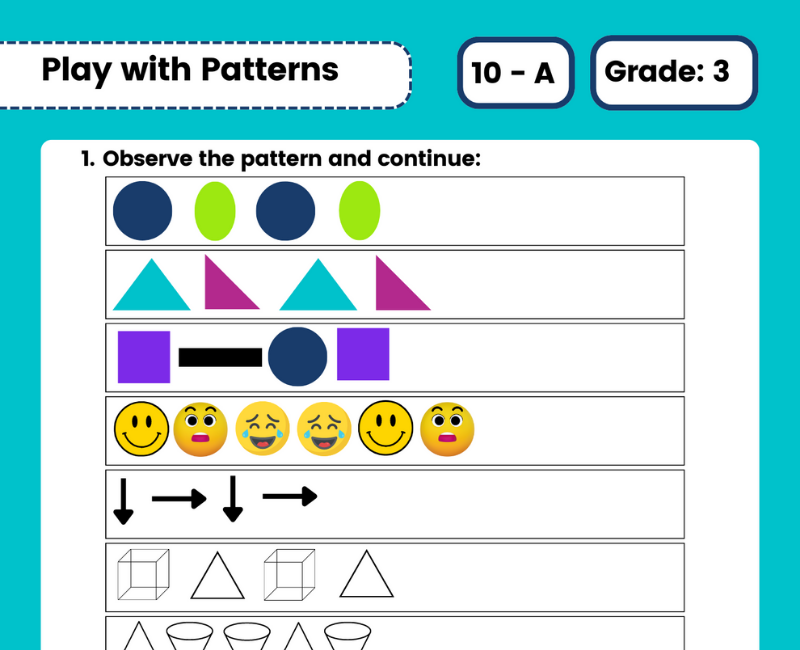
- Patterns worksheet for Class 3: a printable 5-page PDF with number patterns, shape patterns, colour patterns, word patterns and object patterns.
- Patterns Class 3 quiz: a free 20-question online quiz with easy, average and thinking questions, pictures and instant marks.
- Patterns Class 3 activities: 15 free online activities, made of 5 games, 5 workshops and 5 challenges, with marks and a comment after the challenges.
- Play with patterns Class 3 practice: number patterns, shape patterns, colour patterns and growing patterns in one place.
What is a pattern?
A pattern is a set of numbers, shapes, colours, words or objects that repeat or change in a regular way. Every pattern follows a rule. When you know the rule, you can say what comes next.
Repeating patterns of shapes and colours
In a repeating pattern, a small part called the core repeats again and again. In circle, square, circle, square the core is circle, square. In triangle, triangle, square, triangle, triangle, square the core is triangle, triangle, square. To continue the pattern, find the core and keep repeating it.
Number patterns
A number pattern is a list of numbers that follows a rule. In 2, 4, 6, 8 each number is 2 more than the one before, so the rule is add 2. In 50, 45, 40, 35 each number is 5 less, so the rule is subtract 5. To find the rule, subtract one number from the next and check the other pairs.
Increasing and decreasing patterns
An increasing pattern goes up, such as 10, 20, 30, 40. A decreasing pattern goes down, such as 100, 92, 84, 76. Both can be described with a rule such as add 10 or subtract 8.
Skip counting patterns
Skip counting means counting in jumps. Counting in 3s gives 3, 6, 9, 12. Counting in 5s gives 5, 10, 15, 20. These are the times tables, so the 10th number in the pattern of 3s is 3 × 10 = 30.
Growing patterns with matchsticks
In a growing pattern each step adds the same amount. One square needs 4 sticks. Each new square joined on needs 3 more sticks, so 2 squares use 7 sticks, 3 squares use 10 sticks and 4 squares use 13 sticks. A row of triangles starts with 3 sticks and each new triangle adds 2 more sticks.
Word and object patterns
Words, letters and objects can make patterns too. The days of the week, the months of the year and the letters A, C, E, G, I follow rules. Cat, dog, cat, dog repeats in 2s.
Finding the odd one out
If one item breaks the rule, it is the odd one out. In 5, 10, 15, 21, 25, the rule is add 5, so 21 should be 20. Find the rule from the first two numbers and then check each one.
Finding the 8th or 10th item of a repeating pattern
Count the items in the core, then divide the place by that number. For circle, square, triangle the core has 3 items. For the 8th shape, 8 ÷ 3 = 2 remainder 2, so the 8th shape is the 2nd one in the core, a square. If there is no remainder, the shape is the last one in the core.
Solved examples
Common mistakes
| Mistake | Correction |
|---|---|
| Looking at only the first two numbers | Check every pair of neighbours to be sure the rule is the same. |
| Mixing up add and subtract | If the numbers get bigger, add. If they get smaller, subtract. |
| Not finding the core of a repeating pattern | Find the smallest part that repeats, then keep repeating it. |
| Counting the empty box as part of the core | Use only the shapes that are shown to find the core. |
| Forgetting the first stick in a growing pattern | Count the sticks for the first step before you add the same amount each time. |
| Choosing a number that looks nice | Always use the rule to find the answer and check it. |
Patterns in daily life
Patterns are all around us: the days of the week, the stripes on a zebra crossing, tiles on a floor, rangoli designs, beads in a necklace and the times tables. Asking your child to spot patterns at home helps them see that maths is everywhere.
What your child learns from the patterns worksheet for Class 3, the patterns Class 3 quiz and patterns Class 3 activities
- Spotting and continuing number patterns
- Spotting and continuing shape and colour patterns
- Finding the rule of a pattern
- Skip counting patterns and increasing or decreasing patterns
- Growing patterns made of matchsticks and dots
- Word and object patterns
- Finding the odd one out
- Finding a later item of a repeating pattern
Tips for parents and teachers
Use beads, buttons or coloured blocks at home to make patterns and ask your child to continue them. Say the pattern aloud as you build it. Use the printable PDF worksheet for written practice and the online activities for quick revision. Revisit the common mistakes table when you see the same error twice.
Related Maths Worksheets
- Multiplication worksheets for Class 3Times tables and skip counting
- Mental Maths worksheet for Class 3Quick sums
- Addition and Subtraction word problems for Class 3Story problems
- Place Value Class 3 worksheet with online activities and quizTens and ones
- Equal Sharing and Equal Regrouping worksheet for Class 3Division basics
- Division Word Problems worksheet for Class 3Sharing stories
- Geometry Class 3 worksheet with online activities and quizShapes and designs
- Fun with Shapes Class 3 worksheet from NCERTShape fun
- Give and Take Class 3 worksheetsAdd and subtract
- House of Hundreds II Class 3 worksheetNCERT Maths Mela
- Fractions Class 3 worksheet with online activities and quizEqual parts
- Data Handling Class 3 worksheet with online activities and quizRead charts
Frequently Asked Questions
What is a pattern?
A pattern is a set of numbers, shapes, colours, words or objects that repeat or change in a regular way, following a rule.
What is a repeating pattern?
In a repeating pattern a small part, called the core, repeats again and again. In circle, square, circle, square the core is circle, square.
How do I find the rule of a number pattern?
Subtract one number from the next number and check the other pairs. If the difference is always the same, that is the rule. For example, 5, 10, 15, 20 follows the rule add 5.
What is the difference between an increasing and a decreasing pattern?
An increasing pattern goes up, such as 10, 20, 30. A decreasing pattern goes down, such as 100, 92, 84.
What is skip counting?
Skip counting means counting in jumps of the same size, such as 3, 6, 9, 12. It follows the times tables.
What is a growing pattern?
A growing pattern adds the same amount at each step. For example, each new square in a row of matchsticks needs 3 more sticks.
How many sticks do 4 squares need in a row of matchsticks?
The first square needs 4 sticks and each new square needs 3 more. So 4 squares need 4 + 3 + 3 + 3 = 13 sticks.
How do I find the 10th item in a repeating pattern?
Count the items in the core and divide 10 by that number. The remainder tells you which item of the core it is. If there is no remainder it is the last item of the core.
How do I find the odd one out in a pattern?
Find the rule from the first two items and check every item. The one that does not follow the rule is the odd one out.
What are word and object patterns?
They use words, letters or objects instead of numbers, such as Monday, Tuesday, Wednesday or cat, dog, cat, dog.
Why are patterns important in maths?
Patterns help children predict what comes next, find rules and understand times tables, addition and subtraction.
What is included on this patterns page for Class 3?
This page has a printable 5-page patterns worksheet for Class 3, a 20-question patterns Class 3 quiz and 15 patterns Class 3 activities online. The activities include bubble pop, odd one out, colour memory, growing patterns, a timed sprint and challenge marks with a comment.
 Download