Class 3 Mathematics · NCERT Maths Mela Chapter 7
Raksha Bandhan Class 3 Maths Worksheet NCERT with Quiz and Activities
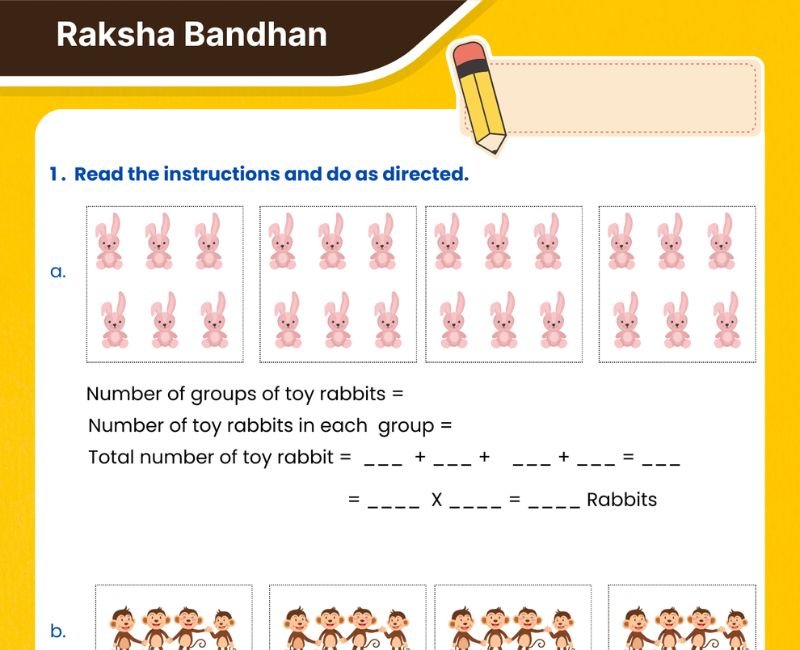
Learn multiplication as repeated addition, division as equal sharing, skip jumping and the times tables. Learn Class 3 Maths Chapter 7 from the NCERT Maths Mela book, then use the Raksha Bandhan Class 3 worksheet and play the Raksha Bandhan Class 3 quiz and Raksha Bandhan Class 3 activities online.
Raksha Bandhan Class 3 Online Quiz
Which multiplication is the same as 5 + 5 + 5?
Raksha Bandhan Class 3 Activities
Read the idea, try the lab, then tap Games, Workshops or Challenges to play.
Explore the Raksha Bandhan Class 3 worksheet for NCERT Maths Mela Chapter 7 with a free online quiz and online activities. Use the Times table lab to see equal groups, repeated addition, multiplication and division together, share sweets equally among plates, skip jump on a number track, learn the times tables and multiply by tens. Every activity is a game you can tap or type.
Times table lab
Pick the table and the number of groups. See equal groups, repeated addition, multiplication and division together.
size of each group4
how many times3
4 + 4 + 4 = 12
3 × 4 = 12
The times-4 table
Equal Groups
Game 1 of 5Goal: Show equal groups and read them as multiplication.
How to play: Press + and − for groups and for each group. Press Check.
Picture 1 of 4: Show 3 groups with 4 in each group. Use + and −. Press Check.
1 × 1 = 1
Practice sheet
Type your answers in the boxes. Press Check when you finish.
ARepeated addition
BSharing equally
CSkip jumping and tables
DTens and bigger numbers
Raksha Bandhan Class 3 Complete Guide
This guide supports the Raksha Bandhan Class 3 maths worksheet on this page. It covers Class 3 Maths Chapter 7 from the NCERT Maths Mela book, which is part of the latest NCERT syllabus for CBSE schools. Topics include multiplication as repeated addition, equal groups, division as equal sharing and repeated subtraction, skip jumping, times tables, patterns in tables, multiplying by tens, and word problems with bigger numbers. Use it with the printable Raksha Bandhan worksheets for Class 3, the Raksha Bandhan Class 3 quiz and the 15 Raksha Bandhan Class 3 activities above.
Introduction to NCERT Class 3 Maths Chapter 7 Raksha Bandhan
Book: Maths Mela, the NCERT Mathematics textbook for Class 3 (Grade 3). Chapter: 7, Raksha Bandhan. Board: CBSE and other schools that follow NCERT. This chapter starts the big ideas of multiplication and division. Children get ready for a festival, make rakhis, buy sweets and play on a number track. Along the way they see that multiplication is repeated addition, that division is equal sharing, and that the times tables can be built by skip jumping.
What is there in the chapter?
- Counting objects in a picture and finding how much material is needed to make 5 rakhis
- Repeated addition written as times and as a multiplication sentence such as 5 × 2
- Counting sweets arranged in a box and in groups, and buying more than one box
- Sharing sweets equally among people and writing a division sentence such as 18 ÷ 9
- Equal sharing using drawings and repeated subtraction, such as 20 shared among 5
- Counting objects in equal groups and different ways of grouping, such as 8 × 6 and 6 × 8
- Writing the table of 2 for animals, and a skip jumping game on a number track
- Making times tables with repeated addition, with number lines and with sticks
- Patterns in the times-5 table and relations between tables
- Multiplying by tens, such as 30 × 5, and finding how many wheels can be made from spokes
- Word problems on legs, wheels, horns, money and shells, and repeated subtraction for larger numbers
- A puzzle with number cards in envelopes
NCERT Class 3 learning objectives for this chapter
These objectives are written from the content of the chapter. They are not copied from the book.
- To understand multiplication as repeated addition of equal groups
- To write equal groups as a multiplication sentence and read it as times
- To understand division as equal sharing and as repeated subtraction
- To write division sentences and link them with multiplication
- To build and use the times tables through skip jumping and patterns
- To notice patterns in the tables, such as the last digit of the times-5 table
- To multiply by tens and by bigger numbers using what is already known
- To solve word problems with multiplication and division
Learning outcomes
After this chapter and the practice on this page a Class 3 child should be able to:
- write 3 + 3 + 3 + 3 as 4 × 3 and find the total
- explain that 8 × 6 and 6 × 8 give the same answer
- share a number of objects equally and write a division such as 20 ÷ 5 = 4
- skip jump on a number line and say which numbers are landed on
- say and use the times tables up to 10
- find a pattern in a times table, such as the times-5 table ending in 0 or 5
- find 30 × 5 by using 10 × 5
- solve a word problem by choosing multiplication or division
Raksha Bandhan Class 3 resources on this page
- Raksha Bandhan Class 3 worksheet: a printable NCERT style worksheet on multiplication, division and times tables.
- Raksha Bandhan Class 3 quiz: a free 20-question online quiz with easy, average and thinking questions, picture questions and instant marks with a reason for every answer.
- Raksha Bandhan Class 3 activities: 15 free online activities, made of 5 games, 5 workshops and 5 challenges, with marks and a comment after the challenges.
- Practice sheet: 16 questions you can type and check, with a Show answers button.
What is Class 3 Maths Chapter 7 Raksha Bandhan?
Chapter 7 of the NCERT Class 3 Maths book Maths Mela is called Raksha Bandhan. It introduces multiplication and division in a festival setting. Children already know addition and subtraction. Here they learn that adding the same number again and again is multiplication, and that taking the same number away again and again, or sharing equally, is division.
Multiplication as repeated addition
When each rakhi needs 2 threads and 5 rakhis are made, the threads needed are 2 + 2 + 2 + 2 + 2 = 10. This is read as 5 times 2 and written as 5 × 2 = 10. The first number tells how many groups and the second tells how many are in each group. Four beads for each of 5 rakhis is 5 × 4 = 20. One flower for each of 5 rakhis is 5 × 1 = 5.
| Repeated addition | Times | Multiplication |
|---|---|---|
| 1 + 1 + 1 + 1 + 1 = 5 | 5 times 1 | 5 × 1 = 5 |
| 2 + 2 + 2 + 2 + 2 = 10 | 5 times 2 | 5 × 2 = 10 |
| 4 + 4 + 4 + 4 + 4 = 20 | 5 times 4 | 5 × 4 = 20 |
| 3 + 3 + 3 = 9 | 3 times 3 | 3 × 3 = 9 |
Different ways of grouping
The same objects can be grouped in different ways. A flower bed with 8 rows of 6 plants has 6 + 6 + 6 + 6 + 6 + 6 + 6 + 6 = 48 plants, which is 8 × 6. Counted as 6 rows of 8 plants it is 8 + 8 + 8 + 8 + 8 + 8 = 48, which is 6 × 8. The answer is the same. So the order of the two numbers does not change the product. Arranging objects in rows and columns makes this easy to see.
Division as equal sharing
If 18 laddoos are shared equally among 9 people, each person gets 2 laddoos. This is written as 18 ÷ 9 = 2. To find it, give one laddoo to each person, then another, and keep going until no laddoos are left. This is the same as taking 9 away again and again from 18. Division is the opposite of multiplication. Since 9 × 2 = 18, we know that 18 ÷ 9 = 2 and 18 ÷ 2 = 9.
| Sharing | Division | Check with multiplication |
|---|---|---|
| 20 shared among 5 | 20 ÷ 5 = 4 | 5 × 4 = 20 |
| 16 shared among 4 | 16 ÷ 4 = 4 | 4 × 4 = 16 |
| 15 shared among 5 | 15 ÷ 5 = 3 | 5 × 3 = 15 |
| 12 wheels, 2 for each cycle | 12 ÷ 2 = 6 cycles | 6 × 2 = 12 |
Skip jumping and the times tables
On a number track starting at 0, a child can jump by the same number again and again. Skip jumping by 3 lands on 3, 6, 9, 12, and so on. After 4 jumps the child is at 4 × 3 = 12. The numbers landed on make the times-3 table. Skip jumping by 6 gives the times-6 table and by 4 gives the times-4 table. In a game, a flower is placed on a number such as 12 and players choose a jump size to reach it in the fewest jumps. Jumps of 6 reach 12 in just 2 jumps.
Writing tables with sticks and seeing patterns
Tables can also be made by drawing sticks and counting the points where they cross. The times-5 table is 5, 10, 15, 20, 25 and so on. Its answers end in 0 or 5. So 18 × 5 ends in 0 and 23 × 5 ends in 5. The tables also have relations. The times-2 table plus the times-3 table gives the times-5 table. For example 4 × 2 = 8 and 4 × 3 = 12, and 8 + 12 = 20 = 4 × 5.
Multiplying by tens
To find the number of spokes in 20 wheels with 5 spokes each, first find 10 wheels. 10 × 5 = 50. Another 10 wheels need 50 more. So 20 × 5 = 50 + 50 = 100. In the same way 30 × 5 = 150 and 40 × 5 = 200. Each extra 10 adds 50. This pattern helps with 50 × 5, 60 × 5 and up to 100 × 5 = 500.
| Multiplication | Using 10 × 5 = 50 | Answer |
|---|---|---|
| 10 × 5 | one 50 | 50 |
| 20 × 5 | 50 + 50 | 100 |
| 30 × 5 | 50 + 50 + 50 | 150 |
| 40 × 5 | four 50s | 200 |
Word problems and bigger numbers
Word problems use multiplication when equal groups are joined and division when a number is shared or grouped equally. A spider has 8 legs, so 5 spiders have 5 × 8 = 40 legs. A 3-wheeled auto rickshaw means 18 of them have 18 × 3 = 54 wheels. Two wall hangings of 42 rupees each cost 2 × 42 = 84 rupees. Five cups of rabdi at 75 rupees cost 5 × 75 = 375 rupees, so 4 notes of 100 rupees are given and 25 rupees come back. For division with big numbers, repeated subtraction works. From 112 shells, taking away 28 again and again gives 84, 56, 28 and 0, so 4 necklaces can be made.
Types of questions to practise
Questions on this chapter ask children to write repeated addition as multiplication, count equal groups, share equally, write division sentences, skip jump on a number line, complete times tables, find patterns, multiply by tens, solve word problems with legs, wheels and money, and use repeated subtraction. The online quiz on this page mixes choice questions, true or false questions, picture questions and typed answers, and the practice sheet has 16 typed answers.
Solved examples
Common mistakes
| Mistake | Correction |
|---|---|
| Writing 3 + 3 + 3 as 3 × 3 × 3 | 3 + 3 + 3 is 3 × 3 = 9. Multiplication means repeated addition, not repeated multiplication. |
| Adding instead of multiplying, 5 × 2 = 7 | 5 × 2 means 2 added 5 times. It is 10. |
| Giving unequal shares | In division every person gets the same number. |
| Thinking 18 ÷ 9 and 9 ÷ 18 are the same | 18 ÷ 9 = 2. You cannot share 9 sweets equally and give 18 people one each. |
| Starting skip jumping at 1 | Start at 0. Jumps of 3 land on 3, 6, 9. |
| Counting the start as a jump | Count only the jumps. 4 jumps of 3 land on 12. |
| Saying the times-5 table ends in 5 only | It ends in 0 or 5: 5, 10, 15, 20. |
| Forgetting tens in 30 × 5 | 30 × 5 is three tens of 5, which is 150, not 15. |
Multiplication and division in daily life
We use multiplication and division when we buy the same thing many times, share sweets among friends, count wheels, legs or eggs in a tray, and pay money. Ask your child how many wheels there are on 6 cycles, how many legs on 5 chairs with 4 legs each, or how to share 20 sweets among 4 friends.
What your child learns from the Raksha Bandhan worksheet
- Repeated addition and multiplication
- Equal groups and different ways of grouping
- Division as equal sharing
- Skip jumping and the times tables
- Patterns in times tables
- Multiplying by tens
- Word problems with legs, wheels and money
- Repeated subtraction for bigger numbers
Tips for parents and teachers
Use real objects such as beads, buttons or sweets. Make equal groups and write the multiplication together. Share the objects equally on plates and write the division. Draw a number track on the floor with chalk and let your child skip jump by 2, 3, 4 and 5. Say a table as a song or clap it. Ask your child to explain how they found each answer.
Related Maths Worksheets
- Mental Maths Worksheet Class 3
- What’s in a Name Worksheet Class 3
- Toy Joy Worksheet Class 3
- Double Century Worksheet Class 3
- Vacation with My Nani Maa Worksheet Class 3
- Fun with Shapes Worksheet Class 3
- House of Hundreds I Worksheet Class 3
- House of Hundreds II Worksheet Class 3
- Multiplication Worksheet Class 3
- Addition and Subtraction Worksheet Class 3
- Play with Patterns Worksheet Class 3
- Give and Take Worksheet Class 3
Frequently Asked Questions
What is Class 3 Maths Chapter 7 Raksha Bandhan?
It is the seventh chapter of the NCERT Class 3 Maths book Maths Mela. Children learn multiplication as repeated addition, division as equal sharing, skip jumping, the times tables and multiplying by tens.
What is multiplication?
Multiplication is a quick way to add the same number again and again. 5 × 2 means 2 added 5 times: 2 + 2 + 2 + 2 + 2 = 10.
What is division?
Division means sharing equally or taking away the same number again and again. 18 ÷ 9 = 2 means 18 shared equally among 9 gives 2 each.
How are multiplication and division related?
Division is the opposite of multiplication. If 9 × 2 = 18 then 18 ÷ 9 = 2 and 18 ÷ 2 = 9. Use the times table to check a division.
Is 8 × 6 the same as 6 × 8?
Yes. Both are 48. 8 rows of 6 plants and 6 rows of 8 plants have the same total. The order does not change the product.
What is skip jumping?
Skip jumping is jumping by the same number again and again from 0. Jumps of 3 land on 3, 6, 9, 12 and so on. The numbers you land on make the times table.
How do I learn the times tables easily?
Build each table by skip jumping or repeated addition, look for patterns and say the table aloud. The times-5 table ends in 0 or 5. The times-2 table plus the times-3 table gives the times-5 table.
How do I find 30 × 5?
10 × 5 = 50. 30 has three tens, so take three 50s: 50 + 50 + 50 = 150. So 30 × 5 = 150.
How do I divide bigger numbers?
Use repeated subtraction. To find how many 28s are in 112, take away 28 again and again: 84, 56, 28, 0. That is 4 times, so 112 ÷ 28 = 4.
How do I solve a word problem on multiplication or division?
Read the story and ask whether equal groups are being joined or something is being shared equally. Joining equal groups is multiplication. Sharing or grouping equally is division. Draw a picture if it helps.
Does this page have Raksha Bandhan Class 3 questions and answers?
Yes. The online quiz shows the right answer and the reason after you finish, and the practice sheet has a Show answers button. The printable worksheet is the PDF download for this chapter.
What is included on this page?
This page has a free 20-question Raksha Bandhan Class 3 online quiz with instant marks, 15 online activities made of 5 games, 5 workshops and 5 challenges, a Times table lab, a 16-question practice sheet and a complete guide with solved examples.
 Download