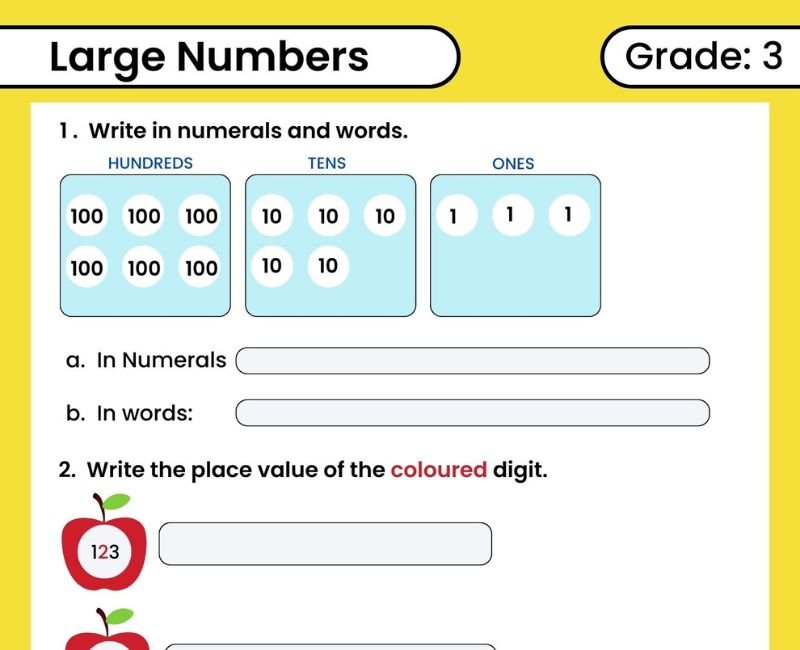
Class 3 Mathematics · NCERT Maths Mela Chapter 3
Double Century Class 3 Maths Worksheet NCERT with Quiz and Activities
Count to 100 and beyond up to 200, make 100 in different ways, read hundreds, tens and ones and write number names. Learn Class 3 Maths Chapter 3 from the NCERT Maths Mela book, then use the Double Century Class 3 worksheet and play the Double Century Class 3 quiz and Double Century Class 3 activities online.
Double Century Class 3 Online Quiz
What is one more than 99?
Double Century Class 3 Activities
Explore the Double Century Class 3 worksheet for NCERT Maths Mela Chapter 3 with a free online quiz and online activities. Use the Number Lab to make numbers with claps, snaps and pats, build numbers with hundred bundles, ten bundles and loose sticks, jump on the number line, make 100 in different ways, estimate a pile of seeds and write number names above 100. Every activity is a game you can tap or type.
Number lab
Make a number with claps (100), snaps (10) and pats (1). See the bundles, the number name and the number line.
100 each1
10 each2
1 each3
123
one hundred twenty-three
1 clap, 2 snaps and 3 pats make 100 + 20 + 3 = 123.
Missing Numbers
Game 1 of 5Goal: Fill the missing numbers before and after a number.
How to play: Tap a card, then tap a box. Press Check.
Fill the missing numbers. Count on to find a number after and count back to find a number before.
Cards. Tap a card, then tap a box.
Practice sheet
Type your answers. For number names write hundreds first, such as one hundred five. Press Check when you finish.
A. Make 100
B. One more and one less
C. Bundles and sticks
D. Number names and 200
Double Century Class 3 Complete Guide
This guide supports the Double Century Class 3 maths worksheet on this page. It covers Class 3 Maths Chapter 3 from the NCERT Maths Mela book, which is part of the latest NCERT syllabus for CBSE schools. Topics include counting from 1 to 100, one more and one less, 100 as 10 tens, making 100 in different ways, numbers from 101 to 200, hundreds tens and ones with matchstick bundles, number names above 100, jumps on the number line, estimating and counting and numbers up to 200. Use it with the printable Double Century worksheets for Class 3, the Double Century Class 3 quiz and the 15 Double Century Class 3 activities above.
Introduction to NCERT Class 3 Maths Chapter 3 Double Century
Book: Maths Mela, the NCERT Mathematics textbook for Class 3 (Grade 3). Chapter: 3, Double Century. Board: CBSE and other schools that follow NCERT. The chapter begins with the story of how people started counting and how the ancient Indians created a way to write any number using ten symbols, 0 to 9. It then takes children from 100 to 200. The name Double Century comes from the cricket word century, which means 100 runs, and double means twice, so the chapter ends at 200.
What is there in the chapter?
- The story of our numbers and estimating how many objects there are in a picture
- A board game of numbers from 1 to 100, with missing numbers to fill in
- The Talking Pot, which says the next number, and 100 as one more than 99
- 100 as 10 bundles of 10 sticks and 10 packets of 10 bindis
- Making 100 in different ways with beads, bundles and a number line, and a flower petal puzzle
- Estimating and counting matchsticks and seeds, and how many boxes or handfuls make about 100
- Numbers from 101 to 110 and their number names
- Matchstick bundles of 100, 10s and 1s for numbers above 100, up to 150
- The clap, snap and pat game for making numbers
- Counting beyond 150 up to 200 and showing 200 on the number line
- Jumping on the number line in jumps of 5 and 20, and one less and one more than a number
- Showing the same number in different ways and marking numbers on number lines
NCERT Class 3 learning objectives for this chapter
These objectives are written from the content of the chapter. They are not copied from the book.
- To count, read and write numbers up to 200
- To find the number that comes after, before, one more and one less than a given number
- To understand 100 as 10 tens and as one more than 99
- To make 100 and 200 in different ways by adding two numbers
- To represent numbers using hundreds, tens and ones with bundles of sticks
- To write number names of numbers above 100
- To show numbers on a number line and use jumps to count on
- To estimate a number of things and then check by counting
Learning outcomes
After this chapter and the practice on this page a Class 3 child should be able to:
- say the number that comes next, and the number that is one more or one less, for numbers up to 200
- explain that 10 bundles of 10 make 100
- find the missing number to make 100, such as 45 and 55
- show a number from 100 to 199 as a number of hundred, tens and ones and read it back
- write the number name of a number such as 105, 146 or 190
- place a number on a number line and find where jumps of 5, 10 or 20 land
- compare and order numbers above 100
- make a sensible estimate and check it by counting
Double Century Class 3 resources on this page
- Double Century Class 3 worksheet: a printable NCERT style worksheet on counting to 200, making 100, bundles and number names.
- Double Century Class 3 quiz: a free 20-question online quiz with easy, average and thinking questions, picture questions and instant marks with a reason for every answer.
- Double Century Class 3 activities: 15 free online activities, made of 5 games, 5 workshops and 5 challenges, with marks and a comment after the challenges.
- Practice sheet: 16 questions you can type and check, with a Show answers button.
What is Class 3 Maths Chapter 3 Double Century?
Chapter 3 of the NCERT Class 3 Maths book Maths Mela is called Double Century. It is about numbers up to 200. Children already know numbers up to 99. Here they see that 99 and one more is 100, learn what 100 looks like and then keep counting on to 200 by thinking of hundreds, tens and ones.
Counting on and the next number
The Talking Pot in the chapter says the number that comes after any number a child says. After 42 it says 43, after 99 it says 100. This is the idea of one more. Count back to find one less. Children can use a number board or a number line to check which number comes just before and just after. Counting on through 109, 110, 111 and then 119, 120 helps children see how the tens digit changes.
Making 100
Ten bundles of 10 sticks make 100 sticks, and 10 packets of 10 bindis make 100 bindis. The chapter shows 100 on a string of beads, with bundles and on a number line. Then children break 100 into two parts, such as 70 and 30, and write a number sentence like 70 and 30 makes 100. A good way to find the missing part is to count up in tens and then in ones. 65 needs 5 to reach 70 and 30 more to reach 100, so 65 and 35 makes 100.
| Part | Other part | Total |
|---|---|---|
| 70 | 30 | 100 |
| 65 | 35 | 100 |
| 45 | 55 | 100 |
| 25 | 75 | 100 |
| 85 | 15 | 100 |
| 60 | 40 | 100 |
Estimating and counting
The chapter asks children to estimate before they count. They look at a picture and guess how many oranges, bangles or laddoos there are. They estimate the number of matchsticks in a box or seeds in a handful, count them and see how close they were. Then they think about how many boxes or handfuls would be close to 100. A good estimate uses groups of 10 in the head. It does not need to be exact.
Numbers from 101 to 199
100 and 1 makes 101, called one hundred one. 100 and 2 makes 102, 100 and 10 makes 110. Every number above 100 is 100 and some more, so it can be written as a number sentence like 100 and 14 more. The chapter shows a table with the number, the number sentence and the number name. Children extend it to 150 and then to 200 in their notebooks.
| Number | Number sentence | Number name |
|---|---|---|
| 101 | 100 and 1 | one hundred one |
| 105 | 100 and 5 | one hundred five |
| 110 | 100 and 10 | one hundred ten |
| 123 | 100 and 23 | one hundred twenty-three |
| 150 | 100 and 50 | one hundred fifty |
| 199 | 100 and 99 | one hundred ninety-nine |
Hundreds, tens and ones with bundles
Matchstick bundles help children see place value. One big bundle is 100, a small bundle is 10 and a loose stick is 1. For 123 there is 1 bundle of 100, 2 bundles of 10 and 3 loose sticks. Children fill a table with columns for 100, 10s and 1s and write the number. They also match numbers such as 101, 116, 110, 100 and 140 with the right bundles. For numbers like 140 there are no loose sticks, and for 106 there are no tens.
| Number | 100 | 10s | 1s |
|---|---|---|---|
| 123 | 1 | 2 | 3 |
| 140 | 1 | 4 | 0 |
| 106 | 1 | 0 | 6 |
| 165 | 1 | 6 | 5 |
Clap, snap and pat
In this game one clap stands for 100, one snap for 10 and one pat for 1. Two claps are 200, two snaps are 20 and two pats are 2. One team shows a number with claps, snaps and pats and the other team guesses it. Clap, snap snap and pat pat pat means 123.
Writing number names above 100
To write the number name of a number above 100, say the hundreds first and then the tens and ones. 105 is one hundred five and 146 is one hundred forty-six. The tens and ones part follows the rules for numbers below 100, with a dash from 21 to 99 inside the name. Some books add the word and, as in one hundred and five. Both are used. Spelling tips: forty has no u, ninety keeps its e and eighty has only one t after the h.
Number line and jumps
A number line shows numbers in order. To show 125, place it halfway between 120 and 130. The chapter uses jumps of 5, 10 and 20 to count on from 100. Jumps of 5 from 100 land on 105, 110, 115 and so on. Jumps of 20 land on 120, 140, 160, 180 and 200. Children also show 200 as 150 and 50 or as 140 and 60 on the number line, mark numbers such as 109, 112, 124, 134 and 146 on a line and write the missing numbers on the stones.
One less and one more
One more than a number is the next number and one less is the one just before. One more than 129 is 130 and one less than 160 is 159. One less than 100 is 99. Children fill a table with 1 less and 1 more for numbers such as 160, 129, 187, 134 and 158. They also show the same number in two different ways, such as 125 with bundles and 145 with a string of beads.
Types of questions to practise
Questions on this chapter ask children to say the number after or before, fill the missing numbers, make 100 and 200, count bundles of hundreds, tens and ones, write number names above 100, place numbers on a number line, find where jumps land, order numbers and estimate. The online quiz on this page mixes choice questions, true or false questions, picture questions and typed answers, and the practice sheet has 16 typed answers.
Solved examples
Common mistakes
| Mistake | Correction |
|---|---|
| Writing 100 and 6 as 1006 or 160 | 100 and 6 is 106. The ones digit is 6 and there are no tens. |
| Saying 1 less than 100 is 101 | 1 less than 100 is 99. 101 is one more. |
| Mixing up 106 and 160 | 106 has 0 tens and 6 ones. 160 has 6 tens and 0 ones. |
| Thinking 90 and 20 makes 100 | 90 and 20 makes 110. 90 and 10 makes 100. |
| Writing fourty for 40 | 40 is spelt forty, with no u. |
| Counting the jumps as the numbers | 3 jumps of 5 from 100 land on 115, not 103. |
| Putting 125 on the line at 120 | 125 is halfway between 120 and 130. |
| Counting every seed when asked to estimate | Look at groups of 10 and guess how many groups. Then count to check. |
Numbers up to 200 in daily life
We use these numbers when we count pages in a book, coins in a jar or steps on a staircase. A cricket century means 100 runs and a double century means 200 runs. Ask your child to count a pile of beans in groups of 10, guess how many there are and then check. Practise making 100 with coins of 10 rupees and 5 rupees.
What your child learns from the Double Century worksheet
- Counting forward and back up to 200
- One more and one less than any number
- 100 as 10 tens
- Making 100 and 200 in different ways
- Hundreds, tens and ones with bundles
- Number names above 100
- Number lines and jumps of 5, 10 and 20
- Estimating and counting
Tips for parents and teachers
Use matchsticks, straws or ice cream sticks and a rubber band to make real bundles of 10. Count in tens and then in ones. Let your child clap, snap and pat numbers for you to guess. Draw a number line on the floor with chalk and let your child hop on it. Praise good estimates and ask how your child decided.
Related Maths Worksheets
- Mental Maths Worksheet Class 3
- What’s in a Name Worksheet Class 3
- Toy Joy Worksheet Class 3
- House of Hundreds Worksheet Class 3
- Place Value Worksheet Class 3
- Fractions Worksheet Class 3
- Data Handling Worksheet Class 3
- Play with Patterns Worksheet Class 3
- Multiplication Worksheet Class 3
- Measurement of Weight Worksheet Class 3
- Measurement Long and Short Worksheet Class 3
- Geometry Worksheet Class 3
Frequently Asked Questions
What is Class 3 Maths Chapter 3 Double Century?
It is the third chapter of the NCERT Class 3 Maths book Maths Mela. Children count from 1 to 100 and then on to 200, make 100 in different ways, use bundles of hundreds, tens and ones, write number names and use the number line.
Why is the chapter called Double Century?
A century in cricket means 100 runs. A double century means 200. The chapter takes children from 100 up to 200.
What is 100 made of?
100 is 10 tens. Ten bundles of 10 sticks make 100 sticks and 10 packets of 10 bindis make 100 bindis. It is also one more than 99.
How do I make 100 with two numbers?
Count up from the first number to the next ten and then in tens to 100. 65 needs 5 to reach 70 and 30 more to reach 100, so 65 and 35 makes 100. Other pairs are 70 and 30, 45 and 55, 25 and 75 and 85 and 15.
How do I write numbers above 100 with bundles?
Count the bundles of 100, the bundles of 10 and the loose sticks. 1 hundred, 2 tens and 3 ones is 123. A number such as 140 has no loose sticks and 106 has no tens.
How do I write number names above 100?
Write the hundreds first and then the tens and ones. 105 is one hundred five, 118 is one hundred eighteen and 146 is one hundred forty-six. Use a dash between the tens and ones from 21 to 99.
What is one more and one less than a number?
One more is the next number and one less is the number just before. One more than 129 is 130 and one less than 160 is 159. One more than 99 is 100 and one less than 100 is 99.
How do I show a number on the number line?
Find the two tens it lies between and count the steps. 125 lies halfway between 120 and 130. 112 is two steps after 110 and 149 is one step before 150.
How do I do jumps of 5 and 20 on the number line?
Add the jump size again and again from the start. Jumps of 5 from 100 land on 105, 110, 115 and 120. Jumps of 20 from 100 land on 120, 140, 160, 180 and 200.
How do I make a good estimate?
Look at a small group of 10 things and imagine how many such groups there are. Then count to check how close your estimate was. A good estimate does not need to be exact.
Does this page have Double Century Class 3 questions and answers?
Yes. The online quiz shows the right answer and the reason after you finish, and the practice sheet has a Show answers button. The printable worksheet is the PDF download for this chapter.
What is included on this page?
This page has a free 20-question Double Century Class 3 online quiz with instant marks, 15 online activities made of 5 games, 5 workshops and 5 challenges, a Number Lab, a 16-question practice sheet and a complete guide with solved examples.
 Download