Class 3 Mathematics
Equal Sharing and Equal Regrouping Worksheet Class 3 Quiz
Share things equally, make equal groups, relate division to multiplication and find quotients and remainders. Use the printable division worksheet for Class 3, then play the division Class 3 quiz and division Class 3 activities online.
Explore WitKnowLearn’s equal sharing and equal regrouping worksheet for Class 3 with a free online division quiz and online activities. Share sweets onto plates, count equal groups, divide by taking away again and again, use multiplication facts, find remainders and share tens and ones. Every activity uses counters, groups, plates or short sharing stories you can tap.
Division Class 3 Quiz: Equal Sharing and Equal Regrouping Online Quiz
What does equal sharing mean?
Division Class 3 Activities: Equal Sharing and Equal Regrouping Online Activities
Share the Sweets
Game 1 of 5Goal: Share sweets equally onto plates.
How to play: Tap + and − on each plate. Press Check.
Round 1 of 3: Share 12 sweets equally among 3 plates. Tap + to put a sweet on a plate and − to take one off.
Sweets left to share: 12
Division Class 3 complete guide: division worksheet for Class 3, equal sharing, equal grouping, remainders and regrouping
This guide supports the equal sharing and equal regrouping worksheet for Class 3 on this page. It covers division as equal sharing, division as equal grouping, division as repeated subtraction, the link between division and multiplication, division facts, dividend, divisor, quotient and remainder, division with and without a remainder, sharing tens and ones, checking division by multiplication and division word problems. It follows the Class 3 maths chapter Can We Share taught in CBSE and NCERT style classrooms. Use it with the printable division worksheet for Class 3, the division Class 3 quiz and the 15 division Class 3 activities above.
Division Class 3 resources on this page
- Division worksheet for Class 3: a printable PDF division worksheet for Class 3 with equal sharing, equal grouping, division facts, remainders and word problems.
- Division Class 3 quiz: a free 20-question online division quiz for Class 3 with easy, average and thinking questions and instant marks.
- Division Class 3 activities: 15 free online division activities for Class 3, made of 5 games, 5 workshops and 5 challenges.
- Equal sharing worksheet for Class 3: practice with sharing things equally, making equal groups and equal regrouping in one place.
What is division?
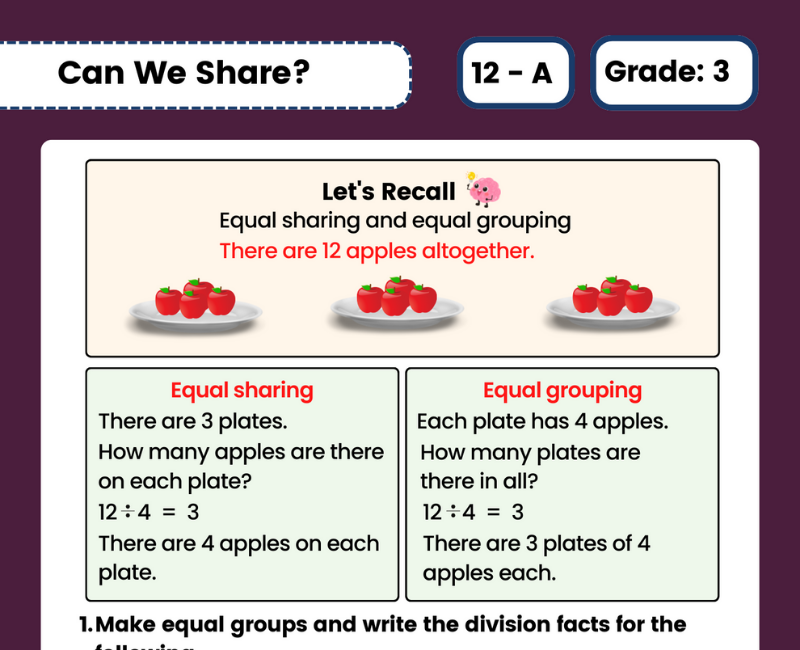
Division means sharing a number equally or making equal groups. We use the division sign ÷. The sentence 12 ÷ 3 = 4 is read as twelve divided by three equals four. Division is the opposite of multiplication.
Equal sharing
In equal sharing we know the total and the number of people or plates. We find how many each one gets. If 12 sweets are shared equally among 3 children, each child gets 12 ÷ 3 = 4 sweets. Every share must be the same size.
Equal grouping
In equal grouping we know the total and the size of each group. We find how many groups we can make. If 15 counters are put in groups of 5, there are 15 ÷ 5 = 3 groups.
Division as repeated subtraction
We can divide by taking away the same number again and again until we reach 0. To find 12 ÷ 4, subtract 4 repeatedly: 12 − 4 = 8, 8 − 4 = 4, 4 − 4 = 0. We subtracted 3 times, so 12 ÷ 4 = 3.
Division and multiplication
Division and multiplication are opposites. The multiplication fact 4 × 6 = 24 gives two division facts: 24 ÷ 4 = 6 and 24 ÷ 6 = 4. Learning the times tables makes division quick, because 24 ÷ 6 asks “6 times what makes 24?”.
Dividend, divisor, quotient and remainder
In 35 ÷ 5 = 7, the number being divided, 35, is the dividend. The number we divide by, 5, is the divisor. The answer, 7, is the quotient. When the sharing is not exact, the number left over is the remainder.
Division without a remainder
When the number can be shared exactly, nothing is left over. 28 ÷ 4 = 7 because 4 × 7 = 28. The remainder is 0.
Division with a remainder
To divide 17 by 5, find the biggest multiple of 5 that is not more than 17. 5 × 3 = 15. Subtract: 17 − 15 = 2. The quotient is 3 and the remainder is 2. The remainder must always be smaller than the divisor. If it is as big as the divisor, you can share one more time.
Equal regrouping: sharing tens and ones
To divide a 2-digit number, split it into tens and ones. Share the tens first, then share the ones. For 84 ÷ 4: 8 tens ÷ 4 = 2 tens and 4 ones ÷ 4 = 1 one, so the answer is 21. If a ten cannot be shared equally, regroup it as 10 ones and add them to the ones. For 52 ÷ 4: share 4 tens, 1 each. The 1 ten left becomes 10 ones, so there are 12 ones. 12 ÷ 4 = 3. The answer is 13.
Checking division by multiplication
Multiply the quotient by the divisor and add the remainder. You should get the dividend. For 23 ÷ 4 = 5 remainder 3, check 4 × 5 + 3 = 23.
Properties of division
- Any number divided by 1 stays the same: 9 ÷ 1 = 9.
- Any number divided by itself is 1: 7 ÷ 7 = 1.
- 0 divided by any number is 0: 0 ÷ 5 = 0.
- We cannot divide by 0.
Division word problems
Read the story slowly. Decide whether to share equally or to make groups. Write the division sentence, solve it with a times table and write the answer with a unit. Think about the remainder: 50 eggs packed in boxes of 6 need 50 ÷ 6 = 8 remainder 2, so 9 boxes are needed because the 2 left-over eggs need a box too.
Solved examples
Common mistakes
| Mistake | Correction |
|---|---|
| Subtracting once instead of dividing | Division asks how many times the divisor fits in the number. |
| A remainder bigger than the divisor | The remainder must be smaller than the divisor. Share once more. |
| Mixing up dividend and divisor | The dividend is the number being shared. The divisor is the number you divide by. |
| Forgetting the leftover when a remainder is part of the story | Read the question. Left-over items may need one more box or group. |
| Unequal shares | Every share in equal sharing must have exactly the same number. |
| Not checking the answer | Multiply the quotient by the divisor and add the remainder. |
Division in daily life
We divide when we share sweets, pack eggs into boxes, split a bill, put students into teams or cut a rope into equal pieces. Practising with real objects such as beads, counters or biscuits helps children see what division means before they learn the sums.
What your child learns from the division worksheet for Class 3, the division Class 3 quiz and division Class 3 activities
- Sharing things equally and making equal groups
- Division as repeated subtraction
- The link between division and multiplication facts
- Dividend, divisor, quotient and remainder
- Division with and without a remainder
- Sharing tens and ones in 2-digit division
- Checking division with multiplication
- Solving division word problems
Tips for parents and teachers
Use real objects at home. Ask your child to deal out 12 biscuits among 3 plates and then to make groups of 4. Say the pairs aloud: “3 times 4 is 12, so 12 divided by 3 is 4.” Use the printable PDF worksheet for written practice and the online activities for quick revision. Revisit the common mistakes table when you see the same error twice.
Related Maths Worksheets
- Multiplication worksheets for Class 3Times tables help division
- Fair Share Class 3 worksheet from NCERTShare fairly
- Addition and Subtraction word problems for Class 3Story problems
- Money Addition and Subtraction worksheet for Class 3 and quizShopping sums
- Rupees and Paise worksheets for Class 3Rupees to paise
- Place Value Class 3 worksheet with online activities and quizTens and ones
- Mental Maths worksheet for Class 3Quick sums
- Give and Take Class 3 worksheetsAdd and subtract
- House of Hundreds II Class 3 worksheetNCERT Maths Mela
- Fractions Class 3 worksheet with online activities and quizEqual parts
- Data Handling Class 3 worksheet with online activities and quizRead charts
- Perimeter and Area Class 3 worksheet with online quiz and activitiesMeasure shapes
Frequently Asked Questions
What is division?
Division means sharing a number equally or making equal groups. It is the opposite of multiplication. For example, 12 ÷ 3 = 4 because 3 × 4 = 12.
What is equal sharing?
Equal sharing means giving every person or plate the same number of things. If 12 sweets are shared among 3 children, each child gets 4 sweets.
What is equal grouping?
Equal grouping means putting a total into groups of the same size and finding how many groups there are. 15 counters in groups of 5 make 3 groups.
What are the dividend, divisor, quotient and remainder?
The dividend is the number being divided. The divisor is the number you divide by. The quotient is the answer. The remainder is what is left over when the sharing is not exact.
How is division related to multiplication?
Division is the opposite of multiplication. One multiplication fact gives two division facts. 4 × 6 = 24 gives 24 ÷ 4 = 6 and 24 ÷ 6 = 4.
How do I divide by repeated subtraction?
Subtract the divisor again and again until you reach 0. The number of subtractions is the quotient. For 12 ÷ 4, subtract 4 three times to reach 0.
How do I divide with a remainder?
Find the biggest multiple of the divisor that is not more than the number. Subtract it from the number to get the remainder. For 17 ÷ 5, 5 × 3 = 15 and 17 − 15 = 2, so the quotient is 3 and the remainder is 2.
Why must the remainder be smaller than the divisor?
If the remainder is as big as the divisor, you can share out one more time. So the remainder is always smaller than the divisor.
What is equal regrouping in division?
Equal regrouping means sharing tens and ones separately. If a ten cannot be shared equally, we regroup it as 10 ones and add them to the ones before sharing.
How do I check a division answer?
Multiply the quotient by the divisor and add the remainder. The result should be the dividend. For 23 ÷ 4 = 5 remainder 3, 4 × 5 + 3 = 23.
Can we divide by 0?
No. We cannot divide by 0. Any number divided by 1 stays the same and any number divided by itself is 1.
What is included on this division page for Class 3?
This page has a printable division worksheet for Class 3, a 20-question division Class 3 quiz and 15 division Class 3 activities online. The activities include sharing sweets, equal groups, remainders, tens and ones sharing and a timed round.
 Download