NCERT JOYFUL MATHEMATICS • CLASS 2 • CHAPTER 1
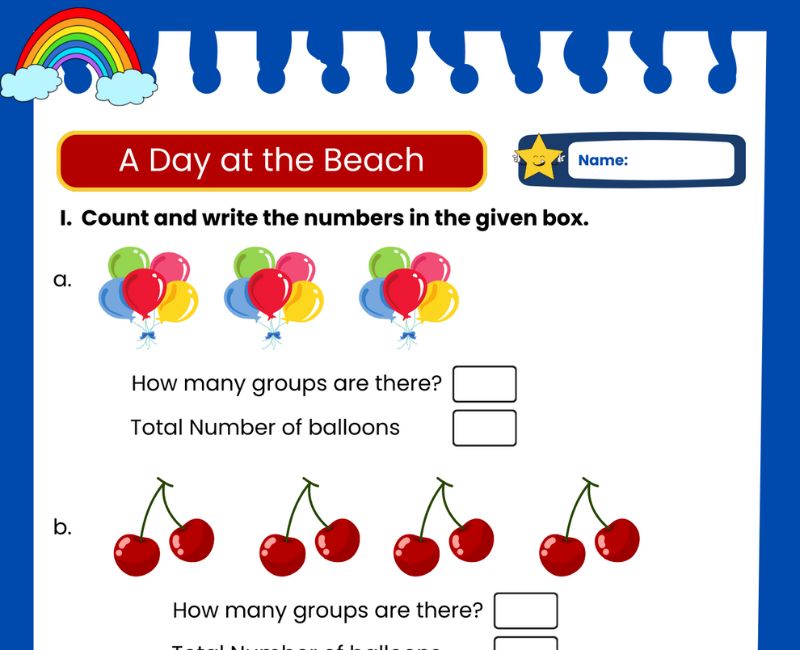
A Day at the Beach Class 2 Worksheet
Counting Groups Tens and Ones with Online Activities
Count seaside objects, pack groups of ten and discover how numbers help us describe quantity, order and labels. Explore the chapter through clear models and playful challenges.
Count and Organise
Count selected objects, build full groups and include the loose ones.
Build Number Sense
Exchange ten units, construct a hundred grid and order number cards.
Read Numbers in Context
Compare quantities and explore positions, sample dates and number labels.
A Day at the Beach Class 2 Quiz
Question 1 / 20 • Easy • Answered 0/20
Optional audio controls
How many shells are shown altogether?
Loose objects
Tap an answer to continue.
Quiz and listening guide
Try 10 easy, five average and five thinking questions. The 20-minute timer starts with the first answer or question-navigation action. Read-aloud alone does not start it. Answers advance except at the final question. Review using the question numbers. Submission or timeout shows every explanation. Restart clears answers and pauses the timer. Speech depends on the browser and available voices; all questions and instructions remain visible.
Five A Day at the Beach Discovery Games
Tap the raised selector. Each game has five original chapter-based challenges.
Beach Object Hunt
Select every object of the named type and enter how many you found.
Select all the shell objects. Then enter their count.
Count the named type only and avoid selecting the same object twice.
Five NCERT Chapter Exploration Activities
Keep the topic, model and controls together while you explore tens, positions and dates.
Chapter 1 Questions and Thinking Practice
Beach Number Riddles
Use every place-value clue to recover the number.
I have six tens and four ones. What number am I?
Read the place and range clues together.
Using the activities
Five games and five exploration activities provide ten interactive formats. Five thinking sets bring the total to 75 tasks, plus a separate 20-question quiz. Switching sets preserves progress while the page stays open. Reset options clear one task or the selected set. Answer within the question and model: tap objects, fill the inline number slots, colour ten-strips and choose positions or dates directly. Practice pictures and numbers are original examples, so use the displayed quantities.
A Day at the Beach Notes Objectives Examples and Solutions • Tap to Read
A Day at the Beach Class 2 NCERT Worksheet and Chapter Guide
This A Day at the Beach Class 2 worksheet supports Chapter 1 of NCERT Joyful Mathematics. It connects counting objects with grouping, tens and ones, number comparison and the different jobs numbers do in daily life. The online practice follows the chapter’s concepts using fresh examples.
What Does A Day at the Beach Teach?
The chapter begins with observing and counting objects in a beach setting. It develops the idea of organised groups, especially groups of ten, before connecting these groups with written numbers. Later tasks extend number sense through comparison, ordering, positions, calendar reading and identifying labels.
The learning goals here are to count each object once, include every loose object, interpret a complete ten, read a numeral using its places and explain a comparison. Children also practise distinguishing “how many”, “which position” and “which named item”.
Counting Objects in a Picture
Choose the object type named in the question before beginning. If the question asks for shells, do not include coconuts or boats. Touching, pointing or marking each counted object can help avoid counting it twice.
The Beach Object Hunt lets children tap the matching objects and write the count in the question’s answer slot. An answer is checked against the objects actually shown, rather than an unrelated beach photograph.
Groups and Loose Objects
A group count and an object count are different. Three full trays with ten objects in each contain thirty objects. If four objects remain outside the trays, the collection contains thirty-four.
Two complete groups of ten shells and seven loose shells make twenty-seven shells. The groups account for twenty; the loose objects contribute seven.
When making groups of five, use five objects in each complete group. Do not automatically treat every container as a ten. Read the stated group size and include everything outside the full groups.
From Groups of Ten to Tens and Ones
A complete group of ten is one ten. A loose single unit is one one. Four tens and seven ones represent forty-seven. The left digit counts tens and the right digit counts ones.
Each blue strip represents ten units. Yellow pieces represent ones.
In the models, each blue strip has ten marked cells. A strip represents ten units even though it is one piece. The single yellow objects represent ones. Count the value represented by the pieces, not just the number of pieces.
Zero in the Ones Place
Eighty has eight tens and zero loose ones in its usual representation. The zero does not remove the ten-groups. It records the empty ones place and keeps the eight in tens.
Writing eight instead of eighty changes the quantity. Compare the models and say the complete number aloud when checking a whole ten.
Exchanging Ten Units for a Ten Strip
Ten single units can be exchanged for one strip of ten. The number of pieces changes, but their total value stays the same. For example, twenty-three loose units can become two ten-strips and three loose units.
The exchange activity asks children to trade every available complete group of ten. The remaining loose units must be fewer than ten in the usual tens-and-ones form.
Making 100 with Ten Strips
Ten strips with ten units in every strip represent one hundred units. Two colours can show different combinations of those strips while keeping the total fixed.
Yellow strips 4 • Red strips 6
For example, four yellow strips and six red strips make ten strips altogether. Their values are forty and sixty, giving one hundred. A completed hundred grid contains one hundred cells, not ten single units.
Expanded Form and Number Cards
Expanded form describes the values of the digits. Forty-seven can be recorded as 40 + 7. The forty comes from four tens, while the seven comes from seven ones.
Digit cards offer another way to investigate place. With the cards seven and two, placing seven in tens creates seventy-two. Swapping the positions creates twenty-seven. The same digits can therefore represent different quantities.
A two-digit numeral cannot start with zero. The cards six and zero can make sixty as a two-digit value. Writing zero before six does not create a new two-digit number.
Comparing More and Less
Compare tens first when checking two-digit numbers. Seventy-four has more than sixty-nine because seven tens exceed six tens. If the tens match, compare ones: fifty-eight is more than fifty-three.
The signs >, < and = describe the relationship between two values. The comparison game shows two labelled quantities, so children can connect the chosen sign with a clear explanation.
Ordering and Number Riddles
Decreasing order moves from greatest to smallest. In a trail containing sixty-four, twenty-eight, eighty-one and forty-three, the correct decreasing order starts with eighty-one and ends with twenty-eight.
A number riddle may name a digit position or describe a range. Check every clue rather than choosing a number that meets only one condition. Some open questions can have more than one correct answer.
Ordinal Positions in a Boat Race
First, second, third, fourth and fifth describe positions. A boat in third position has two boats ahead of it. These words answer a different question from how many boats are racing.
The boat activity uses a labelled practice finish order. Move the named boat through the positions and count how many boats are ahead. Its diagram is an original practice model, not the textbook race illustration.
Reading Dates without Mixing Calendar Years
A calendar places numbered dates under weekday headings. Read the stated calendar rather than assuming that a date always falls on the same weekday.
The calendar printed in the chapter is based on 2023, including in the reprint checked for this update. It should not be treated as a current-year festival calendar. The online activity therefore uses an explicitly labelled sample month with thirty days and Day 1 on Monday. It teaches the reading skill without asserting current festival dates.
Numbers as Quantities Positions and Labels
“Twenty-four shells” gives a quantity. “Fourth boat” gives a position. A bus route number or a jersey number identifies something and does not by itself tell how many passengers or players there are.
The Numbers Have Different Jobs activity asks children to sort these uses. Always read the surrounding words before interpreting a number.
Practice Questions with Solutions
Five groups of ten and six loose shells represent fifty-six. The expanded form is 50 + 6.
Sixty-two is greater than twenty-six because six tens are greater than two tens. The order of digits matters.
The fourth boat has three boats ahead of it. Four is its position, not the number of boats ahead.
Helpful Home and Classroom Activities
Make bundles of ten sticks, arrange ten counters in each tray and pair tens cards with ones cards. Ask children to explain what stays the same when loose units are exchanged for a full ten. Use a sample calendar and safe toy boats or labelled cards to explore the other uses of numbers.
Visible models, optional listening, tap controls and spoken explanations offer several ways to participate. Begin with a manageable collection, then increase the quantity when the child is ready.
Chapter reference NCERT Joyful Mathematics Chapter 1 A Day at the Beach.
Related Class 2 Maths Worksheets
Frequently Asked Questions
Can children answer directly in the activities?
Yes. Tap the objects and answer slots within each question. Groups, ten strips, comparison signs, digit places, boat positions and dates are directly interactive. Number answers appear as compact blanks within the question, and feedback appears below the same activity.
Which NCERT chapter does this worksheet support?
Chapter 1 A Day at the Beach in Joyful Mathematics for Class 2.
What are the main learning objectives?
Counting and grouping objects, representing tens and ones, making one hundred, comparing and ordering numbers, and recognising positions, dates and number labels.
Is A Day at the Beach only about skip counting?
No. Group counting is the starting point, with wider number-sense ideas developed through the chapter.
How are loose objects included in the total?
Count the value of every full group, then add the objects left outside those groups.
How many units does a ten strip represent?
Ten units. A strip is one piece but represents a complete group of ten.
How many ten strips make 100?
Ten complete ten strips represent one hundred units.
Why does zero matter in 80?
It marks zero ones while keeping the eight in the tens position.
How should children compare two-digit numbers?
Compare tens first. When tens match, compare ones.
Can a two-digit number begin with zero?
No. A leading zero does not create a two-digit value.
Does the sample calendar show current festival dates?
No. It is a labelled practice month. The textbook calendar checked is based on 2023, so its weekdays and festival placements should not be reused as current dates.
Does a jersey number tell how many players there are?
No. It identifies a player; it does not by itself give the size of the team.
Are these exact textbook picture answers?
The online questions use original practice models aligned with the chapter. Count the displayed objects and follow each task’s instructions. Answers and explanations appear in the quiz review and activity feedback.
 Download