NCERT JOYFUL MATHEMATICS • CLASS 2 • CHAPTER 8
Grouping and Sharing Class 2 Worksheet
Little Groups Big Discoveries
Build equal groups, share counters fairly and turn pictures into multiplication facts. Explore arrays, make tables and solve thoughtful everyday problems.
See the Groups
Count groups and the objects in each group.
Share Fairly
Give every plate the same number.
Build and Explain
Connect arrays, tables and number stories.
Grouping and Sharing Online Quiz
20 questions • 10 easy • 5 average • 5 thinking
The timer starts with your first answer or quiz navigation. Read Question does not start it. You can revisit answers before submitting.
Question 1 of 20 • Easy
There are 3 equal plates with 2 counters each. How many counters altogether?
Five Grouping and Sharing Games
Choose a raised selector to change the game. Each game has five tasks.
Equal Group Builder • Task 1 of 5
Build 3 equal groups with 4 counters in each. Tap a plate to add one counter.
Counters in tray 12
0 of 5 tasks completed
Five More Interactive Activities
Build tables, rebalance shares and connect different ways of showing the same number.
Table Tile Puzzles • Task 1 of 5
Complete these three facts from the table of 2.
0 of 5 tasks completed
Reasoning and Thinking Questions
Everyday Number Stories • Task 1 of 5
Four boxes hold 3 crayons each. How many crayons altogether?
0 of 5 tasks completed
How to use this learning studio
Ten interactive games and activities offer 50 tasks. Five thinking sets add 25 more tasks. Use the pictures, optional audio and direct taps to explore the same ideas in different ways. Each model, answer and feedback stay together.
Use Previous and Next to move through a set. Reset Task clears one task. Reset Set clears its five tasks. Progress is kept only while this page remains open. The separate quiz has 20 questions and a 20-minute timer. Its timer and End Quiz button stay inside the quiz section.
These are original practice models aligned with the chapter topics, not reproductions of textbook pictures. Yellow circles are counters. This studio reads a × b as a groups of b. Swapping the factors keeps the total but changes the grouping description.
Read about the Grouping and Sharing Class 2 worksheet
NCERT Class 2 Maths Chapter 8 Grouping and Sharing
This Grouping and Sharing Class 2 worksheet supports Chapter 8 of NCERT Joyful Mathematics. Children practise equal groups, repeated addition, multiplication tables, arrays and equal sharing through original questions and interactive models.
Equal groups and repeated addition worksheets
A group is a collection of objects. For multiplication practice, every group must contain the same number. Three bowls containing four counters each can be counted as 4 + 4 + 4 = 12. We write this as 3 × 4 = 12. Collections containing 2, 3 and 4 counters have nine counters in total, but they do not show three equal groups.
Multiplication worksheets for Class 2
Start with pictures before recalling facts. Count the groups, find how many objects are in each group and then work out the total. Four packets with five stickers each give 4 × 5 = 20 stickers. The studio also practises the tables of 2, 3, 5 and 10 and builds new facts by combining known facts.
Arrays and changing the grouping
An array arranges objects in equal rows. Two rows of six counters and six rows of two counters both contain twelve counters. The total is unchanged even though the number of rows and the number in each row are different. Turn the array in the activity to see this relationship.
Equal sharing worksheets for Class 2
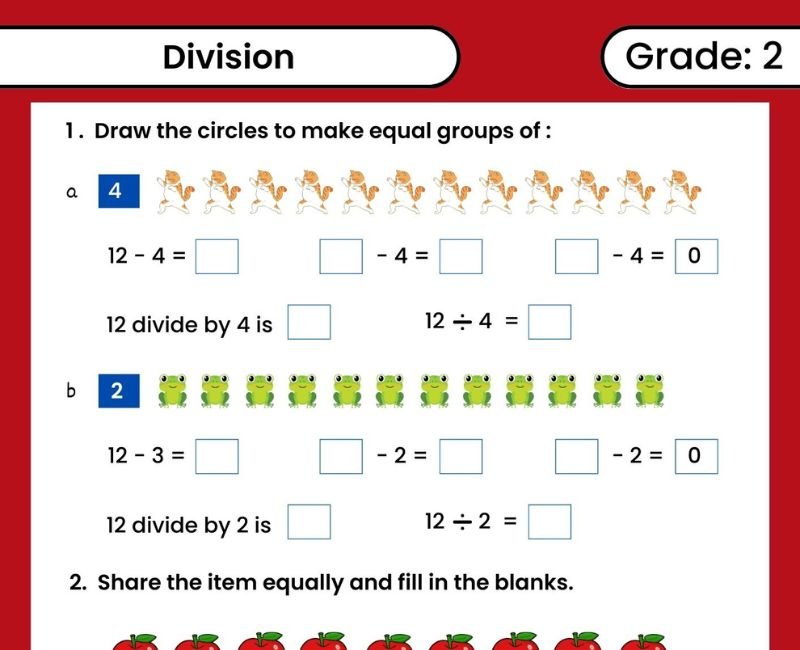
Sharing equally means giving everyone the same amount. If fifteen counters are shared among three plates, each plate gets five. Write 15 ÷ 3 = 5. Check that the plates have equal amounts and that all fifteen counters have been used.
Making groups and finding the number of groups
Grouping starts with the total and a chosen group size. Eighteen beads packed in groups of three make six groups. Write 18 ÷ 3 = 6. Here the answer counts groups; in an equal-sharing question, the answer may count objects in each group. Read the question carefully.
Multiplication and division word problems
Look for what is known and what needs to be found. Equal group totals suggest multiplication. A known total shared fairly, or packed into equal groups, suggests division. Write the answer with a useful word such as counters, packets or counters per plate.
Common mistakes and useful checks
Do not multiply just because there are several collections—check that their sizes are equal. Do not stop sharing while counters remain in the tray. In a number story, distinguish the number of plates from the amount on each plate. Check a division answer using multiplication.
Try a hands-on activity
Use twelve large safe counters. Arrange them in two equal rows, then three equal rows. Record each arrangement. Next, share them among four plates and explain why three counters on each plate is fair. An adult can ask the child to explain before checking the calculation.
More Class 2 Maths Worksheets
Frequently Asked Questions
What does Grouping and Sharing teach in Class 2?
NCERT Joyful Mathematics Chapter 8 develops equal groups, repeated addition, multiplication, tables, arrays and equal sharing.
How is repeated addition related to multiplication?
Adding the same number repeatedly can be written as multiplication. For example, 3 + 3 + 3 + 3 = 12 becomes 4 × 3 = 12.
What is the difference between grouping and sharing?
In equal sharing, the number of groups is known and we find how many objects go in each. In grouping, the size of each group is known and we find how many groups can be made.
Which multiplication tables should children practise?
Build the tables of 2, 3, 5 and 10 with equal groups. The chapter also explores making new tables by adding known table facts.
How do you share 18 counters equally among 3 plates?
Give each plate six counters. There are three equal shares and no counters left. Check with 3 × 6 = 18.
How many groups of 4 can be made from 20 objects?
Five groups. Count 4, 8, 12, 16, 20 or calculate 20 ÷ 4 = 5.
Are 3 groups of 4 and 4 groups of 3 the same?
Both contain twelve objects. Their grouping descriptions differ: one has three groups of four and the other has four groups of three.
Can unequal groups be written as repeated addition of one number?
Not directly as the same equal-group model. First check the size of each group. For example, groups of 2, 3 and 4 need 2 + 3 + 4, not 3 × 3.
How can parents teach equal sharing at home?
Use large safe counters and plates. Let the child distribute one at a time, check that every share is equal and count what remains.
What activities are included on this page?
Ten interactive games and exploration sets include equal groups, fair sharing, packing, arrays, equal jumps, table puzzles, combined facts, share repair, matching and group spotting. Five more sets provide reasoning practice, with a separate 20-question quiz.
Are these exact NCERT exercise answers?
The interactive questions are original chapter-based practice. Use your textbook for the exact illustrations and exercise wording.
Can children hear the questions?
Read Question and Read Task use the device’s available browser voice. Stop Reading cancels it. All tasks can also be completed without audio.
 Download