Equal Groups and Skip Counting Worksheets for Class 2
Count Smarter with Online Activities
Make equal groups, follow number jumps and find how many altogether. Explore counting in 2s, 3s, 5s and 10s with bright models and hands-on challenges.
See the Groups
Count the groups, inspect their contents and find the total.
Build and Jump
Bundle counters, make arrays and travel in equal number steps.
Spot and Explain
Repair broken patterns and explain why a grouping model works.
Equal Groups and Skip Counting Quiz for Class 2
Question 1 / 20 • Easy • Answered 0/20
Optional audio controls
Look at the trays. How many counters are there altogether?
Tap an answer to continue.
Quiz and listening guide
Try 10 easy, five average and five thinking questions. The 20-minute timer starts with the first answer or question-navigation action. Read-aloud alone does not start it. Answers advance except at the final question. Review using the question numbers. Submission or timeout shows every explanation. Restart clears answers and pauses the timer. Speech depends on the browser and available voices; all questions and instructions remain visible.
Five Equal Groups and Skip Counting Games
Tap the raised selector to choose a game. Every game contains five tasks.
Group Total Detective
Inspect every group and find how many counters are present altogether.
Find the total number of counters in these groups.
Count how many groups there are and how many counters are in each. Empty groups contribute zero.
Five Interactive Grouping Labs
Use the model and controls together to explore equal groups and repeated steps.
Counting in Groups Word Problems and Reasoning
Counting Story Solver
Use the group count and group size to answer the story.
Four pencil pots contain 3 pencils each. How many pencils are there altogether?
Check whether the answer should count objects, groups or the landing total.
Using these counting activities
Five games and five labs provide ten interactive formats. Five thinking sets bring the total to 75 tasks, plus a separate 20-question quiz. Switching sets preserves progress while this page stays open. Reset options clear one task or the selected set. Activities with leftover counters distinguish complete groups from the counters that remain.
Skip Counting and Equal Groups Worksheets for Class 2
These skip counting worksheets for Class 2 help children count objects in equal groups, complete number patterns and find totals without counting every object separately. The online activities connect pictures, group-building controls, repeated addition and number-line jumps. Start with pairs, then explore groups of three, five and ten.
What Is Counting in Groups?
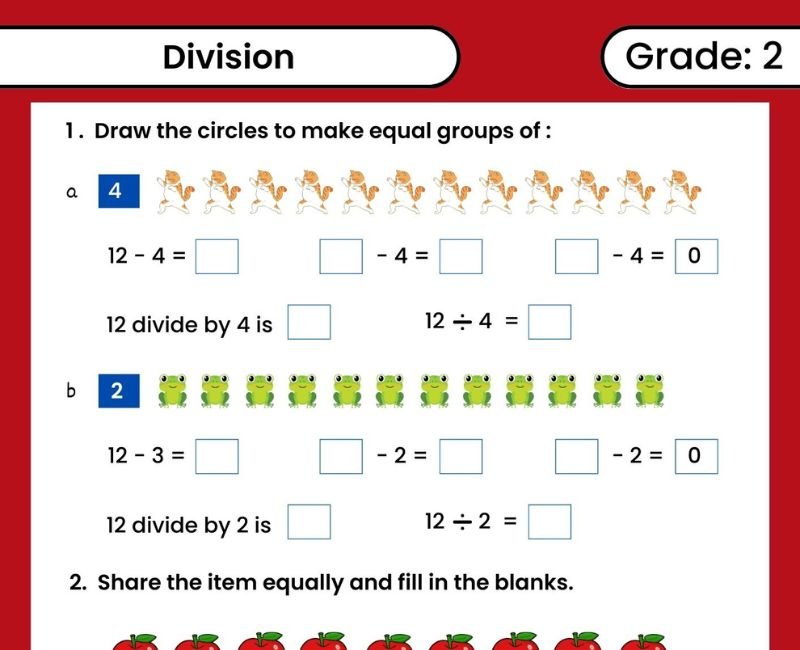
Counting in groups means organising objects into collections and using those collections to find the total. For three baskets with four counters in each basket, there are three groups, four counters in every group and twelve counters altogether. Each of these numbers answers a different question.
Count the baskets to find how many groups there are. Count one basket to find how many are in each group. Count all the counters, or add four three times, to find the total. Naming the three quantities clearly helps prevent confusion.
Equal Groups and Unequal Groups
Equal groups contain the same number of objects. Groups containing three, three and three counters are equal. Groups containing three, two and three are unequal because one group has a different count.
The containers do not need to share a colour or shape. Equal grouping refers to the number of objects in each group. Repeatedly adding one fixed group size describes the whole collection only when every group has that size.
How to Skip Count in 2s
Starting at zero, add two at every step: zero, two, four, six, eight, ten. Pairs of socks, shoes or counters can help children see the repeated group of two. Four pairs contain eight objects, not four objects.
When a sequence starts somewhere else, keep the same step. Starting at three and counting on in twos gives three, five, seven, nine. The difference between neighbouring terms is two even though the terms are odd numbers.
Counting in 3s 5s and 10s
Count in threes by adding three each time: three, six, nine, twelve, fifteen. Count in fives with five, ten, fifteen, twenty, twenty-five. Count in tens with ten, twenty, thirty, forty, fifty.
A skip-counting pattern is controlled by its step, not by the final digit alone. Read the starting number and the change between terms. Some tasks include groups of four as an extra way to apply the same method.
Finding the Total Number of Objects
Four trays contain five counters each. Add five four times: 5 + 5 + 5 + 5 = 20. Alternatively, count five, ten, fifteen, twenty as each tray is included. There are twenty counters altogether.
The last skip-counting total includes all the groups counted so far. Counting four trays gives the number of groups; it does not by itself give the number of counters.
Repeated Addition and Multiplication
Repeated addition records one equal addend for each group. Three groups of four can be written as 4 + 4 + 4 = 12. In the convention used on this page, 3 × 4 means three groups of four.
Four groups of three also total twelve, but they describe a different grouping arrangement. The totals match while the number of groups and objects in each group are exchanged. Read the words and the model before choosing the expression.
Number-Line Jumps for Skip Counting
Start at zero and make three jumps of five. The landing numbers are five, ten and fifteen. The endpoint gives the total increase, while the number of arcs gives the number of jumps.
Count the intervals travelled rather than the printed starting point. Zero is the start of the journey, not a completed jump. The Jump Along the Number Line lab lets children add or undo whole jumps.
Rows Columns and Arrays
An array arranges objects in equal rows and columns. In the Array Builder, each row is treated as one group. Three rows with four counters in each row make twelve counters.
Always read the stated orientation. Three rows of four and four rows of three contain the same total but have different row structures. A correct total alone does not prove that a model matches the requested number of rows.
Making Complete Groups and Finding Leftovers
Seventeen counters are packed into groups of three. Five complete groups use fifteen counters. Two remain. Check the collection by combining the fifteen grouped counters and the two loose counters.
The leftover counters are still part of the total. They are not another complete group of three. The Complete Group Packer asks for both the number of complete groups and the number left over.
Adding One Object to Every Group
If four groups each receive one extra counter, four counters are added altogether. If every group receives two extra counters, eight are added. The change depends on how many groups receive the extra objects.
This differs from adding one object to the entire collection. Use the One More in Every Group lab to see every group change together.
Different Equal Groups with the Same Total
Twelve counters can make three groups of four, four groups of three or six groups of two. Rearranging the counters changes the structure without changing the total number of counters.
The Two Grouping Plans activity asks for two distinct arrangements that use the exact target total. Every saved arrangement must have equal groups and fit the available controls.
Counting in Groups Questions with Solutions
Five packets contain two stickers each. There are ten stickers because 2 + 2 + 2 + 2 + 2 = 10.
Twenty counters are packed five to a tray. Four full trays are needed because four groups of five make twenty.
The sequence five, ten, sixteen, twenty should increase by five. Replace sixteen with fifteen to restore the equal steps.
Common Group Counting Mistakes
Giving the group count as the total Three groups of five contain fifteen objects, not three.
Adding the two quantities once Four groups of three do not mean four plus three. Add three four times.
Overlooking an unequal group Check every group before using one repeated addend.
Counting zero as a jump Starting at zero has not moved along the number line.
Losing leftover counters Include all loose counters when checking the original collection.
Practical Counting Ideas for Parents and Teachers
- Use counters, bottle tops or safe classroom objects to make equal groups.
- Ask separately for the number of groups, the number in each and the total.
- Clap or tap once for each equal jump while saying the running total.
- Build an array and describe its rows before writing an expression.
- Change the arrangement without adding or removing counters.
- Use visible diagrams, optional audio and physical objects in any helpful combination.
Related Class 2 Maths Worksheets
Frequently Asked Questions
What do these skip counting worksheets for Class 2 help children find?
They help children find totals in equal groups, count in fixed steps, complete patterns and distinguish the number of groups from the objects in each group.
What is the difference between counting in groups and skip counting?
Grouping describes how objects are arranged. Skip counting uses equal number steps to keep track of totals, often one step for each equal group.
How do we count in groups of two?
Make pairs and count two, four, six, eight and so on. Each step includes another pair.
How do we count in fives and tens?
Add five or ten at every step. Starting at zero, fives give five, ten, fifteen, twenty; tens give ten, twenty, thirty, forty.
Do equal groups need the same number of objects?
Yes. Equal groups contain the same count. Their containers can differ in colour or appearance.
What are three groups of four?
They contain twelve objects. There are three groups, four objects in each and twelve altogether.
How is repeated addition used for counting groups?
Write the group size once for each equal group and add those values. Three groups of four give 4 + 4 + 4 = 12.
What is an array for Class 2?
It is an arrangement in equal rows and columns. In these activities each row is treated as one group.
Can different group arrangements have the same total?
Yes. Three groups of four and four groups of three both contain twelve objects, though their grouping structures differ.
What happens when not all counters make a full group?
Count the complete groups and keep track of the loose counters. The loose counters still belong to the original total.
Does skip counting always start at zero?
No. The step must stay equal, but the starting number can vary. Three, five, seven, nine increases by two each time.
How do the timer and optional audio work?
The timer starts with the first answer or quiz-navigation action. Reading alone does not start it. Audio controls are separate from the question card, and the timer stays within the quiz area.
 Download