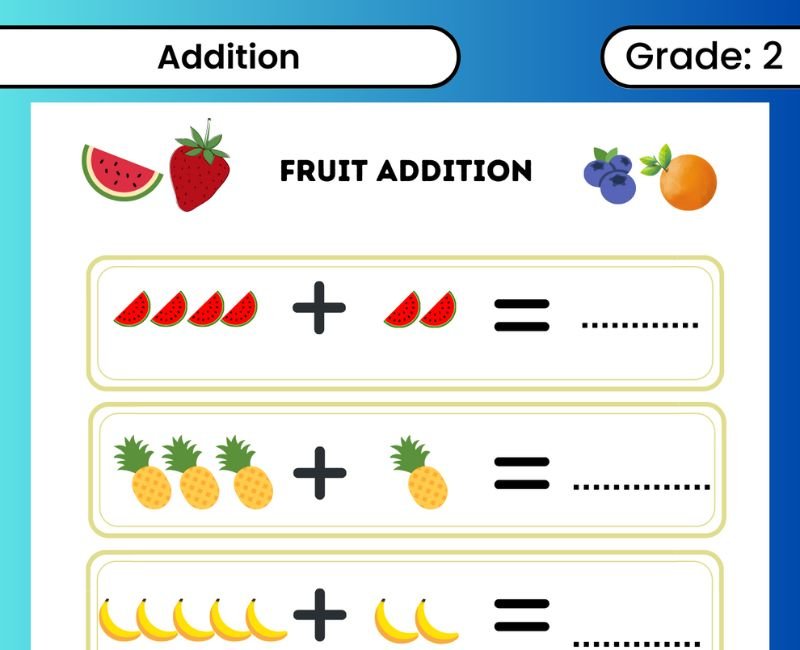
CLASS 2 MATHS • THE ADDITION ADVENTURE
Addition Worksheets for Class 2
with Online Activities and Quiz
Build a number, hop along a line and turn ten ones into a ten. Explore addition with pictures, listening, movement and thoughtful little challenges.
Build and Explore
Join counters, make number bonds and hop to a sum.
See Hear and Do
Use blocks, optional listening and tap-to-move models.
Think It Through
Find missing numbers, explain errors and discover more than one answer.
Addition Class 2 Online Quiz
Question 1 / 20 • Easy
Count the two groups. What is 4 + 3?
Tap an answer to continue.
Quiz and listening guide
Try 10 easy, five average and five thinking questions. The 20-minute timer starts with the first answer or question-navigation action. Read-aloud alone does not start it. Answers advance except at the final question. Review using the question numbers. Submission or timeout shows every explanation. Restart clears answers and pauses the timer. Speech depends on the browser and available voices; all questions and instructions remain visible.
Five Addition Adventure Games
Tap the raised selector to choose a game. Each one has five challenges.
Counter Train
Tap each yellow passenger to join the blue group, then enter the total.
Join 5 blue counters and 4 yellow counters. How many altogether?
Move every yellow counter once. Count the full collection.
Five Hands-On Online Addition Activities
Use a model, listen if you wish and explain what changes.
Addition Reasoning and Extra Practice
Little Addition Stories
Read the story, choose a model and type the answer.
A box has 24 red pencils and 18 blue pencils. How many pencils altogether?
Identify the two amounts being joined. Add ones and tens.
| T | O |
|---|---|
| 2 | 4 |
| + 1 | 8 |
| ? | ? |
How the activity sets work
Five games, five activities and five extra-practice sets provide 75 tasks, separate from the quiz. Games and activities share one active main workspace. Extra practice is independent. Switching sets keeps progress while this page stays open. Use Reset options for one task or its whole set. Work in short sessions. Read-aloud, diagrams, counters and physical suggestions are optional ways to explore the same idea.
Eight Addition Tips for Children
- Find out what the two groups represent.
- Start with the bigger number when counting on.
- Count the jumps, not the starting number.
- Keep tens with tens and ones with ones.
- Ten ones can be exchanged for one ten.
- Try making ten for sums such as 8 + 5.
- Check that both sides of an equal sign have the same value.
- Explain your answer with blocks, a picture or words.
Five Tips for Parents and Teachers
- Allow children to choose counters, a number line or place-value blocks.
- Read the problem aloud and keep its text available.
- Use bundles of ten sticks to explain regrouping before a written carry.
- Ask for a second way to make a total and compare the methods.
- Use short discussion and movement breaks without assigning children fixed learning styles.
Addition Worksheets for Class 2 Guide Solved Examples and Thinking Questions
How can 8 + 5 become an easier sum? Why does exchanging ten ones keep the total unchanged? These addition worksheets for Class 2 connect counting, place value and reasoning. Use the printable worksheets offered on the page for written work and the online activities to build, test and explain addition ideas.
This general topic resource includes addition without carrying, addition with carrying or regrouping, two-digit addition, mental maths, missing addends, adding three numbers and addition word problems. It is not presented as a particular textbook chapter. Choose tasks that suit the child's current school sequence.
What Is Addition?
Addition combines quantities or increases an amount. The numbers being added are called addends; their total is the sum. In 6 + 3 = 9, six and three are addends and nine is the sum. The plus sign means add, and the equal sign means both sides have the same value.
For a picture question, count each group once and then combine them. When a child can already recognise the first group, encourage counting on rather than recounting every object.
Count On Using a Number Line
To calculate 14 + 3, start at 14 and make three one-step jumps to the right. The landing numbers are 15, 16 and 17. The answer is 17. The starting number is not counted as the first jump.
For a larger addend, split it into tens and ones. For example, 32 + 14 can be modelled as one jump of ten followed by four jumps of one. Both jump sizes move along the same number scale.
Two-Digit Addition Without Carrying
Line up numbers by place value. Add the ones, then add the tens. In 24 + 13, four ones plus three ones make seven ones, and two tens plus one ten make three tens. Therefore 24 + 13 = 37.
| T | O |
|---|---|
| 2 | 4 |
| + 1 | 3 |
| 3 | 7 |
There is no regrouping because the ones total is less than ten. Aligning the digits helps children avoid adding a tens digit to a ones digit.
Addition With Carrying Explained Using Blocks
Consider 27 + 35. Seven ones plus five ones make twelve ones. Exchange ten of those ones for one ten, leaving two ones. The tens are now two tens, three tens and the exchanged ten: six tens altogether. The total is 62.
| T | O |
|---|---|
| 1 | |
| 2 | 7 |
| + 3 | 5 |
| 6 | 2 |
The small carried 1 represents one ten. It is not one extra object added to the total. Regrouping changes the way the same quantity is represented. The Ten Ones Exchange activity makes this change visible.
Make Ten Addition Strategy
For 8 + 5, move two from the group of five to complete ten with eight. Three remain. Now calculate 10 + 3 = 13. The five has been split into two and three; no objects have been created or removed.
9 + 7 = 9 + 1 + 6 = 10 + 6 = 16.
Nine needs one to reach ten. Split seven into one and six.
Ten frames help children see the empty spaces needed to complete ten. The interactive frame starts with one group and lets the learner move only the required extra counters.
Mental Maths Addition for Class 2
Useful strategies include counting on, making ten, adding whole tens, using doubles and using near doubles. For 6 + 7, a child who knows 6 + 6 = 12 can add one more to get 13. For 43 + 20, adding two tens gives 63 while the ones digit stays three.
Ask which strategy is helpful and why. A method that works is valuable even when it differs from another child's method. Speed should grow from understanding and practice.
Adding Three Numbers
Choose a convenient pair first. For 5 + 8 + 5, pair the two fives to make ten, then add eight to get eighteen. Changing the grouping or order of addends does not change their sum. Children can demonstrate this by moving the same counters into different groups.
Missing Numbers in Addition
In 16 + □ = 23, ask how much must be added to sixteen to reach twenty-three. Count on four to twenty and three more to twenty-three. The missing number is seven. Check by writing 16 + 7 = 23.
A missing addend can appear on either side of the plus sign. Avoid assuming that an empty box always represents the final total.
Understanding the Equal Sign
The equal sign means the quantities on both sides match. In 9 + 4 = 8 + 5, both sides total thirteen. The right side can contain another sum rather than a single answer. A balance puzzle encourages children to create several correct pairs for one total.
Addition Word Problems for Class 2 with Solutions
A class has 26 red counters and 17 blue counters. How many counters are there altogether?
26 + 17 = 43. Six ones plus seven ones make thirteen ones. Regroup one ten. There are four tens and three ones.
A library shelf has 34 books. A teacher adds 12 books. How many are on the shelf now?
34 + 12 = 46 books. Add ten and then two, or add tens and ones separately.
Three trays contain 4, 9 and 6 counters. How many are there in all?
4 + 9 + 6 = 19. Pair four and six to make ten, then add nine.
Read the story for meaning. Decide whether quantities are being joined or an amount is increasing. A keyword alone does not identify the operation reliably in every story.
Reasoning and Thinking Questions
- Will swapping 18 and 7 change the sum?
No. Both 18 + 7 and 7 + 18 equal 25. The same two quantities are combined.
- If one addend increases by one and the other decreases by one, what happens?
The sum stays the same. For example, 12 + 8 and 13 + 7 both equal 20.
- Can two different pairs make 15?
Yes. For example, 6 + 9 = 15 and 7 + 8 = 15. The open puzzles accept any pair meeting the stated conditions.
- A child says 29 + 14 = 33. What needs checking?
Nine plus four gives thirteen ones. One ten must join the tens column, so the correct sum is 43.
- Does adding zero make a number bigger?
No. Zero adds no extra amount. For example, 47 + 0 = 47.
- How can you check a number-line answer?
Check the starting number, the number and size of jumps, and the final landing point.
Learning with Pictures Listening and Movement
Children can view counters and blocks, listen to a question, move digital pieces, explain a method to a partner or use real objects. These are flexible ways to participate, rather than labels that fix a child as one type of learner.
For a practical task, bundle ten sticks with an elastic band and exchange ten loose sticks for a bundle. For movement, place number cards on the floor and step forward to count on. For discussion, ask a partner to build a different pair for the same total. An adult can read every written instruction if speech is unavailable.
Using Printable Addition Worksheets and Online Activities Together
Start with a model, solve a few written sums and return to a model when an error needs explaining. Use the answer explanations after the quiz to discuss a method. Keep practice short enough for the child to remain thoughtful and comfortable.
Use this general addition resource for practice selected by the teacher or parent. It does not claim a fixed textbook chapter, guaranteed test questions or one compulsory method for every child.
More Class 2 Maths Practice
Frequently Asked Questions
What do addition worksheets for Class 2 cover?
This resource practises counting on, two-digit sums, addition with and without regrouping, missing addends, adding three numbers and simple word problems.
What is addition without carrying?
The ones total is less than ten, so no group of ten ones needs to move to the tens column. For example, 32 + 16 = 48.
What does carrying mean in addition?
Carrying records an exchange between place values. Ten ones become one ten. The small 1 in the tens column represents one ten.
How do I explain 28 + 15 using place value?
Eight ones and five ones make thirteen ones. Exchange ten ones for one ten. Two tens plus one ten plus the exchanged ten make four tens, with three ones left. The answer is 43.
How do number-line addition activities work?
Start at the first addend and move right by the second addend. Count the jumps, not the starting point. A ten-jump moves ten number units.
What is the make-ten strategy?
Split one addend to complete ten with the other. For 7 + 6, use three of the six to make ten, then add the remaining three to get thirteen.
How can children find a missing addend?
Count on from the known addend to the total or use counters to see the missing amount. Then check the complete addition sentence.
Does the order of addends matter?
The sum stays the same when the two addends are swapped. Children can check this with the same groups of objects.
Why include puzzles with more than one answer?
They encourage children to find examples, check conditions and compare strategies. A total can have several valid addend pairs.
Can children hear the questions?
Read-aloud buttons use browser speech when it is available. Text remains visible. Speech can be stopped, and an adult can read the task instead.
Are these worksheets from a named textbook chapter?
This is a general Class 2 addition practice page, not a named chapter worksheet.
Do the games work without dragging?
Yes. The tasks use tap buttons, number fields, sliders and native selectors. The topic, model and controls stay in the same activity card.
 Download