CLASS 2 MATHS • THE BALANCE DETECTIVE STUDIO
Heavy and Light Worksheets for Class 2
Compare Weights with Online Activities
Which pan goes down? Which parcel is the lightest? Explore comparing mass with colourful balance scales, movable weights and clever little puzzles.
Look at the Balance
Identify heavier, lighter and equal masses from pan positions.
Build and Investigate
Add weights, pack parcels and test what keeps a balance equal.
Follow the Evidence
Order labelled masses, solve clues and challenge size-based guesses.
Heavy and Light Quiz for Class 2
Question 1 / 20 • Easy • Answered 0/20
Optional audio controls
Which load is heavier on this balance?
Tap an answer to continue.
Quiz and listening guide
Try 10 easy, five average and five thinking questions. The 20-minute timer starts with the first answer or question-navigation action. Read-aloud alone does not start it. Answers advance except at the final question. Review using the question numbers. Submission or timeout shows every explanation. Restart clears answers and pauses the timer. Speech depends on the browser and available voices; all questions and instructions remain visible.
Five Heavy and Light Discovery Games
Tap the raised selector to choose a game. Each game has five different tasks.
Balance Pan Detective
Read the pan positions and choose the load described by the clue.
Which load is heavier? Choose A, B or Equal mass.
The heavier load is on the lower pan. The lighter load is higher. Level pans mean equal mass.
Five Interactive Weighing Labs
Watch the scale while using the controls in the same activity frame.
Weight Comparison Word Problems and Reasoning
Weight Story Solver
Solve a short mass story and enter the requested number.
Bag A is 9 kg and Bag B is 4 kg. How many kilograms heavier is A?
Decide whether the story asks for a difference, a combined mass, a missing amount or a remainder.
Using the games and practice sets
Five games and five weighing labs give ten interactive formats. Five thinking sets bring the total to 75 tasks, alongside a separate 20-question quiz. Switching sets preserves work while this page stays open. Reset options clear the current task or the selected set. Blue unit weights represent identical model units, not automatically grams.
Heavy and Light Objects Worksheets for Class 2
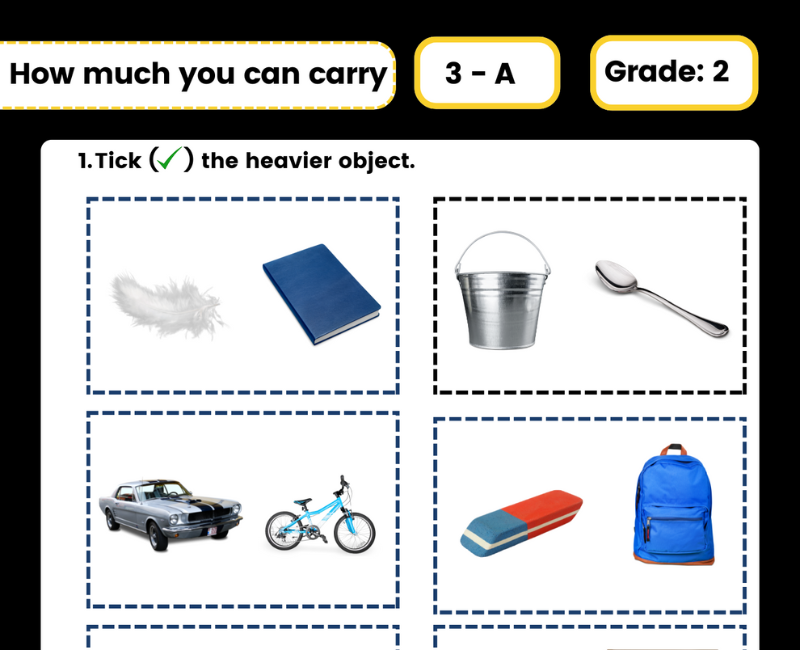
These heavy and light worksheets for Class 2 help children find which object is heavier or lighter, recognise equal weights and order objects from lightest to heaviest. The online models connect comparison words with visible balance-scale evidence. Labelled measurements introduce simple mass comparisons in grams and kilograms without relying on the apparent size of a drawing.
What Do Heavy and Light Mean?
Heavy and light are useful everyday words for comparing objects. When one object has more mass than another, we describe it as heavier. When it has less mass, it is lighter. The comparison always needs a reference: a parcel can be heavier than one packet and lighter than another.
For early maths, the language of weight helps introduce measuring mass. Mass is commonly recorded in grams or kilograms. The activities use ordinary classroom comparisons rather than formal calculations involving force or gravity.
How to Read a Balance Scale
On an ideal equal-arm balance, the heavier side moves down and the lighter side moves up. If the pans are level after the balance settles, the total masses on the two sides are equal. Look at the pan positions rather than the colour of an object.
In this example, the left pan is lower. Its load has greater mass. The right load is lighter. A tilted beam shows the direction of the comparison; the angle in these learning diagrams is not a measurement of how many grams the loads differ by.
Equal Weight Does Not Mean the Same Appearance
Objects can have equal mass while looking different. A model parcel can balance a collection of identical unit weights. The parcel and weights need not share a shape, colour or size.
If a parcel balances six identical unit weights, its mass is six of those units. The units must be alike. Six arbitrary classroom objects would not be a reliable six-unit measurement because their masses may differ.
Finding the Heaviest and Lightest Objects
Heaviest means greatest mass within the group being compared. Lightest means least mass. For three labelled packets of 20 g, 45 g and 70 g, the 70 g packet is heaviest and the 20 g packet is lightest.
The middle packet is heavier than the lightest but lighter than the heaviest. This is why a worksheet answer should name the comparison, rather than calling one object simply “heavy” in every situation.
Ordering Objects from Lightest to Heaviest
First check that the measurements use the same unit. Then compare their values. A set of 15 g, 35 g and 60 g is already in order from lightest to heaviest. Reverse that order when the instruction asks for heaviest first.
When a task gives only balance clues, combine them. If Parcel A is heavier than Parcel B and Parcel B is heavier than Parcel C, Parcel A is heaviest and Parcel C is lightest. Their exact masses are not needed to decide the order.
Does a Bigger Object Always Weigh More?
No. Size by itself does not determine mass. A large empty cardboard box may be lighter than a smaller box filled with books. The material and contents matter, so use a scale or reliable measurement when an answer is uncertain.
Pictures on this page illustrate the task. Their drawn sizes are not a substitute for measurement. Comparisons with named objects refer to the stated labels or the shown balance, not a rule about every object of that kind.
Measuring Weight in Grams and Kilograms
A gram is written g and a kilogram is written kg. One kilogram equals one thousand grams. Small classroom items may have masses recorded in grams, while a filled school bag may be recorded in kilograms. Read its actual measurement instead of assuming a fixed mass.
For a direct number comparison, keep the unit the same. For example, 80 g is heavier than 50 g. A larger written number does not automatically mean a greater mass when the units differ. Most tasks here use identical model weights or measurements already expressed in one common unit.
Balancing a Parcel with Equal Unit Weights
A parcel balances eight identical model cubes. Place one cube at a time on the other pan. The pans become level at eight cubes, so the parcel has a mass of eight model units.
The unit-weight game uses this visual check. If too few cubes are present, their pan is higher. If too many are added, their pan goes lower. Use Add, Remove and the balance position to investigate.
Finding a Missing Weight
One pan has a mass of nine model units. The other has four. Five more units are needed because four plus five equals nine.
Subtract the smaller load from the target, then check by adding the missing amount. The Missing Weights Lab asks for the number added, so do not confuse that number with the final total on the pan.
What Happens When the Same Weight Is Added to Both Sides?
If two pans start equal, adding an equal mass to both keeps them equal. If one side starts heavier, adding equal masses to both preserves the difference. For example, loads of four and seven units become six and nine after adding two units to each. The gap remains three units.
This is different from adding a weight to just one pan. Use the Same Change Lab to test the claim and explain what changes and what stays the same.
Weight Word Problems with Solutions
Bag A is 8 kg and Bag B is 5 kg. Bag A is heavier by 3 kg because eight minus five equals three.
Two model parcels have masses of three and four units. Their combined mass is seven units. A third parcel with mass seven units would balance them together.
A three-unit weight can replace three identical one-unit weights. The number of pieces changes, but the total model mass stays the same.
Common Heavy and Light Mistakes
Choosing the higher pan as heavier The heavier load goes down on the ideal balance used here.
Counting unequal objects as equal units Use identical unit weights when the count is meant to measure mass.
Guessing from size alone A larger drawing does not prove a greater mass.
Ignoring units Compare like units or convert correctly before comparing different ones.
Practical Weighing Ideas for Parents and Teachers
- Use a stable balance and safe, manageable classroom objects.
- Predict the heavier object, then test the prediction.
- Use identical blocks as non-standard units.
- Record each comparison with a labelled drawing.
- Ask for a sentence using heavier than, lighter than or equal in mass.
- Combine visible models, optional listening, movement and discussion.
Related Class 2 Maths Worksheets
Frequently Asked Questions
What do heavy and light worksheets for Class 2 help children find?
They help children identify heavier, lighter and equal-weight objects, read balance scales, find the heaviest and lightest items, and order labelled masses.
Which side of a balance scale shows the heavier object?
On the ideal equal-arm balance used here, the heavier load is on the lower pan. The lighter load is on the higher pan.
What do level balance pans mean?
They mean that the total masses on the two sides are equal after the balance settles.
What is the difference between heavier and heaviest?
Heavier compares an object with another. Heaviest identifies the object with greatest mass in the whole group being considered.
Does a larger object always have greater mass?
No. Material and contents also matter. Use a balance or a reliable mass label instead of guessing from size alone.
Can different-looking objects have equal weight?
Yes. Different shapes and materials can have equal mass, which a level balance can show.
How do we order masses from lightest to heaviest?
Check the units, then arrange the measurements from smallest to greatest. Balance clues can also establish an order without exact measurements.
Why must model unit weights be identical?
Each counted unit must represent the same mass. Counting different objects does not give a reliable measurement unless their masses are known.
What does g mean and what does kg mean?
The symbol g means gram and kg means kilogram. One kilogram equals one thousand grams.
Does adding the same mass to both pans change the difference?
No. Equal additions preserve the difference between the two loads. If they started equal, they remain equal.
Are the model cubes automatically one gram each?
No. They represent identical model units. A task must explicitly give a value in grams before that conversion can be made.
How do the quiz timer and audio work?
The timer starts with the first answer or quiz-navigation action. Reading alone does not start it. Audio is in a separate panel, and timer controls remain within the quiz section.
 Download