CLASS 2 MATHS • THE THINK AND SOLVE STUDIO
Mental Maths Worksheets for Class 2
Number Strategies with Online Activities
Make a friendly ten, use a double and spot a useful number fact. Practise sums, differences and missing numbers with clear models and thoughtful games.
Find Friendly Numbers
Build number bonds, use doubles and bridge to the next ten.
Try a Useful Strategy
Add nine, subtract nine and count up to find a difference.
Think and Explain
Compare calculations, recover missing numbers and repair mistakes.
Mental Maths Quiz for Class 2
Question 1 / 20 • Easy • Answered 0/20
Optional audio controls
Find the missing part 7+?=10.
Tap an answer to continue.
Quiz and listening guide
Try 10 easy, five average and five thinking questions. The 20-minute timer starts with the first answer or question-navigation action. Read-aloud alone does not start it. Answers advance except at the final question. Review using the question numbers. Submission or timeout shows every explanation. Restart clears answers and pauses the timer. Speech depends on the browser and available voices; all questions and instructions remain visible.
Five Mental Maths Discovery Games
Tap the raised selector to change games. Each game contains five fresh tasks.
Number Bond Builder
Build the missing part to reach the target whole.
Keep the first part 6. Build the other part so the whole is 10.
Find what must join the first part to reach the whole.
Known part
Your missing part
Five Interactive Mental Strategy Labs
Use the larger number models to understand a strategy, then try saying the calculation mentally.
Mental Maths Questions and Thinking Challenges
Mental Maths Story Solver
Choose a useful fact or mental strategy for each short problem.
There are 28 crayons. Five more are added. How many crayons are there now?
Identify a useful number bond, double or whole-ten change.
Using the practice
Five games and five strategy labs give ten interactive formats. Five thinking sets bring the total to 75 tasks, plus the separate 20-question quiz. Games are untimed. Switching sets keeps progress while this page stays open. Reset options clear one task or its selected set.
Mental Maths Notes Strategies and Worked Examples • Tap to Read
Mental Maths Worksheets for Class 2 Addition Subtraction and Number Facts
These mental maths worksheets for Class 2 help children find sums, differences and missing numbers using known facts. The main focus is addition and subtraction, supported by number bonds, doubles, friendly tens and simple reasoning. The models make the strategy visible before children try describing or using it mentally.
What Is Mental Maths?
Mental maths means working with numbers in your head using facts and relationships you understand. It does not have to mean rushing. A child who explains why a method works is developing a useful skill even when the answer takes a little time.
Use pictures and counters while learning a strategy. Gradually reduce the support as confidence grows. The same question can often be solved by more than one sensible method.
Number Bonds to 10 and 20
A number bond separates a total into parts. Seven and three make ten. Thirteen and seven make twenty. If the whole and one part are known, the other part can be found by thinking about what is missing.
Known part
Missing part
For 7 + □ = 10, the missing number is three. Check the completed sentence by combining both parts. A zero part is also valid: ten and zero still make ten.
Doubles and Near Doubles
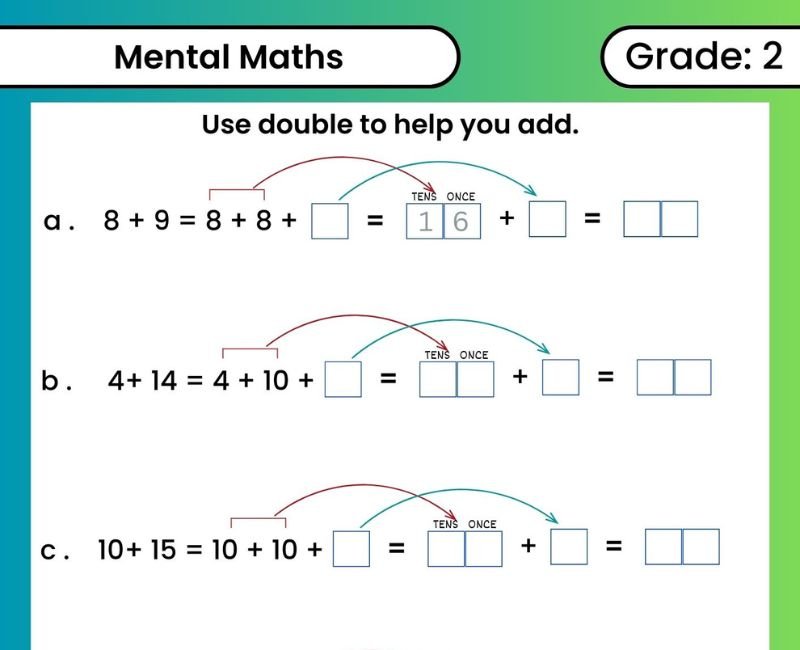
A double adds a number to itself. Double six is twelve because 6 + 6 = 12. A near double uses a nearby known double. For 6 + 7, double six and add one, giving thirteen.
For 8 + 9, start with 8 + 8 = 16. The second addend is one larger, so the sum is seventeen.
The matching-pair game adds one counter to each side at the same time. Every press adds two counters altogether, keeping the two groups equal.
Make the Next Ten
For 27 + 5, split the five into three and two. Add three to reach thirty, then add the remaining two. The result is thirty-two.
27 + 5 = 27 + 3 + 2 = 30 + 2 = 32.
Splitting the second addend does not create extra value. Three and two still make the original five. The Bridge to the Next Ten game asks you to stop the first part exactly at a whole ten.
Adding Nine by Adding Ten
Nine is one less than ten. To add nine to thirty-six, add ten to get forty-six, then subtract one to get forty-five.
36 + 9 = 36 + 10 − 1 = 45.
The correction matters. Stopping after adding ten gives an answer one too large. The workshop lets you perform and undo both steps.
Subtracting Nine by Subtracting Ten
To subtract nine from forty-five, subtract ten first, giving thirty-five. Then add one back because you removed one too many. The answer is thirty-six.
45 − 9 = 45 − 10 + 1 = 36.
Compare the direction of the adjustment in the add-nine and subtract-nine methods. Adding ten needs a correction down by one; subtracting ten needs a correction up by one.
Choose a Friendly Pair in Three-Number Addition
In 8 + 5 + 2, the eight and two make ten. Combine that pair first, then add five to get fifteen. Addition allows the addends to be regrouped without changing their total.
Do not use that rule to rearrange a subtraction expression freely. Subtraction depends on order. For example, 12 − 5 and 5 − 12 do not describe the same calculation.
Counting Up to Find a Difference
The difference between twenty-seven and thirty-two is five. Count up from twenty-seven to thirty, a change of three, and then to thirty-two, a change of two. Three plus two gives five.
32 − 27 = 5 because 27 + 5 = 32.
Count the increase, not the number of printed starting points. A whole-ten jump can make the route easier to track.
Missing Numbers in Addition and Subtraction
A missing number can appear in different positions. In □ + 8 = 15, it is seven. In 18 − □ = 11, it is seven. In □ − 6 = 13, it is nineteen.
Think about the relationship between the quantities rather than applying the same subtraction to every blank. Substitute the answer into the original sentence to check it.
Comparing Two Calculations
The expressions 26 + 7 and 27 + 6 both equal thirty-three. One addend increases by one while the other decreases by one, keeping the total unchanged.
Use = when both sides have equal value, > when the left is greater and < when the left is smaller. The equals sign describes a relationship between values, not just a place where an answer goes.
Class 2 Mental Maths Questions with Solutions
Forty-three plus twenty is sixty-three. Two tens are added while the three ones stay the same.
To complete 14 + □ = 20, find what joins fourteen to make twenty. The missing part is six.
If a robot says 48 + 9 = 58, it has added ten without correcting. Subtract one from fifty-eight to get fifty-seven.
Building Confidence without Rushing
Choose a small set of questions and ask which fact helped. Discuss a mistake, revisit its model and try a related example. Accuracy, explanation and flexible thinking provide a stronger foundation than guessing quickly.
The quiz has the usual timer, while the games can be explored without a countdown. Optional audio reads the visible question; all essential information remains on screen.
Related Class 2 Maths Worksheets
Frequently Asked Questions
What do these mental maths worksheets for Class 2 practise?
Addition, subtraction, number bonds, doubles, near doubles, missing numbers and reasoning about number relationships.
Does mental maths mean answering as fast as possible?
No. Understanding useful facts and explaining a strategy are important. The games are untimed.
What are number bonds?
They are parts that combine to make a whole. Seven and three make ten, while thirteen and seven make twenty.
How do doubles help addition?
A known double can support a nearby sum. Six plus seven is double six plus one, which is thirteen.
How do you add nine mentally?
Add ten and then subtract one. For example, thirty-six plus nine is forty-five.
How do you subtract nine mentally?
Subtract ten and add one back. Forty-five minus nine is thirty-six.
What does making the next ten mean?
Split an addend so that the first part reaches the next multiple of ten. Add the remaining part afterwards.
Can counting up solve subtraction?
Yes. The increase from the smaller number to the larger gives their difference.
Can a missing number be at the start of a sum?
Yes. Work from the relationship between the parts and whole, then check by substitution.
Can the same total have different addition pairs?
Yes. Twelve can be seven plus five or eight plus four. Simply swapping a pair is not a new pair in the two-plan activity.
Do these worksheets focus on multiplication and division?
The main focus of this page is mental addition and subtraction. Related worksheets provide separate multiplication and division practice.
Are the diagrams and long notes easy to access?
The models use large number cards and responsive counter frames. Long explanations are collapsed under Tap to Read. Audio controls are separate from the quiz question.
 Download