CLASS 2 MATHS • THE BASE-TEN BUILDER STUDIO
Tens and Ones Worksheets for Class 2
Place Value Online Activities and Quiz
Build a number, bundle ten cubes and shine a spotlight on each digit. Explore two-digit place value with colourful ten-rods, ones cubes and thinking challenges.
Read Build Match
Count blocks, arrange digit cards and connect descriptions with numbers.
Group and Exchange
Bundle ten ones, open a ten and build different models with equal value.
Compare and Explain
Find digit values, solve number riddles and repair place-value mistakes.
Tens and Ones Place Value Quiz for Class 2
Question 1 / 20 • Easy • Answered 0/20
Optional audio controls
Which digit is in the tens place in 63?
Tap an answer to continue.
Quiz and listening guide
Try 10 easy, five average and five thinking questions. The 20-minute timer starts with the first answer or question-navigation action. Read-aloud alone does not start it. Answers advance except at the final question. Review using the question numbers. Submission or timeout shows every explanation. Restart clears answers and pauses the timer. Speech depends on the browser and available voices; all questions and instructions remain visible.
Five Tens and Ones Discovery Games
Tap the raised selector. Each game has five different challenges.
Base-Ten Block Detective
Count rods as tens and small cubes as ones, then name the number.
Read the block model and enter its two-digit number.
Count the ten-rods in tens, then add the loose ones.
Five Place Value Exploration Activities
Watch the quantities as you change a model. Explain what changes and what stays equal.
Place Value Riddles Comparisons and Reasoning
Place Value Number Riddles
Use both place-value clues before entering the number.
My tens digit is 5 and my ones digit is 8. What number am I?
Find the tens digit and ones digit, then keep them in the correct places.
Using the practice sets
Five games, five exploration activities and five thinking sets contain 75 tasks, plus a separate 20-question quiz. Games and exploration activities share the main workspace. Extra practice is independent. Switching a set preserves progress while this page stays open. Reset one task or the whole selected set through Reset options.
Eight Place Value Habits
- Read the column heading before naming a digit.
- Count a ten-rod as ten, not one.
- Keep loose ones separate from complete tens.
- Use each digit card only as instructed.
- Include zero when a place is empty.
- Write expanded form using digit values.
- Check the total before and after an exchange.
- Explain a number using both its tens and its ones.
Practical Ideas for Parents and Teachers
- Bundle ten sticks and keep extra sticks loose.
- Use a labelled tens-and-ones mat for digit cards.
- Compare a whole ten such as forty with the single-digit number four.
- Ask for two different models of one number after the usual model is understood.
- Combine visible diagrams, optional listening, manipulation and spoken explanations.
Tens and Ones for Class 2 Place Value Charts Expanded Form and Worked Examples
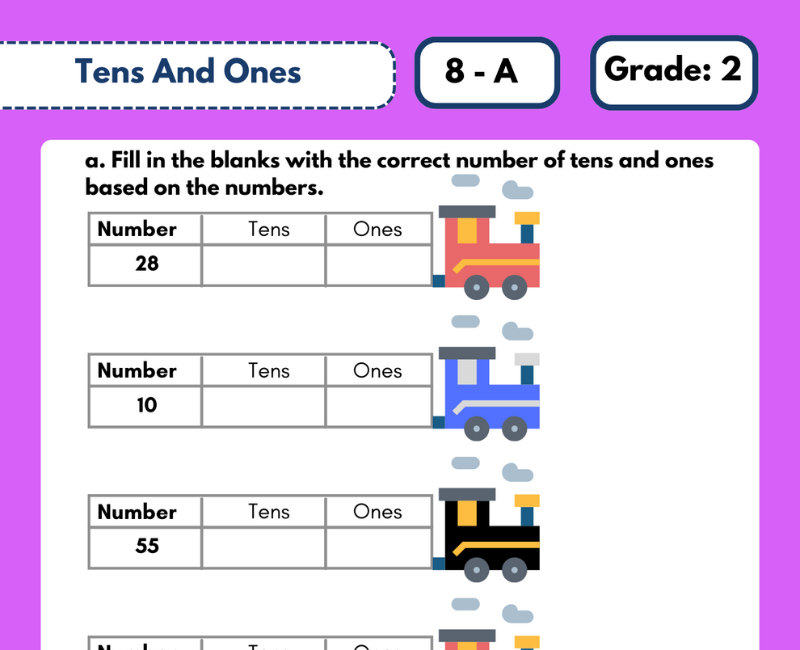
The digits in a two-digit number do different jobs. In forty-six, the four counts tens and the six counts ones. These tens and ones worksheets for Class 2 connect written numerals with base-ten blocks, place value charts, expanded form and reasoning about equal quantities.
The online examples focus on two-digit numbers rather than a full hundreds-tens-ones unit. Begin with usual representations using fewer than ten loose ones, then choose the equal-value exchange activities when the child is ready.
What Are Tens and Ones?
A one is a single unit. A ten is a group of ten ones. When forty-six objects are organised into complete groups of ten, there are four full groups and six objects left over. The number is written 46.
In these diagrams, each long blue rod contains ten marked units. Each small yellow cube represents one unit. Count rods in tens, then add the loose cubes. Four rods and six cubes are not ten single objects; their represented value is forty-six.
How to Read a Tens and Ones Chart
The tens column comes before the ones column in these two-digit charts. Put the count of complete ten-groups in tens and the count of loose single units in ones. Seven tens and zero ones are recorded with 7 in tens and 0 in ones.
Always read the headings. A digit card placed in a different column represents a different amount. Putting the 7 in ones describes seven single units rather than seventy.
Digit Place and Digit Value
A digit is one of the symbols from zero to nine. Its place tells which column it occupies, while its place value tells the amount represented there. In 72, the digit 7 is in tens and has value 70. The digit 2 is in ones and has value 2.
The face value of a digit is the digit itself. The face value of 7 is seven in either 72 or 27. Its place value differs: seventy in 72 and seven in 27. The Digit Value Spotlight activity asks children to select a position and then enter the represented value.
Expanded Form for Two-Digit Numbers
Expanded form separates a number into the values of its digits. For example, 64 = 60 + 4 and 39 = 30 + 9. Writing 6 + 4 for sixty-four would treat the tens digit as six single units and would total only ten.
| Number | Tens | Ones | Expanded form |
|---|---|---|---|
| 46 | 4 tens = 40 | 6 ones= 6 | 40 + 6 |
| 70 | 7 tens = 70 | 0 ones= 0 | 70 + 0 |
| 85 | 8 tens = 80 | 5 ones= 5 | 80 + 5 |
For a whole ten, keeping the zero part visible can help explain the chart. Seventy can be shown as 70 + 0 even though adding zero does not change its value.
Why Zero Matters in the Ones Place
In 60, the zero shows that there are no loose ones in the usual representation. It also keeps the 6 in the tens position. Removing that zero changes the written number to 6, which describes six ones.
Zero does not erase the ten-groups. A model of eight ten-rods and no single cubes still has value eighty. Compare the quantity represented by the rods rather than counting only how many individual pieces are on screen.
Grouping Ten Ones into One Ten
Start with twenty-eight loose ones. Group ten into a rod, then group another ten. Two rods and eight loose cubes remain. The value is still 28.
The bundling activity requires every complete group of ten to be traded before the final loose-ones count is checked. This connects counting single units with the usual tens-and-ones form.
Opening a Ten without Changing the Number
The exchange can go in the other direction. Forty-four can be represented as four tens and four ones, or as three tens and fourteen ones. The second model has more loose cubes but one fewer rod.
Thirty plus fourteen still equals forty-four. The quantity is unchanged because one ten and ten ones have equal value. The open representation activity accepts different valid models and asks learners to save two distinct ones.
Adding or Removing One Ten
For the two-digit changes in the lift activity, adding a ten increases the tens count by one while the ones count stays fixed. Twenty-four becomes thirty-four. Removing a ten from sixty-seven gives fifty-seven.
These examples stay within the two-digit range used by the activity. Watch the loose cubes while a rod is added or removed. The visual model provides evidence for why the ones digit remains unchanged.
Making Numbers with Digit Cards
The cards 4 and 7 can form 47 or 74. Because the tens position has greater value, putting the larger digit in tens makes the greater of these two numbers. Putting the smaller nonzero digit in tens makes the smaller.
A two-digit numeral cannot begin with zero. The cards 5 and 0 can make 50 as a two-digit number. Writing 05 does not create a new two-digit value; it still represents five.
Comparing Two-Digit Numbers
Compare the tens digits first. Eighty-one is greater than seventy-nine because eight tens exceed seven tens, even though one is less than nine. If the tens match, compare the ones.
Use the symbols >, < and = to describe the relationship. In 46 < 64, the smaller side of the symbol points towards forty-six. The comparison activity also asks for the value of the first number’s tens digit, keeping the decision connected with place value.
Place Value Riddles with Solutions
The ones digit is four and the tens digit is seven. The number is 74, not 47. The order in which the clues are read does not change the column headings.
A number has three tens and no loose ones. It is 30. The zero records the empty ones place.
Read every clue and check the completed numeral. A riddle may describe a position, a value, a group count or a comparison rather than naming the whole number directly.
Common Tens and Ones Mistakes
Adding the digits as single units Five tens and eight ones make 58, not 13.
Writing group counts side by side Two tens and seventeen ones make 37, not 217. Combine their values and regroup a complete ten if needed.
Ignoring a zero Nine tens and zero ones make 90, not 9.
Changing the total during an exchange Opening a ten produces ten ones and reduces the rods by one. It does not add ten to the collection.
Using Worksheets and Online Models Together
Build one number with real bundled sticks, draw its chart and write its expanded form. Then try a matching online task. Optional audio, visible models, tap controls and discussion provide flexible ways to explore the same concept.
Use the quiz review to discuss explanations and return to an untimed model when an answer reveals confusion. Short sessions that connect digits with quantities can be more useful than rushing through many disconnected numerals.
Related Class 2 Maths Practice
Frequently Asked Questions
What do these tens and ones worksheets for Class 2 cover?
Two-digit numbers, base-ten blocks, place value charts, digit values, expanded form, zero in ones, comparisons and equal-value exchanges.
What is the difference between tens and ones?
A one is a single unit. A ten is a group of ten ones. Four tens and six ones therefore have value forty-six.
How do you read a two-digit place value chart?
Read the tens heading and its digit first, then the ones heading and its digit. Use the column labels rather than the order in which a clue mentions them.
What is the difference between a digit and its place value?
A digit is the written symbol. Its place value is the amount it represents in its position, such as seventy for a 7 in tens.
What is expanded form for Class 2?
It writes a number as the sum of its place values. For example, 64 = 60 + 4.
Why is there a zero in 70?
It marks zero loose ones in the usual representation and keeps the seven in the tens position.
Can a two-digit number start with zero?
No. A leading zero does not create a two-digit value. The cards 5 and 0 form 50 as a two-digit number.
Can one number have different tens-and-ones models?
Yes. For example, 44 can be four tens and four ones or three tens and fourteen ones. Both have the same total value.
What happens when one ten is added in the lift activity?
The tens count increases by one and the ones digit remains unchanged within the two-digit examples used.
How are two-digit numbers compared?
Compare tens first. If the tens are equal, compare ones. Use the same place-value meaning for both numbers.
Are hundreds included in these online tasks?
These activities focus on tens and ones with two-digit numbers. Choose a broader place-value resource when introducing hundreds.
Where are the audio and quiz controls?
Audio sits in a separate panel above the question card. Timer and End Quiz stay within the quiz area, and reading alone does not start the countdown.
 Download