CLASS 2 MATHS • THE TIME EXPLORER CLUB
Telling Time Worksheets for Class 2
with Online Activities and Quiz
Read a clock, move its hands and explore your day. Discover hours, minutes and time puzzles with colourful models, optional listening and hands-on challenges.
Build and Explore
Read clock faces, move the hands and count in fives.
See Hear and Do
Explore time journeys, daily routines and clock sequences.
Think It Through
Solve time stories, repair clock-reading mistakes and explain your ideas.
Telling Time Class 2 Online Quiz
Question 1 / 20 • Easy
Read the clock. What time is shown?
Tap an answer to continue.
Quiz and listening guide
Try 10 easy, five average and five thinking questions. The 20-minute timer starts with the first answer or question-navigation action. Read-aloud alone does not start it. Answers advance except at the final question. Review using the question numbers. Submission or timeout shows every explanation. Restart clears answers and pauses the timer. Speech depends on the browser and available voices; all questions and instructions remain visible.
Five Telling Time Adventure Games
Tap the raised selector to choose a game. Each one has five challenges.
Clock Detective
Read the short hour hand and long minute hand. Type both parts.
Read the clock and write its hour and minutes.
Read the hour already passed, then count the minutes in fives.
Five Hands-On Online Telling Time Activities
Use a model, listen if you wish and explain how the hands move together.
Telling Time Reasoning and Extra Practice
Little Time Stories
Find how many minutes pass. Each story gives a short interval on the same day.
A lesson runs from 9:00 to 9:30 on the same morning. How many minutes is it?
Count forward in useful minute jumps. Cross an hour at sixty minutes.
How the activity sets work
Five games, five activities and five extra-practice sets provide 75 tasks, separate from the quiz. Games and activities share one active main workspace. Extra practice is independent. Switching sets keeps progress while this page stays open. Use Reset options for one task or its whole set. Work in short sessions. Read-aloud, diagrams and physical suggestions are optional ways to explore the same idea.
Eight Telling Time Tips for Children
- Find the short blue hour hand and long orange minute hand.
- Read the hour the short hand has already passed.
- Count five minutes for every large number on the clock.
- At o’clock, the minute hand points to 12.
- Half past means 30 minutes past the hour.
- Quarter past means 15 minutes past; quarter to means 15 minutes before the next hour.
- Remember that 60 minutes make one hour.
- Use the story to decide AM or PM. The clock face alone cannot tell you.
Five Tips for Parents and Teachers
- Start with whole hours, then half hours before introducing quarter hours and five-minute intervals.
- Move both hands on a teaching clock so children see the hour hand travel gradually.
- Ask children to explain the hour hand’s position before reading the nearest number.
- Offer optional reading aloud, paper clocks and a safe floor-clock activity.
- Use short, untimed activity sessions and discuss mistakes without labelling fixed learner types.
Telling Time Worksheets for Class 2 Guide Examples and Reasoning Questions
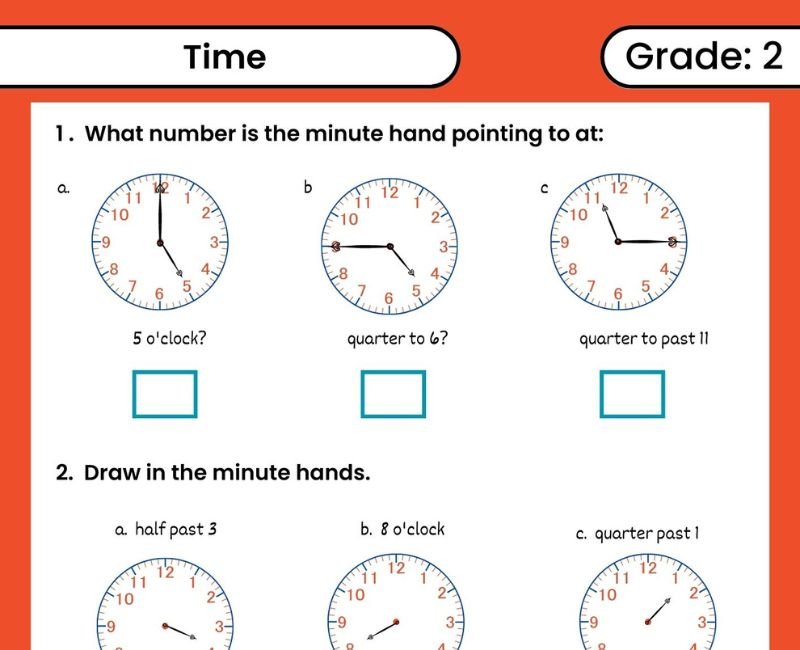
Why is the hour hand between four and five at 4:30? Why does a minute hand pointing to nine mean forty-five minutes rather than nine minutes? These telling time worksheets for Class 2 connect clock pictures, number patterns and everyday routines. Use the printable worksheet available on this page alongside the online activities to read, set and explain times.
This is a general maths topic resource rather than a named NCERT chapter. Begin with whole hours and half hours, then choose quarter-hour and five-minute challenges when the child is ready. The activities also explore AM and PM, simple elapsed time and useful time-unit facts.
How to Read an Analogue Clock
An analogue clock uses hands and a numbered face. The shorter blue hand in these diagrams shows the hour. The longer orange hand shows the minutes. Other clocks may use different colours, so learn to recognise the hands by their length and purpose.
First read the hour that the short hand has reached or already passed. Then read the minutes using the long hand. At 4:20, the hour hand is past four but has not reached five. The minute hand points to the number four, showing twenty minutes.
The hour hand moves continuously. It does not stay exactly on four throughout the whole hour and suddenly jump to five. The interactive models preserve this movement as minutes change.
O’Clock Worksheets for Class 2
O’clock means zero minutes past the hour. The minute hand points to twelve, and the hour hand points exactly to the hour number. When the short hand points to seven and the long hand points to twelve, the time is seven o’clock, written 7:00.
The hour hand points to 10 and the minute hand points to 12. The time is 10:00, or ten o’clock. The twelve at the top marks the beginning of the next cycle of minutes.
Half Past Time Worksheets
Half an hour is thirty minutes. At half past three, the minute hand points to six and the hour hand is halfway between three and four. Write the time as 3:30. Read the hour as three, because four has not been reached yet.
A common mistake is to call 3:30 four thirty because the hour hand is close to four. Ask which hour number the hand has already passed. It has passed three and is moving towards four.
Quarter Past and Quarter To Explained
A quarter of an hour is fifteen minutes. Quarter past eight is fifteen minutes after eight, written 8:15. The minute hand points to three. Quarter to eight is fifteen minutes before eight, written 7:45. The minute hand points to nine and the hour hand is approaching eight.
Quarter past five = 5:15.
Quarter to five = 4:45.
“Past” counts forward from the named hour. “To” tells how long remains before the next hour.
Telling Time to Five Minutes
There are sixty minute marks around the clock and twelve large numbered positions. Each gap between two large numbers represents five minutes. Count clockwise from twelve: 5, 10, 15, 20, 25, 30, 35, 40, 45, 50 and 55. Returning to twelve completes sixty minutes and begins the next hour at :00.
| Minute hand points to | Minutes past | Example |
|---|---|---|
| 12 | 00 | 6:00 |
| 1 | 05 | 6:05 |
| 3 | 15 | 6:15 |
| 6 | 30 | 6:30 |
| 9 | 45 | 6:45 |
| 11 | 55 | 6:55 |
The Minute Marker Explorer asks children to choose the correct clock number. The Skip-Count Clock Trail adds five minutes at a time, showing the hands moving together.
Analogue and Digital Time Matching
A digital time separates the hour and minutes with a colon. In 9:05, the hour is nine and the minutes are five. Keep two digits for the minutes, so five minutes past nine is written 9:05. In a twelve-hour display, the hour uses the numbers one to twelve.
The online matching game pairs clock pictures with digital times. Children can use the short hand to choose the hour, then check the long hand rather than matching only one part of the display.
AM and PM for Class 2
AM runs from midnight up to noon. PM runs from noon up to midnight. A clock face showing seven could mean seven in the morning or seven in the evening. Use an event or an AM/PM label to distinguish them.
For clarity, write 12 noon and 12 midnight when introducing the boundary times. In conventional twelve-hour notation, noon is 12 PM and midnight is 12 AM. Do not infer AM or PM only from a clock picture or assume every child follows the same routine.
A lesson starts at 9 in the morning → 9 AM.
A story is read at 7 in the evening → 7 PM.
The activity states morning, afternoon or evening explicitly so the answer does not depend on guessing a family routine.
Elapsed Time Word Problems with Solutions
Elapsed time is how much time passes between two events. Count forward in manageable jumps. Keep sixty minutes in an hour in mind when crossing an hour boundary.
A game starts at 4:00 and lasts thirty minutes. It ends at 4:30.
A lesson starts at 9:45 in the morning and lasts thirty minutes. Fifteen minutes reach 10:00, and fifteen more reach 10:15. The lesson ends at 10:15 AM.
A reading session runs from 5:15 to 5:45 on the same afternoon. The elapsed time is thirty minutes.
These introductory tasks use short durations. A twelve-hour clock alone does not specify the date or distinguish a short interval from a whole day, so read the context carefully.
Before and After Time Questions
Fifteen minutes after 8:45 is 9:00. Fifteen minutes before 8:00 is 7:45. Use a teaching clock or count in fives. The minute hand passing twelve means the hour must change too.
For one hour later, the minute value stays the same: one hour after 6:20 is 7:20. Moving forward by sixty minutes is different from changing only the minute digits.
Hours Minutes and Seconds
One hour contains sixty minutes. Half an hour contains thirty minutes, and a quarter-hour contains fifteen minutes. One minute contains sixty seconds. One day contains twenty-four hours.
A duration such as thirty minutes answers “How long?” A clock reading such as 3:30 answers “What time?” These are different kinds of information even when the same numbers appear.
Time Reasoning Questions with Answers
-
The minute hand points to six. Is the time always 6:00?
No. It shows thirty minutes past whichever hour the short hand indicates.
-
At 7:45, why is the hour hand close to eight?
Forty-five minutes of the hour have passed. Only fifteen minutes remain before eight.
-
Can an unlabelled clock prove that it is morning?
No. The same face repeats every twelve hours. An AM/PM label or context is needed.
-
What changes after one complete turn of the minute hand?
Sixty minutes pass and the hour hand advances by one hour.
-
Can different times satisfy one clock puzzle?
Yes. Many times between two stated limits can work. The open puzzle accepts every five-minute answer that meets its conditions.
Learning with Clock Pictures Listening and Movement
Children can inspect clock faces, hear a question, use buttons and sliders, explain to a partner or move the hands of a paper clock. These are flexible approaches to the same ideas rather than fixed learning-style categories.
For a practical activity, make a paper clock with hands of different lengths. An adult can help fasten the hands safely. For movement, place twelve number cards in a clear space and walk clockwise in five-minute steps. All online instructions remain visible if browser speech is unavailable.
Using Printable Time Worksheets with Online Activities
Start with a clock model, read or set its time, then write the matching digital time on paper. Introduce more difficult intervals gradually. Use the quiz explanations to discuss why an answer works, and let children revisit an untimed activity when a concept needs more practice.
More Class 2 Maths Practice
Frequently Asked Questions
What do telling time worksheets for Class 2 cover?
This resource practises whole hours, half hours, quarter hours, five-minute intervals, analogue and digital matching, AM and PM, and simple elapsed time.
Which hand shows the hour and which shows the minutes?
The short hand shows the hour and the long hand shows the minutes. Here they are blue and orange respectively; colours vary on other clocks.
What does half past mean?
Half past means thirty minutes after the hour. Half past four is 4:30, with the hour hand halfway between four and five.
What is the difference between quarter past and quarter to?
Quarter past means fifteen minutes after the named hour. Quarter to means fifteen minutes before it. Quarter past six is 6:15; quarter to six is 5:45.
Why do we count in fives on a clock?
Each gap between large clock numbers covers five minutes. Twelve groups of five complete sixty minutes.
Why is the hour hand between two numbers?
The hour hand moves gradually throughout the hour. At 2:30, it is halfway between two and three.
How do I teach analogue and digital time together?
Read the short hand first, then the minutes. Write the matching hour and two-digit minute value, such as 8:05.
Can the clock face tell us AM or PM?
No. The same clock face repeats every twelve hours. A label or the situation must tell us whether it is before or after noon.
How do children find elapsed time?
Count forward from the start in useful jumps. From 3:45 to 4:15 on the same afternoon is fifteen minutes to four and fifteen more, so thirty minutes.
Are the clock hands movable without dragging?
Yes. Activities use sliders, buttons and clock-number choices that can be operated by tapping or keyboard. No dragging is required.
Can children listen to the time questions?
Read-aloud uses browser speech when available. The full question stays visible, and Stop Reading cancels speech.
Is this a specific NCERT chapter worksheet?
No. This is a general telling-time resource. Choose the tasks that match the child’s current classroom sequence.
 Download