CLASS 2 MATHS • THE LENGTH EXPLORER STUDIO
Length Measurement Worksheets for Class 2
Online Activities Games and Quiz
Slide a strip, fix a measuring mistake and compare equal footsteps. Turn ruler readings into discoveries with centimetres, metres and colourful length models.
Read and Move
Build endpoints, slide strips and order lengths from shortest to longest.
Measure and Make
Repair gaps, build metric strips and compare two step sizes on one path.
Reason and Explain
Choose sensible units, solve length stories and diagnose ruler errors.
Diagram rule The rulers and objects on screen are teaching diagrams, not life-size measuring tools. Read their labelled units. Use a real ruler to measure a real object.
Length Measurement Class 2 Online Quiz
Question 15 / 20 • Average • Answered 0/20
Optional audio controls
A 12 cm stick and a 7 cm stick differ by how much?
Tap an answer to continue.
Quiz and listening guide
Try 10 easy, five average and five thinking questions. The 20-minute timer starts with the first answer or question-navigation action. Read-aloud alone does not start it. Answers advance except at the final question. Review using the question numbers. Submission or timeout shows every explanation. Restart clears answers and pauses the timer. Speech depends on the browser and available voices; all questions and instructions remain visible.
Five Length Discovery Games
Tap the raised selector and choose a challenge. Each game contains five tasks.
Endpoint Builder
Move the ending mark while the start stays fixed. Build the requested length.
Start at 2 cm. Build a strip exactly 5 cm long.
The end reading is the starting reading plus the required length.
Start 2 cm • selected length 0 cm • end 2 cm
Five Practical Length Activities
Explore an equal-unit model, try a new pair or explain why the path stays the same.
Length Reasoning and Word Problems
Length Story Challenges
Write or explain a number sentence, then enter an answer with the unit shown.
A 17 cm ribbon and a 9 cm ribbon are joined without overlap. Find the total length.
Identify whether lengths are joined, removed or compared. Keep the stated unit.
Using the challenge sets
There are 75 tasks across five games, five practical activities and five thinking sets, plus the separate 20-question quiz. Games and practical activities share the main workspace. Thinking practice stays independent. Changing a selection preserves progress while the page remains open. Reset one task or its entire set using Reset options.
Eight Smart Measuring Habits
- Identify what length the question asks you to find.
- Locate the ruler’s zero mark before measuring.
- Count equal spaces between marks.
- Subtract the start reading when it is not zero.
- Keep repeated units equal, with no gaps or overlaps.
- Check units before comparing numbers.
- Estimate with a known reference, then measure to check.
- Explain the answer and write its unit.
Practical Ideas for Parents and Teachers
- Measure a book using identical blocks and then a real ruler.
- Draw two parallel starting lines before comparing paper strips.
- Use a fixed paper foot template to model repeated equal steps.
- Let children predict whether a smaller unit will need more repeats.
- Offer pictures, optional listening, tapping and discussion as flexible ways to participate.
Measuring Length for Class 2 Worked Examples Ruler Practice and Common Questions
A ruler reading is more than the number near the end of an object. Children also need to find the start, recognise the unit and count the distance between the marks. These length measurement worksheets for Class 2 develop those habits through ruler diagrams, comparing lengths, centimetre and metre choices, and non-standard measurement activities.
This page concentrates on length. Its original online questions support general practice rather than reproducing a named textbook chapter. Use the printable worksheet available on the page alongside a few model-building tasks, then discuss how the measurements were obtained.
How to Measure Length with a Ruler
For a direct reading, put one end of an object at the zero mark. Keep the ruler beside the object and read the mark at the other end. The zero line may be slightly inside the physical edge of the ruler, so lining up with the plastic edge alone can introduce an error.
A strip from 0 cm to 8 cm is eight centimetres long. There are eight equal spaces, even though the printed labels include nine numbers from zero through eight. Each space represents a unit of length.
Ruler Reading When the Start Is Not Zero
A strip starts at 2 cm and ends at 10 cm. Calculate 10 − 2 = 8. Its length is 8 cm, not 10 cm.
The strip covers the distance between its endpoints. Count those intervals or subtract the starting reading from the ending reading. The Ruler Mistake Detective tasks ask children to explain this repair as well as give the corrected number.
Position and Length Are Different
A five-centimetre strip can occupy the interval from 0 cm to 5 cm or from 4 cm to 9 cm. Moving it without stretching changes the endpoint readings but preserves their difference. Ask the child to predict the new end before moving the model.
In Endpoint Builder, the starting position stays fixed while the length is changed. In Slide without Stretching, both ends move together. Comparing the two activities helps distinguish making an object longer from putting it in a different place.
Centimetres and Metres for Class 2
Centimetres, written cm, are convenient for shorter lengths such as a crayon or notebook. Metres, written m, are convenient for larger lengths such as a room or path. Both units measure length. The sensible choice depends on the size of the object and the number being stated.
| Unit | Useful context | Example description |
|---|---|---|
| Centimetre cm | Short classroom objects | A crayon about 8 cm long |
| Metre m | Larger spaces and distances | A room about 4 m wide |
| 100 cm = 1 m | Relating the units | Ten pieces of 10 cm make one metre |
These examples suggest sensible sizes; they do not replace measuring the actual object. A number needs its unit. Four centimetres and four metres describe very different lengths.
Comparing and Ordering Lengths
Check that measurements use the same unit before comparing their numbers. A 9 cm strip is 4 cm longer than a 5 cm strip because 9 − 5 = 4. Strips of 3 cm, 6 cm and 9 cm are already ordered from shortest to longest.
When units differ, use a known relationship. Since 1 m = 100 cm, one metre is longer than 95 cm. Looking only at the numbers 1 and 95 would give the wrong comparison.
Non-Standard Units of Length
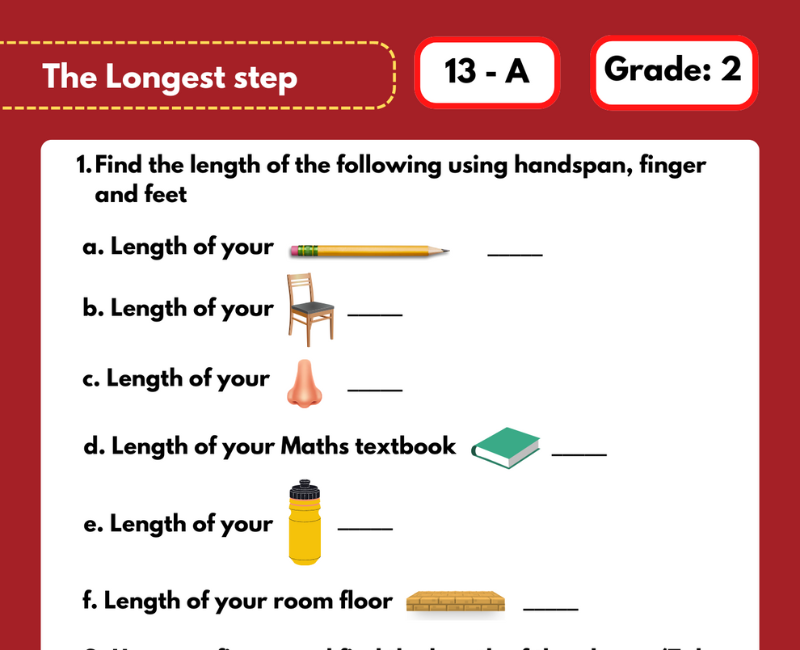
A block, paper clip or foot template can act as a non-standard unit. Repeat the same unit end to end without gaps or overlaps. Gaps leave some of the object unmeasured; overlaps count part of its length more than once.
The Gap Repair activity shows displaced equal tiles. Tap their numbered controls to align each tile with the target. For a practical version, line up identical blocks along a book. Keep the same block size throughout that measurement.
Footsteps and the Size of a Unit
Different people may take different numbers of steps along one path because their steps are different lengths. A reliable model fixes each step size and repeats it consistently. On a model path of 60 units, four steps of 15 units and six steps of 10 units both cover the path exactly.
The larger step needs fewer repeats for the same complete distance. This does not mean the path shrinks. The Footstep Fair Test uses two separate rows so children can compare the counts without mixing unit sizes.
Estimating Length with a Reference
An estimate is a reasoned prediction. A known 5 cm strip can serve as a reference: an object that appears twice as long may be about 10 cm. Measure afterwards to check the estimate and discuss why it was close or far away.
Use a real reference for physical measuring. The apparent size of a screen picture changes with device size and zoom. The online benchmark questions state the reference lengths, so answers depend on the labels rather than the physical size of the display.
Length Word Problems with Solutions
A 17 cm strip and a 9 cm strip meet end to end without overlap. Their combined length is 17 + 9 = 26 cm.
A string measures 34 cm. Cutting off 12 cm leaves 34 − 12 = 22 cm.
A 28 cm branch and a 19 cm twig differ in length by 28 − 19 = 9 cm.
First decide whether the story joins lengths, removes a piece or compares two objects. Keep the unit consistent. For a two-stage story, record the intermediate length before making the second change.
Open Length Puzzles and Reasoning
Can different pairs have the same difference? Yes. Lengths of 6 cm and 2 cm differ by 4 cm, as do 9 cm and 5 cm. The open activity asks for two distinct pairs that follow its rule.
Does cutting create more ribbon? No. If a 10 cm ribbon is cut into 3 cm and 7 cm pieces, their combined length remains 10 cm, assuming no material is removed by the cut.
Does a longer number always mean a longer object? Only after accounting for the units. Convert or compare with an equivalent representation when the units differ.
Using Pictures Listening and Practical Work
Let children inspect a model, listen to its instruction if helpful, manipulate the controls and explain their decision. These are flexible choices rather than fixed learner types. Every question stays visible when browser speech is unavailable.
Combine one online set with a short measuring task using real classroom objects. The quiz review supplies explanations, while the untimed games allow repeated exploration. Return to a model when a mistake reveals a misunderstanding about zero, intervals or unit size.
Related Class 2 Maths Worksheets
Frequently Asked Questions
What do these length measurement worksheets practise?
Ruler readings, start and end positions, centimetres and metres, ordering lengths, equal units, step-size comparisons and length word problems.
How do you read a ruler for Class 2?
Place the object at the zero mark, then read its other endpoint. Count equal centimetre spaces rather than counting the printed numbers.
What if an object starts at a mark other than zero?
Subtract the starting reading from the ending reading. A strip from 2 cm to 10 cm has length 8 cm.
Does moving an object along a ruler change its length?
No, if it is not stretched or altered. Both endpoint readings may change, but their difference stays the same.
When should children use cm or m?
Centimetres suit short objects; metres suit larger lengths. Consider the stated number and actual object size together.
How many centimetres make one metre?
One metre equals 100 centimetres. Ten strips of 10 cm each cover one metre when joined without gaps or overlaps.
What are non-standard units of length?
They include blocks, paper clips, handspans and footsteps. Use equal-sized repeats for a fair measurement.
Why can two people record different footstep counts?
Their steps may differ in size. The same path can need fewer larger steps or more smaller steps.
How are lengths compared and ordered?
Check their units first. With the same unit, compare the numbers. For different units, use an equivalent representation before comparing.
Can the on-screen ruler measure a real pencil?
No. The diagram changes size with screen settings. Use its labels for online questions and a real ruler for physical measuring.
Can children hear the instructions?
Read Task Aloud and Read Question use browser speech when available. The text remains visible, and Stop Reading cancels playback.
When does the quiz timer appear?
The timer and End Quiz stay inside the quiz section and scroll out of view beyond it. The countdown begins with an answer or question-navigation action and continues during that attempt.
 Download