CLASS 2 MATHS • THE MEASUREMENT DISCOVERY LAB
Measurement Worksheets for Class 2
with Online Activities and Quiz
Measure a ribbon, balance a parcel and fill a jug. Explore length, weight and capacity through colourful models, optional listening and thinking challenges.
Build and Explore
Read rulers, balance scales and fill measured containers.
See Hear and Do
Lay equal tiles, move liquid and build a measured length.
Think It Through
Compare measurements, choose units and explain mistakes.
Measurement Class 2 Online Quiz
Question 1 / 20 • Easy
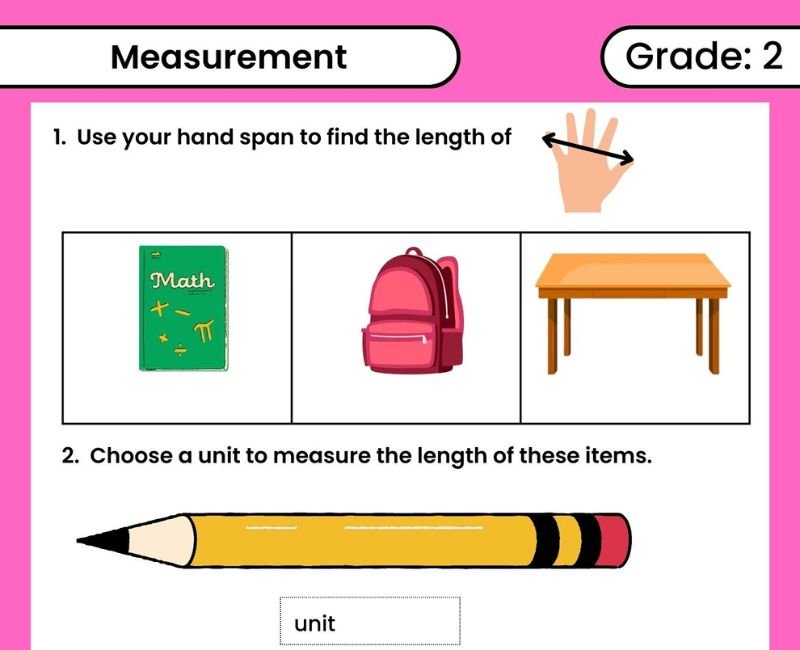
Which unit is suitable for the length of a pencil?
Choose the quantity, use a suitable unit and explain your method.
Tap an answer to continue.
Quiz and listening guide
Try 10 easy, five average and five thinking questions. The 20-minute timer starts with the first answer or question-navigation action. Read-aloud alone does not start it. Answers advance except at the final question. Review using the question numbers. Submission or timeout shows every explanation. Restart clears answers and pauses the timer. Speech depends on the browser and available voices; all questions and instructions remain visible.
Five Measurement Adventure Games
Tap the raised selector to choose a game. Each one has five challenges.
Ruler Detective
Find the distance between the two endpoints. The screen diagram is not life-size.
Read the strip length in centimetres.
Count the intervals or calculate end minus start.
Five Hands-On Online Measurement Activities
Use a model, listen if you wish and explain what each unit measures.
Measurement Reasoning and Extra Practice
Little Measurement Stories
Read the quantity and operation, then enter the answer in the stated unit.
Two ribbons, 12 cm and 8 cm, are laid end to end without overlap. What is their total length?
Identify whether to join, compare or find an amount remaining. Keep the unit.
Choose the quantity, use a suitable unit and explain your method.
How the activity sets work
Five games, five activities and five extra-practice sets provide 75 tasks, separate from the quiz. Games and activities share one active main workspace. Extra practice is independent. Switching sets keeps progress while this page stays open. Use Reset options for one task or its whole set. Work in short sessions. Read-aloud, diagrams, counters and physical suggestions are optional ways to explore the same idea.
Eight Measurement Tips for Children
- Decide whether you are measuring length, weight or capacity.
- Line up an object with the zero mark on a ruler.
- Count the spaces between marks, not the marks themselves.
- If an object starts away from zero, subtract its starting reading from its ending reading.
- Use equal-size units with no gaps or overlaps.
- Compare measurements written in the same unit.
- Read container labels instead of guessing capacity from height.
- Write the unit beside your answer.
Five Tips for Parents and Teachers
- Begin with real objects, equal blocks and direct comparisons.
- Introduce cm and m, g and kg, and mL and L through familiar examples.
- Ask for an estimate before measuring with a suitable tool.
- Use optional read-aloud, pictures and practical exploration without fixed learner labels.
- Use safe, unbreakable containers and adult guidance for water or balance activities.
Measurement Worksheets for Class 2 Guide Examples and Reasoning Questions
How do we find a ribbon’s length if it starts at the 3 cm mark? Can a short, wide container hold more than a tall, narrow one? These measurement worksheets for Class 2 connect practical measuring with pictures, number operations and reasoning. Use the printable worksheets offered on this page with the online activities for short, purposeful practice.
This is a general topic resource rather than a named NCERT chapter. The online practice focuses on metric length, weight and capacity. Choose tasks that match the child’s classroom sequence. Simple unit relationships are included as supported extensions rather than a claim that every conversion must already be mastered.
What Is Measurement?
Measurement compares a quantity with a chosen unit. Length tells how long or tall something is. Grams and kilograms measure mass, commonly called weight in everyday classroom questions. Capacity describes how much a container can hold. First decide what is being measured, then choose a suitable tool and unit.
Length Measurement Worksheets for Class 2
Use centimetres, written cm, for shorter lengths such as a pencil. Use metres, written m, for larger lengths such as the length of a classroom. A ruler or measuring tape helps measure length. A balance scale does a different job.
For a ruler starting at zero, align one end with 0 and read the other end. A strip from 0 cm to 7 cm has length 7 cm. Count seven centimetre intervals, not eight printed numbers.
The screen diagrams show labelled units and are not life-size rulers. Do not hold a real pencil against the screen to measure it. Use a real ruler for physical measurements.
Reading a Ruler When the Object Does Not Start at Zero
A ribbon begins at 3 cm and ends at 9 cm. Its length is 9 cm − 3 cm = 6 cm.
The last printed reading is not always the length. Count the intervals between the two endpoints or subtract the smaller endpoint from the larger. The Ruler Detective game includes this useful reasoning step.
Non-Standard Units and Handspan Measurement
Children can compare lengths using blocks, paper clips or handspans. For a fair comparison, repeat the same-sized unit without gaps or overlaps. Six identical blocks laid end to end measure six block-units.
Different people have different handspans. A table may measure five handspans for one person and six for another. The table has not changed; the unit size has. Standard units such as centimetres help people communicate the same measurement.
Comparing and Ordering Lengths
Compare like units. A 9 cm ribbon is longer than a 6 cm ribbon by 3 cm. To order lengths, compare the values after checking their units. In 4 cm, 7 cm and 10 cm, the shortest is 4 cm and the longest is 10 cm.
A number alone is not enough when the units differ. One metre equals one hundred centimetres, so 1 m is longer than 90 cm. Avoid deciding only that ninety is greater than one.
Weight Worksheets for Class 2
Grams, written g, suit small masses. Kilograms, written kg, suit larger masses such as a bag of rice. Objects with the same size or shape can have different masses, so appearance alone does not settle which is heavier.
On a simple balance, the heavier side goes lower. A level balance indicates equal masses. In the online parcel activity, combine standard model weights until the two sides match.
A parcel balances with one 2 kg weight and one 1 kg weight. Its mass is 2 kg + 1 kg = 3 kg.
The models are simplified teaching diagrams, not calibrated instruments for weighing physical objects.
Capacity Worksheets for Class 2
Capacity is the maximum amount a container can hold. Millilitres, written mL, suit smaller capacities such as a small cup. Litres, written L, suit larger capacities such as a bucket. One litre equals one thousand millilitres.
Distinguish the container’s capacity from the amount currently inside it. A 1,000 mL jug containing 400 mL has room for 600 mL more. It does not become a 400 mL-capacity jug.
Four full 250 mL cups fill a 1,000 mL jug because 250 + 250 + 250 + 250 = 1,000.
A tall container does not necessarily hold more than a short one. Width and shape matter too. Compare labelled capacities or measure with the same cup. In the transfer activity, liquid moves between containers while the total amount stays unchanged.
Choosing the Correct Measurement Unit
| Quantity | Useful units | Example |
|---|---|---|
| Length | cm and m | Pencil length in cm; room length in m |
| Mass or everyday weight | g and kg | Small eraser in g; rice sack in kg |
| Capacity | mL and L | Small medicine cup in mL; bucket in L |
These are suitable units, not exact measurements of every object in that category. Measure the actual object to find its value.
Simple Metric Unit Relationships
1 m = 100 cm. 1 kg = 1,000 g. 1 L = 1,000 mL. Changing the unit changes the number used to describe the same quantity; it does not make the object grow or the liquid multiply. The matching game uses these relationships with whole numbers and visible explanations.
Measurement Word Problems with Solutions
A red ribbon is 12 cm long and a blue ribbon is 8 cm long. Placed end to end without overlap, their combined length is 12 cm + 8 cm = 20 cm.
A 7 kg parcel is 3 kg heavier than a 4 kg parcel because 7 kg − 4 kg = 3 kg.
A jug contains 800 mL. After 300 mL is poured out, 800 mL − 300 mL = 500 mL remains.
A 1,000 mL container holds 600 mL. Another 400 mL can fit, because 1,000 − 600 = 400.
Read whether the question asks for a total, a difference, the amount remaining or the room left in a container. Keep the unit consistent.
Measurement Reasoning Questions with Answers
-
Why might two children record different handspan counts for one table?
Their handspans may differ in size. A smaller unit usually needs more repeats to cover the same length.
-
A strip ends at 10 cm but starts at 4 cm. Is it 10 cm long?
No. Its length is 10 − 4 = 6 cm.
-
Does moving water into another container create more water?
No, provided none is added, spilled or lost. The shape of the water changes but the amount stays the same.
-
Can different pairs of lengths have the same difference?
Yes. For example, 8 cm and 5 cm differ by 3 cm, and 10 cm and 7 cm also differ by 3 cm. The open puzzle accepts every pair within its limits that meets the rule.
-
Can a bigger-looking object be lighter?
Yes. Size alone does not determine mass. Use a suitable balance or scale.
Learning through Pictures Listening and Practical Measuring
Children can inspect diagrams, listen to a question, tap or slide controls, explain a method or measure safe real objects. These are flexible participation choices rather than fixed learning-style categories. Every task remains visible when browser speech is unavailable.
Try measuring a book with equal blocks and then a ruler. Predict which of two unbreakable containers holds more, then test with the same small cup. Use adult guidance and keep water away from devices.
Using Printable Worksheets and Online Activities Together
Estimate first, explore a model, measure or calculate, and explain the result with its unit. Use the printable worksheet for written practice and revisit an untimed online activity when a concept needs more attention. The quiz review explains each answer so children can discuss their reasoning.
More Class 2 Maths Practice
Frequently Asked Questions
What do measurement worksheets for Class 2 cover?
The online tasks cover length, weight or mass, capacity, suitable metric units, ruler readings, comparisons and simple measurement stories.
How do children measure length with a ruler?
Align one end at zero and read the other end. If the object starts away from zero, subtract its starting reading from its ending reading.
Why should we count ruler spaces instead of printed numbers?
Length counts unit intervals. From zero to five there are five centimetre spaces, although six numbers are printed.
What are non-standard units of measurement?
They include handspans, blocks or paper clips. Repeat equal-size units without gaps or overlaps for a fair measurement.
When should children use centimetres and metres?
Centimetres suit shorter lengths such as a pencil. Metres suit larger lengths such as a room. The actual value must be measured.
Which units are used for weight?
Grams and kilograms measure mass, often called weight in everyday primary questions. A kilogram equals one thousand grams.
How does a balance scale compare objects?
The heavier side goes lower; equal masses balance level. The interactive diagrams are simplified models.
What is the difference between capacity and the liquid inside?
Capacity is the maximum a container can hold. The current amount can be less. A 1,000 mL jug with 400 mL inside still has capacity 1,000 mL.
Does a taller container always hold more?
No. Width and shape also matter. Compare labelled capacities or measure with the same cup.
Are the rulers on screen life-size?
No. Read their labelled intervals for diagram questions. Use a real ruler for physical measurements.
Can children listen to the questions and use tap controls?
Yes, when browser speech is available. Text stays visible. The tasks use tapping, typing and sliders without requiring dragging.
Are these from a specific NCERT chapter?
No. This is a general measurement resource. Choose activities according to the child’s current classroom sequence.
 Download